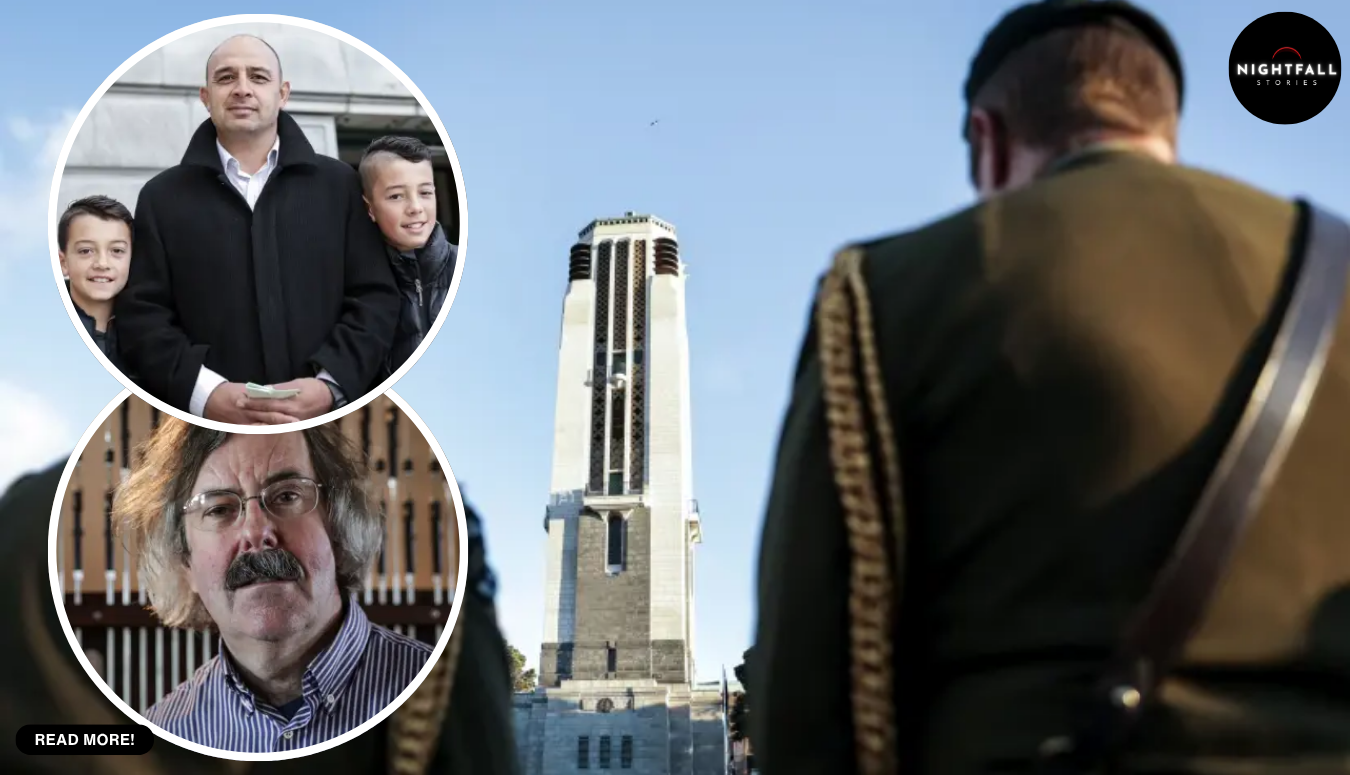
On Anzac Day this year, a little before the service began in Wellington, a twelve and a half tonne bronze bell called Rangimarie was tolled four times from a tower above the city, once for the Army, once for the Navy, once for the Air Force and once for the Merchant Navy. Then 74 bells began to sound over Pukeahu National War Memorial Park for the first time in years, after roughly six million US dollars of earthquake strengthening and a silence that had swallowed most of the last decade and a half.
The man at the keyboard had flown in from Canberra. He was 25 years into a career on an instrument he first touched at fourteen, and he had never played an Anzac Day service in New Zealand before. He was there because the job that should have put a New Zealander in that seat no longer existed. About ten weeks before the bells came back, the Ministry for Culture and Heritage confirmed that its change process had resulted in the disestablishment of the role of National Carillonist, a permanent public position that had existed since the tower opened in 1932 and had been held, in all that time, by exactly four people.
To understand why that is strange rather than merely bureaucratic, you have to understand what a carillon actually is, because it is not a set of church bells and it is not a clock chime. It is a musical instrument the size of a building, and it has to be played by hand.
The Pukeahu carillon hangs inside a campanile about 51 metres high, a tall pale tower that has been one of Wellington’s landmarks for most of a century. Inside it are 74 fixed bells, cast bronze, weighing something in the order of 70 tonnes in total, which makes the instrument the third largest carillon in the world by weight. The bells do not swing. Each one has a clapper connected by a stainless steel cord running down through the frame to a wooden baton keyboard in a small cabin partway up the tower. The player sits at that keyboard and strikes the batons with closed fists, and works a set of pedals with both feet for the heaviest bells. The sound does not come out of a speaker. It comes out of the tower and travels across a city.
The tower is not a decoration on top of something else. It is the memorial. Beneath and beside it sit the Hall of Memories and the wider Pukeahu park, a place built so that a country could put its war dead somewhere and go and stand there. That matters to the engineering argument, because a carillon is a memorial that works by being audible. A silent one is a very tall headstone. Every mechanical fact about the thing therefore carries freight that a concert instrument would not: the cords are load-bearing in two senses, and a broken connection is not only a dead note.
It is worth being precise about one detail that gets repeated wrongly, because it is the sort of thing that sounds better than the truth and does not need to be. Rangimarie, the great bass bell, is not the third heaviest carillon bell on earth. It is the heaviest bell in the southern hemisphere, which is a remarkable thing on its own. It is the carillon as a whole, all 74 bells together, that comes third in the world. That bell was one of four large bass bells added in 1995, more than sixty years after the instrument first sounded.
The tower opened on Anzac Day in 1932 with 49 bells, cast by Gillett and Johnston at Croydon in England and shipped out the year before, weighing a little over 30 tonnes between them. The first national carillonist was Gladys Watkins, appointed to the role in 1932, which is its own small piece of history. The instrument was substantially rebuilt and enlarged from 1984 onward, with 21 smaller treble bells added, then the four bass bells in the mid nineties. By then its player was Timothy Hurd, who holds the Queen’s Service Medal and who occupied the post for around four decades, climbing the tower several times a week to play it.
That is the part of this story that has no first person account anywhere that can be reached. Hurd has not, in any coverage that is publicly available, described in his own words what it was like to spend forty years as the only person in the country whose job was to play a war memorial, or what it was like to lose that job in the same season the memorial came back to life. It would be easy to write feelings into that silence. It would also be made up. What can be said is what the ministry itself said, and what the ministry itself did, and those two things are not perfectly aligned.
Here is the documented sequence. In March 2012, engineers identified seismic vulnerabilities and the tower went into strengthening work. Refurbishment ran to late 2013, but the carillon did not reopen until the end of May 2018, after a job that reportedly involved taking some 15,000 individual pieces apart and putting them back. It played for about twenty months. In February 2020 it closed again, after an engineering report found the structure meeting only around 15 percent of the national building standard for earthquakes. A full seismic assessment completed later that year pointed at the bell frames as the weakest element in the whole thing. Along the way the tower’s cladding came under separate scrutiny as well.
So the universal framing this year, that the bells rang for the first time in fourteen years, needs a small correction. They were silent from 2012 to 2018, they sounded for less than two years, and then they were silent again from 2020 until this past Anzac Day. The public broadcaster that has followed the tower’s engineering problems most closely was careful about this, writing that the bells had been silent for most of the last fourteen years rather than all of them, and an earlier piece put it as seven of the previous ten years. That is the accurate version. It is also, if anything, a worse story than the simple one, because it means the instrument was fixed once already and then found to be unsafe again.
The strengthening that finally brought it back cost 10.1 million New Zealand dollars from 2020 onward, roughly six million US dollars. For a country that had lived through the Christchurch earthquakes, a 70 tonne array of bronze suspended 50 metres above a national memorial was not an abstract risk, and nobody seriously argues the work should not have been done.
What is argued is the arithmetic that came next. An internal ministry report written in July last year recorded that the decision had been made to disestablish the carillonist, with the change deferred until the end of April 2026. That is the week the tower was due to reopen. When the decision became public in August last year, the framing in the national press was blunt: the government had spent ten million dollars fixing the bells and was removing the one person who could play them.
In February this year the ministry set out its position in writing. Its change process had resulted in the disestablishment of the National Carillonist role. It said it was exploring a range of options, including contracting carillonists when required, and that this would cost it less than retaining a fulltime carillonist position. It said it was working with the Carillon Society of Australia to make sure a trained player would be available for Anzac Day. And in the same statement it said that Timothy Hurd had since retired, and acknowledged his long contribution to the carillon and to national commemorations.
Those last two sentences sit together uneasily, and it is worth leaving them uneasy rather than tidying them up. One account has the role abolished in a restructure. Another has its holder retiring. Later coverage quoted the Secretary for Culture and Heritage saying that once Hurd had made the decision to retire, the ministry worked closely with the Carillon Society of Australia. Both things can be literally true at once, and the honest description is the narrow one: the ministry ran a change process, the outcome of that process was that the permanent position ceased to exist, and the ministry says the person who held it retired. He was not, on any available account, dismissed. Nor is this a simple retirement, because the post itself did not survive him. It is a job that ended at the same time as a career, and the ministry’s stated reason for the first of those is cost.
There is a narrow version of that reasoning that is hard to dispute. A fulltime salary for a player whose instrument is closed for six years running is money spent on nothing, and the ministry had just absorbed a seven-figure bill it did not choose. Contracting a specialist for the handful of days a year the bells are needed is exactly what any organisation would do with a rarely used skill. The objection is not that the sum is wrong. It is that the skill is not rare because demand is low; it is rare because supply takes a lifetime to build, and the fulltime post was the thing building it. Abolish the post and you have saved the salary and quietly outsourced the pipeline too.
Which brings us to the Australian in the cabin. Peter Bray learned the carillon at fourteen and has played something like 70 of the roughly 700 carillons in the world, a reasonable estimate of how small this profession is. He came from Canberra, home to Australia’s own National Carillon, to play Wellington’s.
The preparation was tighter than anyone would have liked. Days before the service, around ten of the 74 bells were still being connected to their playing cords, which is to say the instrument was not fully assembled the week it was due to be heard by a nation. It came together. Bray played six pieces. Both published programmes agree on the waiata Pokarekare Ana and on a work by the Estonian composer Arvo Part; beyond that the lists differ, one naming Karl Jenkins and another naming Finzi, so the full running order is not something to state with confidence. Rangimarie was tolled its four times. People stood in a park built for exactly this and listened to bells they had not heard in six years.
And then the visiting player went home, and the keyboard in the tower had nobody whose job it was to sit at it.
That is the question the story actually leaves behind, and it is not a question about one man’s exit. A carillon is a slow instrument to learn. It is not transferable from a piano in an afternoon; the touch is different, the sound arrives late, the feedback comes off a tower rather than out of a box, and there are only a few hundred of these things on the planet to practise on. Timothy Hurd was in the post for around forty years because that is roughly the timescale on which carillonists are made. The ministry has talked about monthly recitals and about discussions with Victoria University’s music school on training a resident player, which is a genuine route and not a cynical one. But training a carillonist requires access to a carillon and someone who already knows how to play it, and New Zealand has one of the former and, in an official capacity, none of the latter.
There is a version of this that ends well. The tower is strengthened and open. A university with a serious music school sits a short walk from it. Carillon societies across the world are small enough that people share students and share instruments, and the Australians have already proved willing to fly. If a New Zealander in their twenties starts on those batons this year, the post that was abolished for costing too much could be replaced by something better, which is a player who has decades ahead rather than behind.
There is also a version where the bells become an occasional event, hired in for the days that matter, and the thing that made Pukeahu unusual quietly stops. The carillon was not built to be switched on twice a year. It was built in 1932 as a memorial you could hear, played several times a week by someone who lived in the same city as it.
The bells opened on Anzac Day, 1932. They came back on Anzac Day, 2026, after six million dollars and a decade and a half of mostly silence, and they sounded, by every account, magnificent. Ninety four years, four national carillonists, and on the morning the instrument returned, the title had already been retired along with the man who held it. Somebody still has to climb the tower.