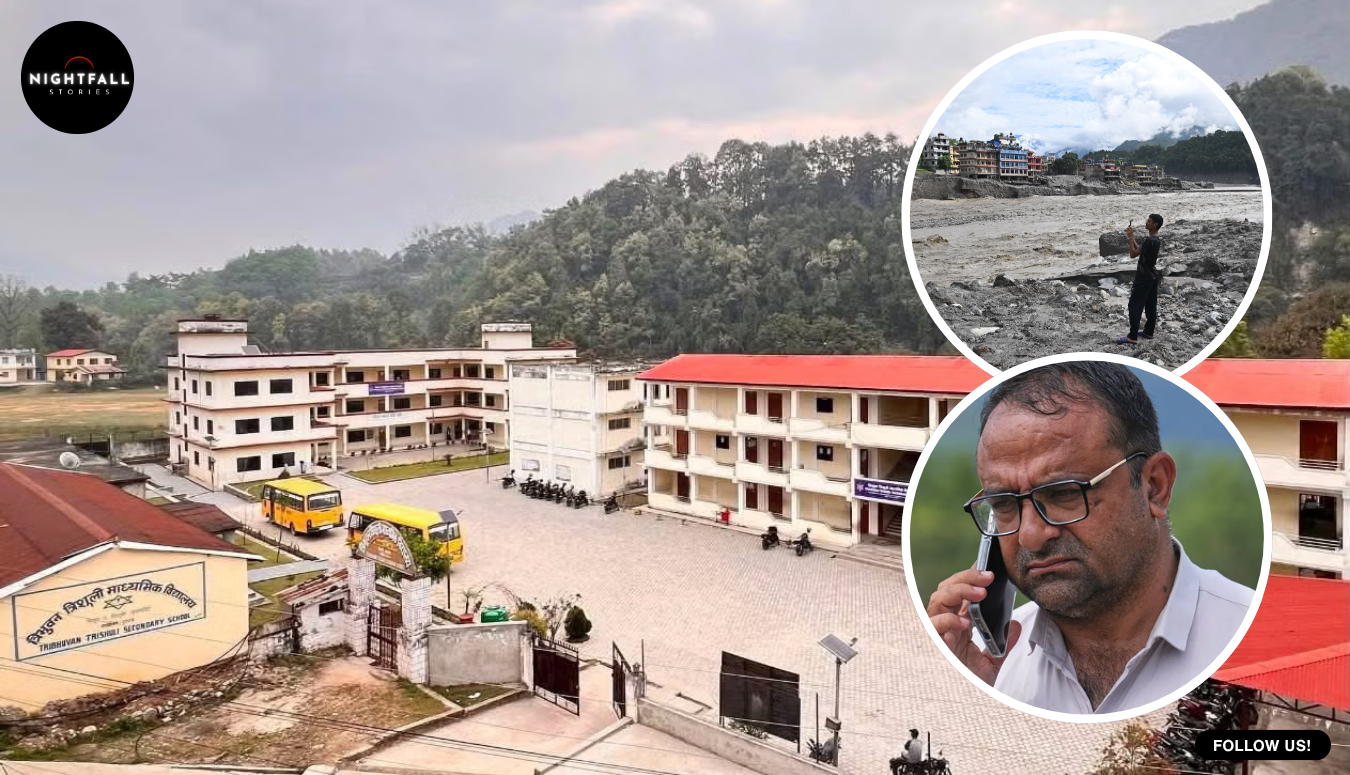
The bell at Tribhuvan Trishuli Secondary School in Bidur, Nepal, is not an electronic chime. It is rung by hand, the way it has been rung since the school was founded in the middle of the last century, and on a Wednesday morning in late August it was rung by the principal himself, out of sequence, while the morning assembly was still standing in rows.
Rajendra Dawadi had about fifteen minutes. That is his own figure, given later to a Nepali newspaper, and it is the only figure for the gap that comes from him rather than from the retelling. What he knew in that window was not much. A colleague had told him water was coming down the valley. A teacher had taken a phone call moments afterwards. A parent had turned up at the gate wanting her child, which in a river town is its own kind of alarm, because parents do not usually arrive mid-assembly without a reason.
There was no siren. No message from a government system, no automated alert, no official instruction to evacuate. Three people with telephones and a bad feeling, and a man who had to decide in front of nine hundred children whether to believe them.
He rang the bell and sent the school up the hill.
What followed was less cinematic than it sounds and more logistically difficult. Around 900 of the school’s 1,643 enrolled pupils were on the premises. They did not all leave on foot. Students and staff crossed the bridge and went up to higher ground by car, by bus, by motorbike, in whatever was available and whatever direction was uphill. Dawadi got on the phone to his bus drivers, who were still out on their morning runs bringing children in towards the river, and turned them around. That detail is the one that tends to get lost, and it is arguably the most consequential thing he did, because a school bus heading towards a flooding river at nine in the morning is the worst possible place for a child to be, and the only person who could reverse it was the man holding the staff directory.
By his own account to local reporters, he and one staff member were the last to leave. He left with roughly seventy students still around him, taking them to safer ground, and with no idea where most of the rest of his pupils were, because the ones who had been sent home were somewhere on the roads between the school and their houses, and the ones who had not yet arrived were somewhere else again. For days afterwards he was saying publicly that he did not know how many of his students were accounted for. Security agencies could not tell him. He had a register of 1,643 names and no way to read it against the valley.
Then the water came.
What hit Bidur that morning did not start there, and it did not start as rain. Shortly after half past eight, a mass of rock and ice detached from a steep slope on the northern side of the Langtang range, high above the Nepal and Tibet border. It did not simply fall. It travelled, gathering loose sediment and meltwater as it went, turning from an avalanche into a debris flow, which is a different and far more destructive thing. Somewhere along the route it dammed the Lhende Khola, a tributary, and a lake built up behind that temporary blockage until the blockage failed. When it failed, everything the mountain had already sent down came through at once, into the Bhotekoshi and then into the Trishuli, and down a valley lined with towns, bazaars, bridges, border posts and schools.
This is worth being precise about, because the early shorthand for the disaster was a glacial lake burst, and that is not what the researchers who have since examined it describe. There was no long-standing glacial lake that overtopped. There was a slope failure, a cascade, a short-lived landslide dam and then a release. Cryosphere scientists looking at the sequence, among them Ashim Sattar at the Indian Institute of Technology Bhubaneswar, Christian Huggel at the University of Zurich and Basanta Raj Adhikari at Tribhuvan University in Kathmandu, have placed it in a category of multi-hazard chain events that are harder to monitor than lakes, for a simple and uncomfortable reason. You can put a sensor on a lake. Nobody has put sensors on every unstable slope in the Himalaya, and as one assessment of the response put it, monitoring those slopes is nobody’s job.
It matters because the two mechanisms behave differently on the ground. A glacial lake that overtops gives a valley a known source, a known volume and, in the better-studied basins, a sensor and a siren. A slope that lets go gives you no address. Nobody can tell you in advance which of several thousand ice-and-rock faces above a populated valley is the one that has quietly lost its support, and the thing that comes down carries boulders and trees as well as water, which is why it removes bridges and foundations rather than simply flooding them.
There is a reason those slopes are getting less stable. Research on the Langtang glaciers has found them retreating around one and a half times faster in the first two decades of this century than they were in the decades before, with warming above four thousand metres running at roughly a third of a degree Celsius per decade, well ahead of the global average. When glaciers thin and pull back, they stop buttressing the rock and ice above them. Hanging masses are left sitting on steep ground with less support underneath and thawing permafrost behind them. The mountains are not becoming more dangerous in some abstract future tense. They are becoming more dangerous now, and the people who live under them are the ones holding the risk.
Nepal does have river monitoring. The gauges on the rivers transmit readings at ten minute intervals, which is a sensible design for the thing they were built to watch, a monsoon flood that rises over hours and gives a valley time to react. A debris surge arriving as a wall is a different problem. In this case the flood destroyed sensors before they could usefully transmit anything. One police officer who tried to warn people with a megaphone was swept away himself. The alert that actually worked that morning, the one that emptied a school of nine hundred children, was a colleague shouting and a teacher’s phone ringing.
The building did not survive. Dawadi watched it go. Seventeen structures across roughly eighty-six ropani of school land were destroyed, and the way he describes it is not that the buildings collapsed but that the ground they stood on is no longer there. A newer block had been put up only a few years earlier with Indian grant funding under a community development programme, and the school’s origins also trace back to Indian assistance in the middle of the twentieth century, laid out by an engineer connected to the Trishuli hydropower project. None of that history is visible on the site now. A resident quoted afterwards said there was simply no sign of the school any more.
Two members of staff could not get to higher ground. They were swept away and at the time of writing they remain missing. The piece you are reading is not a clean rescue story and should not be read as one. Every pupil who was inside the building that morning got out. Two of the adults who were there to get them out did not.
Nor did the school’s losses stop at its gate. A pupil in the eleventh grade, Abhinash Nepali, and his mother were among the missing in the community. Dawadi has spoken about exactly this gap, and it is the most honest thing anyone has said about the morning. The students were safe from the school, he said, but they were not safe in their own neighbourhoods, and that is what keeps him awake. A principal can control what happens inside a compound for fifteen minutes. He cannot control what happens to a child’s house.
What a working alert would have to do here is uncomfortable to spell out, because it is not expensive hardware. It is a chain of people with a protocol. Somebody upstream sees the river behaving impossibly. That person reaches somebody downstream who has the authority to empty a building, and that person does not spend four minutes deciding whether to believe it. Dawadi’s school survived because all three links of that chain happened to exist informally on one morning, in one town, between people who knew each other’s numbers. Eighty kilometres of valley cannot be run on acquaintance.
Place that single morning inside the wider event and the proportions change again. The flood killed on both sides of the border. Early counts put the dead across Nepal and China at more than 900 with over 4,700 unaccounted for. By late September, assessments were describing at least 1,400 dead and more than 5,000 still missing, with Nepali figures at one point recording a thousand dead and close to four thousand missing across eight districts. Those numbers have moved as recovery work has gone on, and anyone quoting them should say which count they are using and when it was taken.
The schools alone tell you something. At least 69 schools in northern Nepal were completely destroyed. The education of nearly 19,000 students was disrupted. Dawadi’s school is one entry in that list, and the only reason it is the entry people know about is that the man in charge of it happened to answer a phone.
Which raises the question the story is really about. Why was a school sitting on a river terrace in the first place?
Because that is where the flat ground is. In a steep valley, the level land is the land the river made, and the river made it by doing exactly what it did in August, repeatedly, over a very long time. Towns, markets, bus parks, clinics and schools go on river terraces because there is nowhere else to put a building with a football pitch next to it. This is not carelessness. It is arithmetic. The same geography that makes a terrace buildable makes it, once every few generations, the floor of a flood. What has changed is how often the mountain above sends something down, and how fast it arrives when it does.
Dawadi, who has said he sat in that building as a pupil before he ran it as a principal, spent the weeks after the flood arguing rather than grieving in public. He pressed the education ministry to rebuild the school on safer ground inside Trishuli, and he made a point that goes beyond his own compound. Putting up stronger buildings is not enough on its own. If the paths children walk and the settlements they live in are still exposed, a safe school is a safe box in an unsafe place.
Some of what he asked for has started to happen. India’s ambassador to Nepal, Naveen Srivastava, pledged support for the school’s full reconstruction. A Nepali private foundation put money towards getting classes running again immediately. Bidur municipality coordinated the construction of temporary learning structures. And a few weeks after the water, the school reopened, in pieces and in borrowed space. The younger grades went into a temporary centre. The senior grades were split between a site at a nearby bazaar and the campus of another secondary school in a neighbouring settlement. On the first day back, something over 870 students turned up out of more than 1,600 on the roll.
The practical shape of that is worth picturing, because reopened does not mean restored. The younger grades and the senior grades are no longer in the same place, which means a staff of teachers now commutes between sites to cover a timetable. Laboratory work, libraries and anything that needed a specific room are gone with the rooms. Examination years are the ones that cannot absorb a lost term, and the senior grades were the ones split across two borrowed locations.
Dawadi called that turnout the strongest psychological win available to them, which is a careful way of saying that children walking into a tent is not the same as a school existing, but it is not nothing either. A roll of 1,643 names and an attendance of 872 is a gap you can read two ways, and both are true. More than half the school came back within weeks of losing its building. Nearly half did not, and some of them have reasons that will not be resolved by a temporary roof.
That is where it stands. The reconstruction is a promise, not a building. The two missing staff members are still missing. The land the school stood on is gone in the literal sense, washed into a different shape, and the replacement has to be found somewhere else. What exists for certain is a hand bell that was rung at the wrong time of the morning, nine hundred children who went uphill because of it, and a set of school buses that turned around on a road heading towards a river.
Dawadi has been firm about one thing whenever anyone has called him a hero. He has said it was his responsibility, not heroism. Both can be true at once, and the version that matters more is his. Responsibility is a thing you can ask of a system. Heroism is a thing you can only hope for, and no valley should have to depend on it. The alert that saved that school came from a man with a phone and a colleague who shouted. Nepal has 69 destroyed schools and 19,000 displaced pupils, and the next time the mountain lets go, the question will not be whether someone is brave enough. It will be whether the phone call gets there first.