In 2020 a teenager in Trieu Son district, in the Vietnamese province of Thanh Hoa, sat the national university entrance examination and scored 28.15 out of 30. His marks were 9.4 in mathematics, 9.75 in chemistry and 9.0 in biology. He wanted to study general medicine at Hanoi Medical University, which is the most competitive medical course in the country. That year the cut-off landed at 28.40. He was short by a quarter of a point.
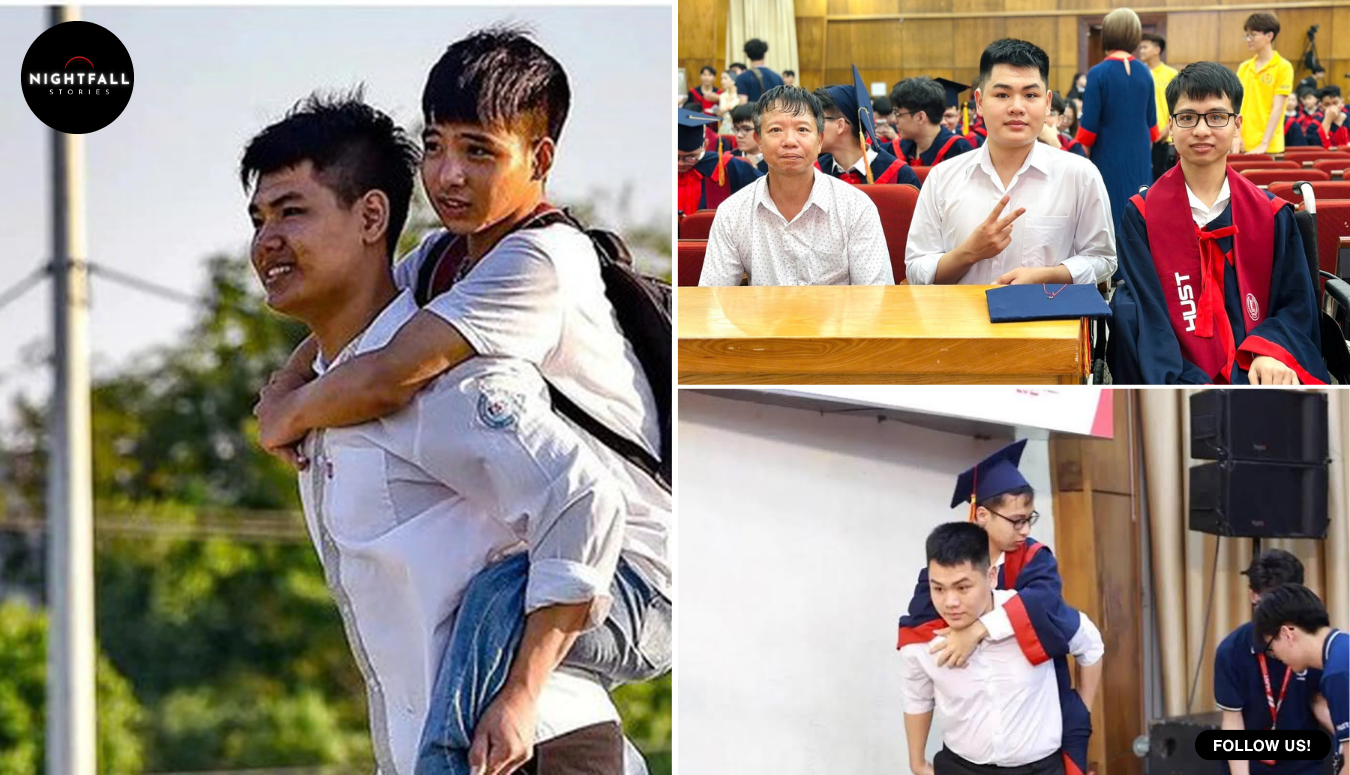
What made the near miss national news was not the score. It was that for the previous ten years he had been carrying another boy to school on his back.
The one doing the carrying is Ngo Van Hieu. The one being carried is Nguyen Tat Minh. They were neighbours. Minh was born with a congenital disability affecting both legs and his right arm, described in Vietnamese reporting as limbs that contracted and wasted as he grew, which left him unable to walk unaided. No diagnosis has been published and no medical source is attached to any account of it, so there is no name to give it here.
What is documented is the arrangement the two boys came to as small children and then simply kept. Hieu carried Minh to class. He did it through primary school and he did it through secondary school, in heat and in rain, until they finished in 2020. Ten years is not a gesture. It is a decade of mornings.
When the examination results came out, the story was everywhere in Vietnam. Hieu was given a national youth award that year and named an inspirational figure of 2020 by one of the country’s larger news outlets. And then came the part of the story that most of the coverage at the time rushed past, and which is probably the most revealing thing about him.
With the public mood behind him, there were widespread calls for Hanoi Medical University to let him in anyway, by special dispensation, on the strength of who he evidently was. A quarter of a point, for this boy, surely could be waived.
He said no.
His reasoning, as he gave it at the time, was in two parts and both are worth sitting with. He did not want to put the university in an awkward position. And he did not want a place that would have to come out of somebody else’s hands. There were other candidates who had made the cut-off fairly. If he went in over the line, one of them went out.
So he enrolled instead at Thai Binh University of Medicine and Pharmacy, in a different province and a different city, which waived his tuition fees. General medicine in Vietnam is a six-year degree. He had six years ahead of him at the school that had not been his first choice, which is a long time to live with a quarter of a point.
Minh, meanwhile, had sat the same examination in a different subject combination and scored about 28.1, with marks of 9.6 in mathematics, 9.25 in physics and 9.25 in chemistry, which by one account included half a point of bonus credit. He went to Hanoi University of Science and Technology to read computer science, and here the story stops being about the boy who was carried and starts being about the person Minh actually is, which the sentimental version of this tends to skip entirely.
By his own account, computer science was not a calling. It was where his score and his list of preferences landed him. He found it interesting once he got there, which is roughly how most people choose most things.
It was hard, and not only for the obvious reason. He has use of one hand for typing, in a degree that is almost entirely typing. He also walked into a cohort of people who had all been the best in their own schools, after a secondary education where he had been near the top of his. His first semester algebra grade was a D plus, which in the Vietnamese marking band is a bare pass and, for someone who had never had to worry about marks, a shock.
He did not treat it as a verdict. He rebuilt how he studied. More practice problems than he thought he needed, material pulled off the internet to fill the gaps, and study groups rather than grinding alone. His grade averages in later semesters came up to around 3.5 out of 4. He finished with a cumulative 3.23 and a distinction, and he graduated in the spring of last year.
He has said, when asked, that he made a decision early on not to let his disability function as an excuse, and that he would rather be judged on whether he can do the work than be given credit for managing at all. That is not an inspirational slogan. It is a working professional’s boundary, and he states it plainly.
Which brings us to the graduation ceremony, the one moment in all of this that is genuinely hard to read about without feeling something.
Hieu was by then in his fifth year of medicine in Thai Binh. When Minh’s turn came to collect his degree at Hanoi University of Science and Technology, Hieu travelled close to a hundred kilometres to be there, put his friend on his back, and carried him up onto the stage in front of the hall to take it. The university’s own photographers covered it. It is the same action, in the same posture, that the two of them had performed thousands of times on a provincial road, done once more in a room full of people who had no idea it had ever been ordinary.
Then everybody went back to work, and the cameras left, and that is usually where this kind of story ends. It is worth being honest that six years went by in which almost nothing was written about either of them.
Minh went home to Thanh Hoa. He got an office job, found through a family connection, and he works as a web programmer. His father drives him in. He puts part of his wage into the household. Asked about his ambitions he declined to talk about anything distant and said he was working on getting better at his job, which is the least quotable and most believable answer available.
He describes Hieu as being like a brother to him. He has made a point, more than once, of saying that Hieu never made him feel like a burden and never seemed to be keeping score. They do not see each other every day the way they did for ten years, and he says the friendship is unchanged anyway. Asked what he thinks matters in a person, he talked about honesty, nerve, kindness and not being fake with people.
Hieu finished his six years earlier this year and holds a degree in general medicine. At the time he graduated he was studying for the next hurdle, and he was candid that he might not clear it. If he did not, he said, he would start clinical training at health facilities to accumulate the practice hours he needed, then sit the national licensing examination and look for a hospital post the long way round.
The hurdle is worth explaining, because it is a feature of Vietnamese medical training that most readers outside the country will not know, and it is the reason the story was not finished in August.
A Vietnamese medical degree does not make you a specialist. The route that does, and the route that essentially determines the shape of a career, is the residency programme, bac si noi tru, and entry is by competitive examination taken once, shortly after graduation, with no second attempt in later years for most candidates. It is a single door and it opens once. Around a thousand people sat it this year. A little over seven hundred cleared the pass threshold. There were 444 places.
Hieu scored 20.76 out of 30 and finished 293rd.
On match day, in the second week of September, he chose diagnostic imaging. And the institution he will be doing it at is Hanoi Medical University.
Six years after the quarter of a point, after declining the offer to be let in on sympathy, he went back and got in on the examination.
There is a temptation to call that poetic justice and a stronger temptation to make it the moral of the whole thing, and neither is quite right. He is not a qualified radiologist. He has a medical degree and a training place, and three years of residency in front of him, which in diagnostic imaging means nights, volume, and the particular pressure of being the person who has to see the thing on the scan that nobody else has seen yet. He has not arrived anywhere. He has been admitted.
What is true, and is more interesting than a tidy ending, is that both of these men got where they were going by routes neither of them would have drawn in advance, and in an order nobody would have predicted.
The disabled boy who had to be carried up a flight of stairs every morning finished his degree first, in four years, with a distinction, and has been earning a living writing code for over a year. The boy who did the carrying took six years, needed a seventh step to get into training, and is still, by the strict definition, not yet practising. Nobody plans that. It is just what happened, and it quietly dismantles the version of this story in which one of them is the hero and the other is the lesson.
It also raises the question that the feel-good framing tends to leave alone, which is why a child needed to be carried in the first place.
The answer is not complicated and it is not unique to Vietnam. A rural district school with steps, no ramps and no lift, on a route with no accessible transport, means a child who cannot walk gets to class on somebody’s back or does not get to class. Minh’s education, from the age of about six to about sixteen, depended on the physical willingness of one particular friend who lived nearby. Had Hieu been a less decent boy, or had his family moved, there is no mechanism in that story that would have picked up the slack.
That is worth saying because the ten years get told as a triumph of friendship, and they were. They were also ten years of a boy’s schooling resting on a single point of failure. Both things are true at once, and the second one does not take anything away from Hieu. It is simply the part that a ramp would have fixed.
The two of them still visit each other’s houses. Neither seems especially interested in being an inspiration, and Minh in particular bristles gently at the idea, which is probably the healthiest response available to anyone who has been a national news item since adolescence.
If you want a single image to keep from all of it, it is not the stairs and it is not the stage. It is a reply Minh gave about those ten years, which was that Hieu helped him naturally, without calculation, as if there were nothing to work out. For a decade, neither boy appears to have thought of the arrangement as remarkable. One of them could not get up the steps and the other one could. That was the whole of it.
One is a programmer in his home province, getting better at his job and driving his own ambitions at a scale he can see. The other is starting three years of training at the school that once came up a quarter of a point short of him, learning to read the inside of a body from a screen.
They walked to the same school for ten years and have ended up in different cities, in different trades, both of them employed and neither of them finished. Which, for two kids from a district in Thanh Hoa, is not a fairy tale. It is better than that. It is just a life, working out.