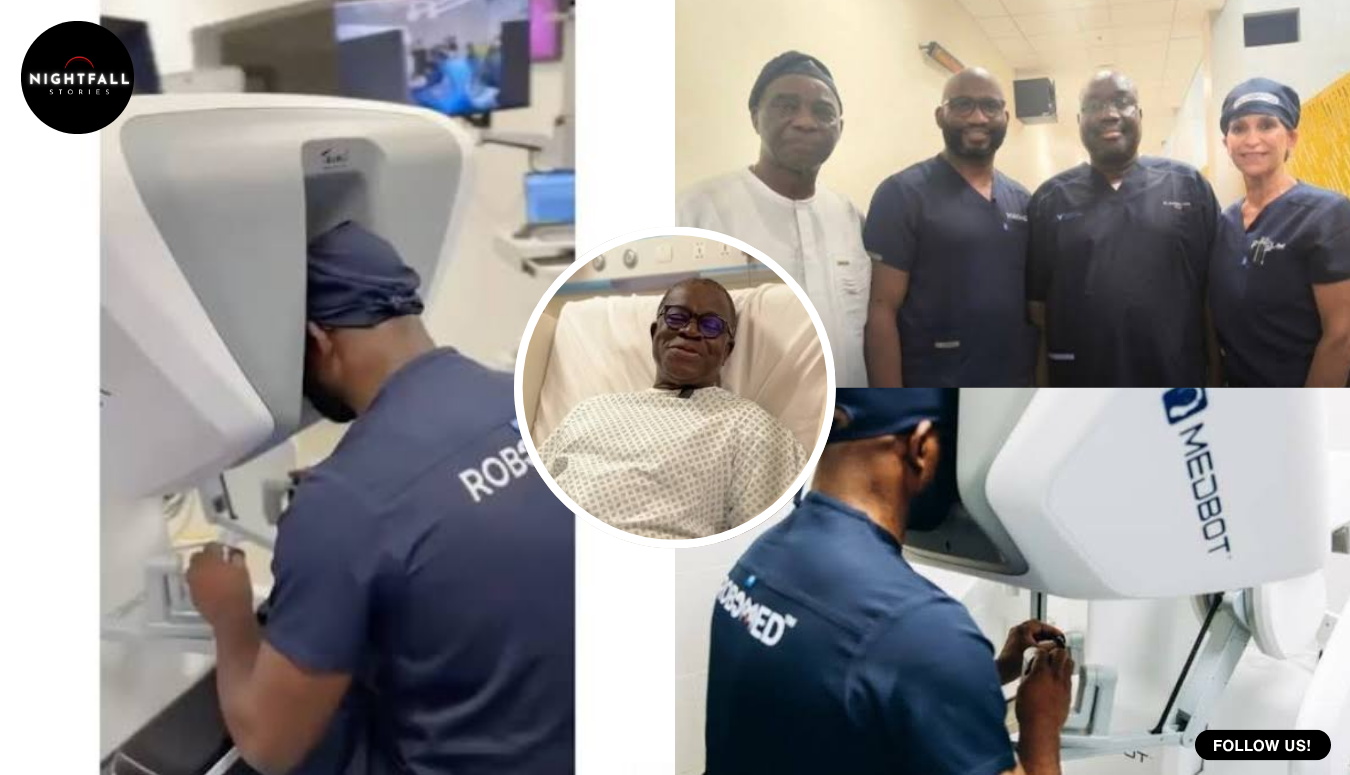
The patient was asleep in an operating theatre in Abuja. The surgeon was sitting in a room in Mowe, in Ogun State, roughly 500 kilometres away, with his hands inside a console and his eyes on a screen. Between them ran a satellite internet link, a mobile network held in reserve, and a Chinese made surgical robot called Toumai standing over the body with instruments already through the skin. The operation was a right radical nephrectomy, the removal of a cancerous kidney, and it took about three hours.
And at some point during those three hours, by the account of one of the doctors involved, the network glitched.
That is the detail worth leading with, because it is the one that tells you what this kind of surgery actually is. Not a demonstration of how clever a robot can be, but a test of what happens when the least glamorous part of the whole arrangement, the connection, does what connections do. Nothing dramatic followed. The surgical team physically present in the Abuja theatre was able to take over. That team was in the room for exactly that reason, and the hospital’s chief executive has been fairly blunt about the logic: machinery can go wrong, connections can cease, so you always keep people on the ground who can do what needs doing.
Which is a more honest description of remote surgery than most of the coverage managed. The robot is not autonomous. It does not decide anything. It holds instruments and reproduces, at reduced scale and with tremor filtered out, whatever the surgeon’s hands do at the console. Take the surgeon away and it stops. Take the link away and it stops. The word robot does a lot of misleading work here, and the surgeon has made the same point himself, that the system magnifies a human surgeon’s movements rather than replacing them.
Before going further, a matter of names, because the reporting cannot agree on one. This operation was performed by a Nigerian born, United States based professor of urology and renal transplantation who co-founded a company called RoboMed Global. Some Nigerian outlets have called him Obi Ekwenna-Davis. Others have called him Obi Davies-Ekwenna. The University of Toledo College of Medicine and Life Sciences, where he holds a tenured professorship in Urology and Renal Transplantation, lists him on its own faculty pages simply as Obi Ekwenna, and that is the name under which his published research appears. His own professional profile carries Davies as an unhyphenated middle name. So Ekwenna is the surname, Davies is not part of it with a hyphen, and Ekwenna-Davis appears to be an inversion that entered circulation and stuck. This article calls him Professor Obi Ekwenna, which is what his university calls him.
That is not pedantry. The name confusion is a symptom of how this story reached the public, and the mechanism matters for how much weight you put on any of it.
Everything reachable about this operation traces back to two hospitals and one news agency. Redeemer’s Health Village in Mowe, a 300 bed facility founded by the Redeemed Christian Church of God, hosted the console. Nisa Premier Hospital in Abuja, founded and run by Dr Ibrahim Wada, had the patient. The News Agency of Nigeria distributed the announcement. From there it went out through Punch, Vanguard, Leadership, Daily Trust, Pulse, BellaNaija, Pharmanews, The Journal and others, and it went out largely unchanged. Seven or eight bylines, one account. No independent clinical verification exists, no regulator has published a confirmation of the procedure, no operative report has been peer reviewed, and the surgical team’s own description is currently the only description there is. That does not mean it did not happen as described. It means nobody outside the room has checked, and the misspelled name is the visible seam where copying rather than reporting shows through.
The patient is not named, which is correct and which also removes the person from the centre of the story. What is known is minimal: an adult with cancer in the right kidney, reported in good condition immediately after the operation. On the ending, the hospitals said the patient was expected to be discharged within twenty four hours. Expected is doing load bearing work in that sentence. A forecast is not an outcome, and no discharge has been independently confirmed in any reporting since. One outlet’s write up states the patient was discharged, but it gives no date, no source and no detail, and it is part of the same institutional cluster, so it does not settle the question. The documented ending, at the time of writing, is a completed three hour operation with the patient in good condition afterwards and a stated expectation of a quick discharge. That is where this account stops.
So what actually happened here, and why should anyone outside Nigeria care?
Start with the regulatory spine, which is the least exciting and most consequential part. In late December 2025 Nigeria’s National Agency for Food and Drug Administration and Control approved the Toumai robotic surgical platform, made by Shanghai MicroPort MedBot, for clinical use. It was reported at the time as the first approval of a robotic surgical platform anywhere in West Africa. Approvals like that are usually where the story ends for a piece of medical equipment in a lower income health system. A regulator signs off, a machine arrives, a press release goes out, and then the machine sits in a hospital that cannot afford to run it or cannot staff it. The interesting thing about this operation is that it is what the approval was actually for, about nine months later.
Then the link. The connection ran over Starlink satellite internet with MTN mobile service as backup, and it is worth understanding why that combination rather than fibre. Telesurgery is not bandwidth hungry in the way video streaming is. What it cannot tolerate is latency and jitter, the delay between a hand moving at the console and an instrument moving in the body, and the variation in that delay. A surgeon can adapt to a consistent lag. A lag that changes unpredictably is dangerous, because the hand learns a rhythm the system then breaks. Dedicated fibre between two Nigerian cities 500 kilometres apart, secured and reserved for a medical procedure, is a large infrastructure ask. Low earth orbit satellite gives you reach without laying anything, at the cost of a link you do not own and cannot fully control. Hence the backup, and hence the team standing in the theatre.
The glitch, when it came, is therefore not an embarrassment to be buried. It is the system’s design assumption being confirmed. A remote operation that had no plan for the link failing would be reckless. One that had a plan, used it, and finished the operation is what a first attempt is supposed to look like.
Now the claim, because the claim has been oversold. The hospitals described this as the first telesurgery in West Africa, and that narrower statement is defensible. What has circulated more loosely, as a first for Africa or a landmark for the continent, is not. Telesurgery has been done in Africa before. In Morocco in May of last year a telerobotic prostate operation was performed over more than 1,100 kilometres, connecting Casablanca with Laayoune, and it was reported as that country’s first national telesurgery. A month later a surgeon in Central Florida operated on a patient in Luanda, Angola, across roughly 11,000 kilometres, a case written up in a peer reviewed robotic surgery journal as a landmark in expanding surgical access in Africa. Both of those preceded this one by more than a year.
The distinction is not trivial and it is not about national pride. It is about who gets new medicine, in what order, and on whose terms. The Morocco case was done by a Moroccan private hospital group on its own patients within its own country. The Angola case was a surgeon in the United States operating on an African patient from 11,000 kilometres away, which is a genuine technical achievement and also a particular model of access: the expertise stays where it already is and reaches in. What happened in Nigeria is a third thing again. The surgeon is Nigerian born and works in Ohio, and for this operation he was physically in Ogun State, at a console in a Nigerian hospital, operating on a patient in a Nigerian city. The expertise came home and then travelled domestically.
That is the part with real consequences, and it connects to a problem that is much larger than one kidney.
Nigeria has somewhere over 200 million people and a surgical workforce that is thin by any measure, with specialists concentrated heavily in a handful of cities. Whole states have no practising urologist at all. For a patient in one of those states, a kidney tumour has historically meant one of three outcomes: travel hundreds of kilometres to a city, travel abroad if the family can raise the money, or be operated on by a general surgeon doing their best outside their subspecialty. Medical emigration makes it worse every year, as the doctors trained in the country leave for systems that pay them properly. Professor Ekwenna is himself part of that pattern, a Nigerian trained abroad who built a career in the United States, and his published research has focused repeatedly on transplantation and surgical capacity in resource constrained settings, including kidney transplantation in Nigeria specifically.
A working telesurgery link changes the arithmetic of that problem without solving it. If a specialist console in one city can reach a theatre in another, then the scarce thing is no longer the specialist’s physical location. But the scarce things that remain are still formidable, and it is worth being clear eyed about them. Each remote theatre needs its own robot, which costs in the low millions of dollars. It needs a full surgical and anaesthetic team on site competent to convert to open surgery at any moment. It needs sterile supplies, blood, intensive care beds and reliable power. A satellite link does not deliver any of those. The uncomfortable truth is that telesurgery is most useful in places that already have a well equipped operating theatre and are only missing the subspecialist, and the places with no urologist tend also to be the places with no robot.
Kidney cancer is a sensible choice for a first attempt, and the choice reveals something about how carefully this was planned. A radical nephrectomy is a removal rather than a reconstruction. There is no delicate suturing of a join that has to hold pressure for the rest of the patient’s life, as there is in a prostatectomy or a transplant. The kidney’s blood supply is anatomically well defined and can be controlled early. The operation is planned rather than emergency, so the team can pick the day, test the link and have everyone in place. And if everything went wrong, the abdomen is accessible to a surgeon standing in the room. You would not choose a bleeding trauma case or a complex reconstruction for the first attempt over a satellite connection.
It also matters which robot this was, and not for brand reasons. For most of the history of robotic surgery the field has been effectively one manufacturer’s market, and the price of a console plus the annual service contract and the per case consumables has put the technology out of reach of most hospitals outside wealthy systems. Toumai is one of a newer generation of Chinese built platforms competing on cost, and a Chinese system being the one a West African regulator approved first is a reasonable indicator of where that competition is heading. Cheaper consoles are the difference between one robot in a country and a dozen, and a dozen is the point at which a remote surgery network stops being a demonstration.
There is also the plain physical oddity of the thing, which the coverage skipped entirely. A surgeon at a console is not standing over a patient. He is seated, leaning into a viewer, working hand controls with his fingers and a set of pedals with his feet, watching a magnified three dimensional view of an interior he is not in the same building as. Nobody in his room is sterile. Nobody in his room is holding anything. For three hours the most consequential activity in two cities was a man sitting still in a chair in Ogun State, moving his fingers.
What remains genuinely unknown is whether any of this becomes routine. One operation, announced by the institutions that performed it, is a proof that it can be done once. It is not evidence of a service. The questions that decide whether this matters in five years are dull ones: whether NAFDAC builds a framework for licensing remote operators across state lines, who is legally liable when a link drops during a procedure, whether any insurer or public health scheme will pay for it, and whether a second robot ever reaches a hospital in a state that currently has no urologist. None of those have answers yet.
But something did happen, and it is worth stating plainly without the inflation. An adult with a cancerous kidney was operated on by a surgeon who was not in the building, on equipment a national regulator had approved nine months earlier, over a consumer satellite link with a mobile phone network as the fallback. The connection faltered and the people in the room handled it. Three hours later the kidney was out and the patient was reported to be in good condition, and a hospital 500 kilometres from where the surgeon was sitting had been, for those three hours, an extension of his hands.
Whether that patient walked out the next day, as the hospitals expected, is not yet on the record. What is on the record is that the distance stopped being the hard part.