About fifty minutes into a film that premiered in Los Angeles earlier this month, the audience was told to close their eyes. Not as a gag, and not for a jump scare. The sequence is called Orpheus, it runs around three minutes, and it is a flicker film, which means it works by pulsing light rather than by showing you anything. Shut your eyes and the flicker still reaches you, through the lids, as colour and pressure and something close to shape. The idea is that you experience the Orpheus myth from where Orpheus actually stood in it, which is to say facing forward, not allowed to look, with everything that matters happening behind you.
The man who built that is Lewis Klahr, he is seventy this year, and he has spent more than four decades making films almost entirely out of paper.
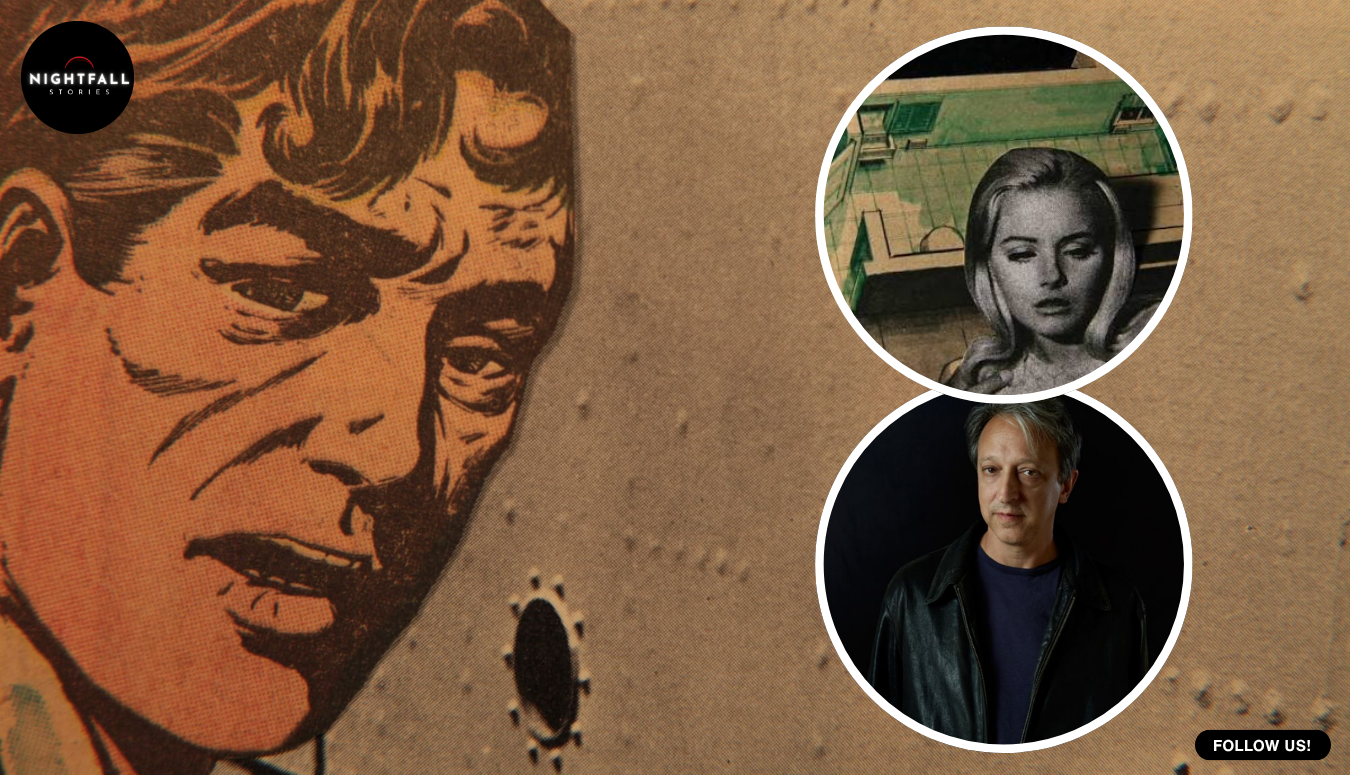
Not paper as a texture or a look. Paper as the actual material. Klahr cuts figures and objects out of mid-century American print, comic books mostly, along with advertisements, catalogues, packaging, magazines from the late fifties through the early seventies, and then he moves the cut-out pieces by hand, frame by frame, across other pieces of printed material used as backgrounds. It is cutout animation, the oldest and least glamorous technique in the medium, the one you can do on a kitchen table, and he has been refining it since a Super 8 series called Picture Books for Adults that he started in 1983 and finished two years later.
The new film is called Fable by the Door. It runs about sixty four minutes, it had its world premiere at Los Angeles Filmforum in front of an audience with Klahr in the room to talk about it afterwards, and it is assembled out of ten separate short films. Not excerpted from them. Assembled out of them, whole, in an order that took him close to two years to settle on.
That last detail is the one worth slowing down for, because it is where the real work of this particular film happened.
The ten pieces run from just over two minutes to nearly fifteen. Three Friends of the Cold Season is the longest at around fourteen and three quarter minutes. Five Days Till Tomorrow is a little over thirteen. Then there are much shorter things, Four Wheel Gods at a bit over two minutes, Dilated Moment at under three, Repast at four, the Orpheus flicker at three, alongside March 20 1960, Rain Once Fallen Rises to Heaven Again, Railroad Bill and a piece called Interstitial Romance, subtitled Warm Novelette, which is close to six. Ten items. One sitting.
Klahr’s stated intention is that the feature should behave like a long playing record rather than like a movie. That sounds like a cute line until you think about what it actually commits him to. A record does not have a plot. It has a running order, and the running order is doing an enormous amount of work that most listeners never consciously notice. Which track opens. What follows the loudest thing. Where you put the slow one so it lands as relief rather than as a sag. Whether side two starts by picking up the mood or deliberately breaking it. A badly sequenced album made of good songs is a worse experience than a well sequenced album made of decent ones, and anybody who has ever made a playlist for somebody they liked already knows this in their hands.
Klahr’s account of getting there is unglamorous and rings true. It happened, he has said, through a great deal of trial and error and through living with different orders until he could tell which one was right. He revised the sequence at least twice before he stopped. Two years, for a decision that leaves no visible trace in the finished thing except the fact that it works.
The wider project this belongs to is called From 45 to 33, and the numbers are vinyl speeds. A 45 is a single, one song a side, three minutes, disposable and urgent. A 33 is an album, the long form, the thing you sit down with. The title describes the direction his work has moved over the decades, out of the short film and towards something that has to hold a room for an hour. He has described the whole undertaking as a media autobiography, a repurposing of his own vast pile of source material into collage, and what he says it is about is the pastness of the present, which is a phrase worth a second read. Not the past. The way the present is already made of old material while you are standing in it.
Here is a correction that matters, because this story has been told wrongly in a few places already. Fable by the Door is being presented as Part 1 of From 45 to 33, and it is genuinely a world premiere. But it is not the first part he finished. Part 2, The Blue Rose of Forgetfulness, was completed back in 2022 and runs around sixty three and a half minutes. He made the second section first and has now gone back and built the first one, four years later. Which is completely consistent with somebody thinking in album terms, since almost nobody records an album in track order, but it does mean the tidy narrative of a man finally reaching feature length this year is simply not true.
It is not even close to true. Klahr has been working at length for over a decade. Sixty Six, from 2015, is his best known recent work and premiered at the Museum of Modern Art in New York to a sold out house. Circumstantial Pleasures came in 2020. He is not a miniaturist stepping up. He is a long form filmmaker who happens to build his long forms out of small units, which is a different and more interesting fact.
So who is he, and how does a person sustain forty three years in a form with essentially no commercial route?
He was born in 1956 and grew up in New York. He studied at Purchase and at Buffalo in the 1970s, which in practice means he came up inside American experimental film at close range, and the people he has named as influences tell you the lineage precisely. Kenneth Anger, Bruce Conner, Ken Jacobs, and Joseph Cornell, the one who is not a filmmaker at all but a maker of boxes, a man who assembled small worlds out of found scraps and secondhand prints. If you want one sentence for what Klahr does, it is that he took Cornell’s boxes and made them move.
It is worth being concrete about what that involves, because the phrase cutout animation hides the labour. Film runs at twenty four frames a second. To get one second of a figure crossing a background, you place the cut paper, expose a frame, move the paper a fraction of a millimetre, expose again, and repeat that twenty four times, and if your hand nudges the background while you are doing it, the whole second is ruined and you start again. A minute of screen time is one thousand four hundred and forty separate placements. Sixty four minutes is a number I will let you do yourself. There is no software shortcut in this method, because the thing being photographed is a physical object on a surface, and the reason the images have the particular weight they have is precisely that a hand was in contact with them.
His early work came in series rather than one-offs. Picture Books for Adults, eight Super 8 films made between 1983 and 1985 out of found footage and rephotography. Tales of the Forgotten Future, twelve films across roughly 1988 to 1991, about outsiders trying to work out who they are. Engram Sepals, seven films on 16mm dealing with addiction and appetite inside a consumer culture. The pattern has been there from the start. He does not make a thing. He makes a set of things and then works out what the set is.
The recognition has been real, if quiet. A Guggenheim Fellowship in 1992. Three appearances in the Whitney Biennial. Work in the permanent collection at the Museum of Modern Art. A Tiger Award at Rotterdam in 2010 for a short called Wednesday Morning Two A.M. The Brakhage Vision Award in 2013, named for Stan Brakhage, which inside this field is about as direct a statement of lineage as an award can make. A five programme retrospective at the Wexner Center. Gallery representation in London. Screenings across the United States, Europe and Asia.
None of that pays a mortgage. What pays it is teaching. Klahr is on the faculty at the California Institute of the Arts, north of Los Angeles, working full time in directing, screenwriting and film. That is the practical answer to how the work continues, and it is worth saying plainly rather than romantically: the films exist because somebody has a salaried job. This is true of most of the serious experimental cinema made in the past fifty years and it is almost never mentioned. He is also married to Janie Geiser, herself a well regarded experimental filmmaker and puppet theatre artist, which suggests a household where the work is simply understood rather than needing to be defended at dinner.
Now, the material itself, because there is a problem inside Klahr’s method that gets more acute every year and almost nobody asks him about it.
His raw supply is finite. He works with printed matter from a specific and narrow window of American commercial culture, roughly the 1950s through the 1970s, and he uses it to take apart the promises that culture was making, the clean kitchens, the confident men, the women drawn with impossible waists, the romance panel where everything is about to be resolved. That material exists in a fixed quantity. Every cut he makes destroys a piece of it. When he needs one more figure in the same drawing style from the same year and the same printing process to match a shot he made eighteen months ago, the correct piece of paper may simply not exist any longer, and no amount of money or searching will conjure it. A painter can mix more of a colour. Klahr cannot print more 1963.
Which quietly explains a lot about why the work looks the way it does, and why it has drifted over the decades towards memory as its subject. The method is itself an act of loss. You cannot make this kind of film without using up the thing you are making it about.
He has not been rigid about it. One of the ten pieces in Fable by the Door, Repast, is live action, shot in Rome. After forty three years of paper, a man puts a camera on a real table with real food on it, and drops it into the running order with the collage work, and the record holds it. That is either a sign of a maker loosening up or a sign of a maker who knows exactly how much variation a side of an album can absorb. Probably both.
The exhibition side of this is worth naming too, because it is easy to say premiere and picture something it was not. This was one screening, on a Sunday afternoon, at a converted hall on Beverly Boulevard, presented by Los Angeles Filmforum, with tickets starting around ten dollars. That is the entire commercial apparatus available to a film like this. No distributor rollout, no streaming window, no second weekend. Work of this kind survives on a circuit of small nonprofit presenters, museum programmes and university screenings, each one a single night arranged by somebody who cared enough to arrange it, and a film can spend years reaching a few thousand people that way. Klahr has been inside that circuit since the Reagan era. He knows exactly what a premiere is and is not worth, which is probably why he spent two years on the running order and not one minute on a trailer.
And the honest question about the whole enterprise is worth putting, because a piece like this should not just admire.
An hour of hand made collage animation with no plot is a genuinely hard sit. Klahr’s own framing invites the comparison that exposes the risk, because a listener puts a record on and moves around the room, makes coffee, drifts in and out, comes back for the bit they like. That drifting is designed into the album form. It is precisely what he says he is after, a cinema of shifting moods and engagements. A cinema audience cannot do that. They are in a fixed seat facing one direction for sixty four minutes with the lights down, and a structure built to reward wandering attention has to survive being watched by people who are not allowed to wander. The Orpheus sequence is the sharpest version of that tension. Telling an audience to shut their eyes in a cinema is either the most generous thing you can do for them or an enormous risk, depending entirely on who is in the seats.
Which is why the premiere mattered more than a premiere usually does. Not because a festival slot validates anything, but because after two years of arranging ten films in his own room, on his own, guessing at how the order would feel to somebody who had never seen any of it, Klahr finally sat in a dark hall in Los Angeles with an audience and found out. Then he stood up and talked to them about it.
He is seventy. The project is called From 45 to 33 and he has now finished two of its parts, out of order, the way you would sequence an album. The material he works with is running out and cannot be replaced. He is still, after forty three years, sitting at a table with a scalpel and a pile of old magazines, moving paper figures a fraction of an inch at a time, twenty four times for every second on the screen.
There are easier ways to spend a life. There are almost no ways to spend one that leave behind something nobody else could have made.