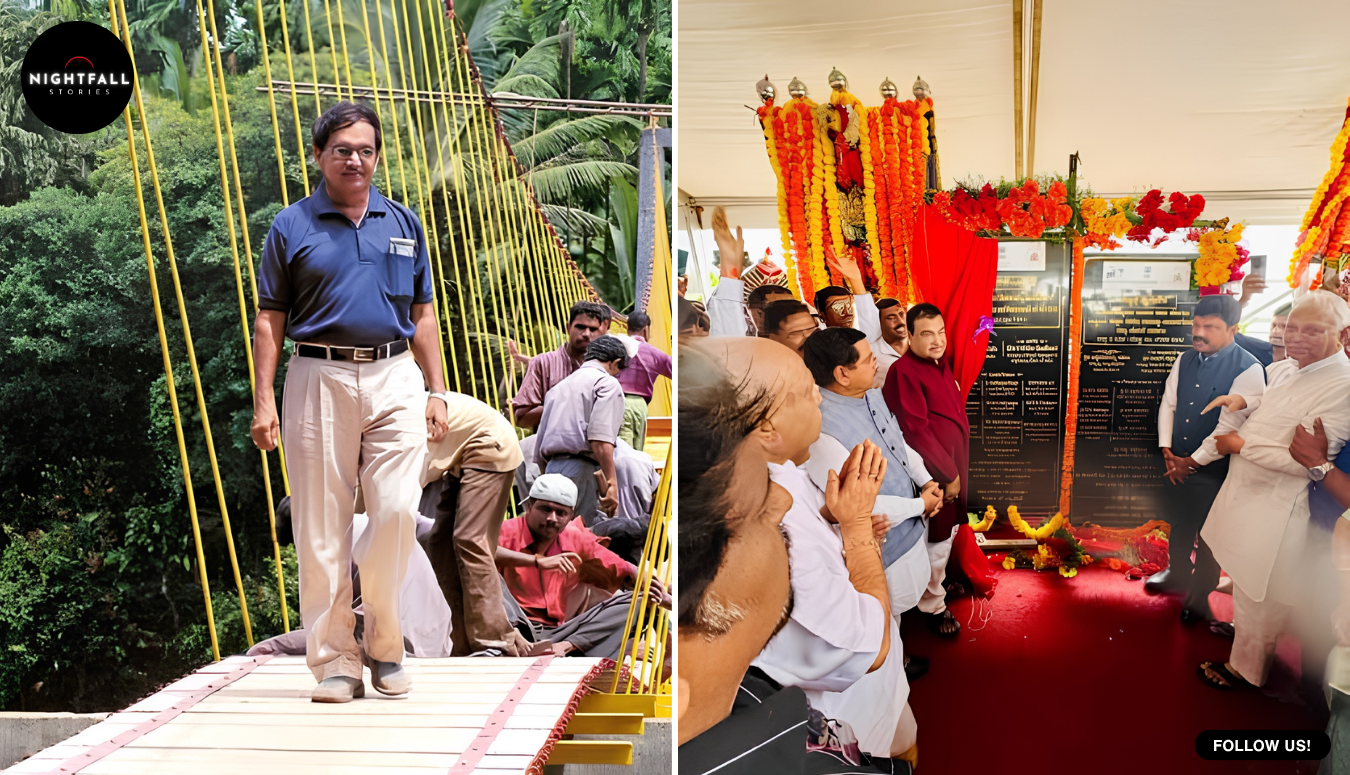
In a village in Kerala’s Kasaragod district, a schoolteacher called Prashanth Nerolu can tell you exactly how many times the man came. Three. Three separate visits to the bank of the Shiriya river, walking the ground, looking at where the water rises, working out what it would take and what it would cost. Each time he went away and wrote the numbers down. Each time the paperwork went up the chain and stopped somewhere.
The man was Girish Bharadwaj, and he had built well over a hundred footbridges across rural India by then, which is why Adkasthala had asked for him specifically rather than waiting any longer for anyone else. He died earlier this year, aged 76, at a hospital in his own home town of Sullia. Adkasthala still has no bridge across the Shiriya.
That is the shape of it, and it is worth putting at the front rather than saving, because the tidy version of this man’s life leaves it out. The tidy version is a national award, a nickname the newspapers liked, and a large number of bridges. The number itself turns out to be one of the strangest things about him, and we will come to that.
He was not a bridge engineer. He trained as a mechanical engineer and graduated first class from P.E.S. College of Engineering in Mandya in 1973, and he had job offers of the kind that take a young man in that part of Karnataka out of it for good. His father, a farmer, told him to stay and fix things people actually needed fixing. So he set up a workshop in Sullia and spent the next decade and a half repairing farm machinery and fabricating whatever the surrounding district brought through the door. Nothing about that is a career heading towards suspension bridges.
Then, in 1989, a group of residents from Aramburu, a village in the same taluk, came to see him. They were separated from the other side of the Payaswini river by water, and their arrangement for crossing it was a country boat, which is an arrangement that fails at exactly the moments you need it most. They had heard he could build things. They asked him whether he could build them a bridge.
He said no. This is the detail that most of the obituaries skipped and it is the one that makes him legible as a person rather than a plaque. He was nearly forty, he had never designed a bridge, and the cost of the kind of bridge he understood a bridge to be was far beyond anything Aramburu could raise. Refusing was not cowardice. It was an accurate assessment.
What changed his mind was that the villagers did not accept the refusal. They kept coming back, and their confidence in him was, by his own later account, out of all proportion to anything he had done to earn it. So he went to look at the river. Then he went and read about suspension bridges, and talked to engineers who had built them, and worked out what the cheapest honest version of one would be.
The bridge he built across the Payaswini was a pedestrian suspension span of somewhere between eighty seven and ninety seven metres, depending on which account you take. It took three months. It cost in the region of one hundred thousand rupees, which even allowing for the exchange rates of the time is a remarkably small figure for a river crossing, and it was raised locally rather than granted from above. The villagers themselves did much of the labour, without pay, which was not a cost saving dressed up as participation. He came to believe it was the point. A village that had carried the cable and dug the anchor pits owned the bridge afterwards in a way that a village handed a finished structure by a contractor did not, and would look after it.
Everything he did for the next thirty seven years was a refinement of that first job. The design stayed deliberately modest: a walkway, not a road. No vehicles, no lorries, nothing that requires piers sunk into a riverbed or months of concrete curing. That restriction is what made the economics work. A conventional concrete bridge in that terrain takes at minimum eighteen months and a budget in a different order of magnitude. His took about three months. He could put up roughly three a year with a working team of about thirty people, which sounds unambitious until you consider that he was doing it in places where the alternative was nothing at all, indefinitely.
The engineering behind the cost is not mysterious, and he never pretended it was. A vehicle bridge has to hold up a moving mass of many tonnes at unpredictable points along its length, which forces you into deep foundations in a riverbed, heavy decking, and the long slow business of concrete. A footbridge carries people. Suspend the walkway from cables anchored into the banks and you do not have to touch the riverbed at all, which in monsoon country removes the single most expensive and most weather dependent part of the job. The components are fabricable in a workshop, which is precisely the workshop he already had, and assembled on site by people who do not need to be specialists. What he spent nearly four decades doing was tightening that formula: lighter where it could be lighter, stronger at the two or three places where failure would actually matter, and standardised enough that the next village’s bridge did not need to be designed from nothing.
The other half of the method was social rather than structural, and it is the half that most schemes get wrong. Because the village supplied labour, the village knew how the thing was put together. He was also insistent on being physically present while a span went up, on the grounds that he was watching two things at once, the quality of the work and the safety of the men doing it. A bridge built that way tends to still be standing twenty years later, because somebody local notices a frayed cable before it becomes a collapse.
It is easy to write about rural connectivity in the abstract and lose what a footbridge actually is. So: it is a child not missing school for four months of the monsoon. It is a market reachable on foot on the day the crop is ready rather than the day the water goes down. It is, most bluntly, the difference between a person having a heart attack at nine in the evening and a person having a heart attack at nine in the evening on the wrong side of a river. Villages with no crossing do not simply travel further. They make different decisions about their whole lives, and most of those decisions are worse. A hundred metres of walkway changes the arithmetic of everything.
The work spread outward from Dakshina Kannada in a way he never seems to have planned. A forest officer who had been transferred from Sullia to Kushalnagar asked him whether he could connect an island in the Cauvery to the mainland, and he did. Kerala took him up in numbers, with something like thirty bridges there. Then Telangana, Andhra Pradesh, Odisha, and by most accounts Tamil Nadu. In Odisha he put a hundred and fifty one metre span across the Nagavali river at Chekaguda in Rayagada, begun in late 2011 and finished the following March, working with a state agency, at a cost of about fifteen million rupees. He set up a foundation, Bharat Grama Sethu Pratisthana, to carry the work. His son Pathanjali came into the design and construction side.
And here is the odd thing about the total, which matters because it says something about how invisible this kind of work is even when it is being praised. Nobody knows how many bridges he built. Not approximately. Not within a reasonable margin.
The Kerala outlet that reported his death and the Adkasthala story put it at more than one hundred and forty. A national broadcaster’s headline on the same day said more than three hundred, and repeated the figure in its own text, while a Kannada post embedded in that same page said more than one hundred and forty. One major Indian daily settled on more than a hundred and fifty. A development sector write up said a hundred and forty plus, noting that the figure had been given as a hundred and twenty eight back in 2017 and nearly a hundred and fifty by the end of his life. His encyclopaedia entry says around a hundred and twenty seven. A profile written years earlier, mid career, said nearly eighty in twelve years, with over a hundred more requests outstanding.
Those numbers are not variations on a theme. The gap between one hundred and forty and three hundred is not a rounding difference or a translation slip. It is more than a hundred and fifty bridges, each of them a real structure standing over a real river that somebody walks across, and the Indian press could not agree on whether they exist. I am not going to split the difference and print an average, because an average of two contradictory figures is not a fact, it is a way of hiding that you do not know. The defensible floor, supported by nearly every source and by his own foundation’s accounts, is well over a hundred. Beyond that, the honest answer is that the record is a mess.
There is a reason for the mess, and it is not sloppiness so much as the nature of what he did. He built where the state had not, for communities that do not generate paperwork, often funded by a mixture of village collections, local donations and whatever government scheme could be persuaded to contribute. There was no single register. A man who had built ninety bridges and a man who had built two hundred and ninety would look the same from Delhi, because neither of them appears in the national accounts in any form that adds up.
Delhi did notice him eventually. In 2017 he was given the Padma Shri, India’s fourth highest civilian honour, in the social work category. He collected honorary doctorates. Journalists gave him the nickname that stuck, the Bridge Man of India, and by his own account in later years the thing people said to him most often was thank you, from villagers describing what the crossing had changed.
What the award did not do is what awards generally do not do. It did not put a fast lane in front of the files. Which brings us back to Adkasthala.
The village sits in the Enmakaje panchayat in Kasaragod, on the wrong side of the Shiriya, along with the hamlets of Nerolu, Gurinerolu and Manjalagiri. It has been asking for a crossing for more than three decades. The specific project has been formally under consideration since 2010, which is sixteen years of being considered. Bharadwaj went there three times, at their request, and produced estimates each time. The approval never came.
Nerolu, the teacher, has made the argument in the plainest available terms. He has a car, so for him the detour is an inconvenience. He asks people to think instead about the schoolchildren and the college students who make the same journey every day, in both directions, without one. That is the whole case. It has been the whole case since before some of those students were born.
Nobody has published a villain here, and inventing one would be dishonest. There is no record of a minister refusing, no scandal, no single decision to point at. What there is instead is the ordinary machinery: a proposal that needs clearance from more than one department, in a place where a river forms a boundary between jurisdictions, with no constituency loud enough to make delay expensive for anyone. Files like that do not get rejected. They get considered, which is a thing that can be done forever.
He died on a Tuesday in early July, at a private hospital in Sullia, after a brief illness that was reported as heart related. He was 76, born in Sullia in 1950 and dead in it. He is survived by his wife Usha and their children. The tributes were warm and largely accurate and used the nickname a great deal.
It would be easy to end by saying the bridges are his monument, and easier still to say that the one he never built is somehow the most eloquent of them. Both of those are ways of making an unfinished thing sound complete, and the second one is close to obscene, because an unbuilt bridge is not poetry. It is a river that children still have to go round.
So the honest ending is the one the village is living in. Girish Bharadwaj spent thirty seven years demonstrating that a footbridge over a rural river in India is a three month job, requires no exotic technology, and can be paid for with a sum that would not cover the landscaping on a flyover. He proved it well over a hundred times, in at least five states, well enough that the government pinned a medal on him for it. Then he went to Adkasthala three times, wrote down what it would cost, and waited with them for an approval that did not arrive in his lifetime.
The bridge is still not built. The estimates presumably still exist in a file somewhere. The man who knew how to do it is dead, and the children are still walking the long way.