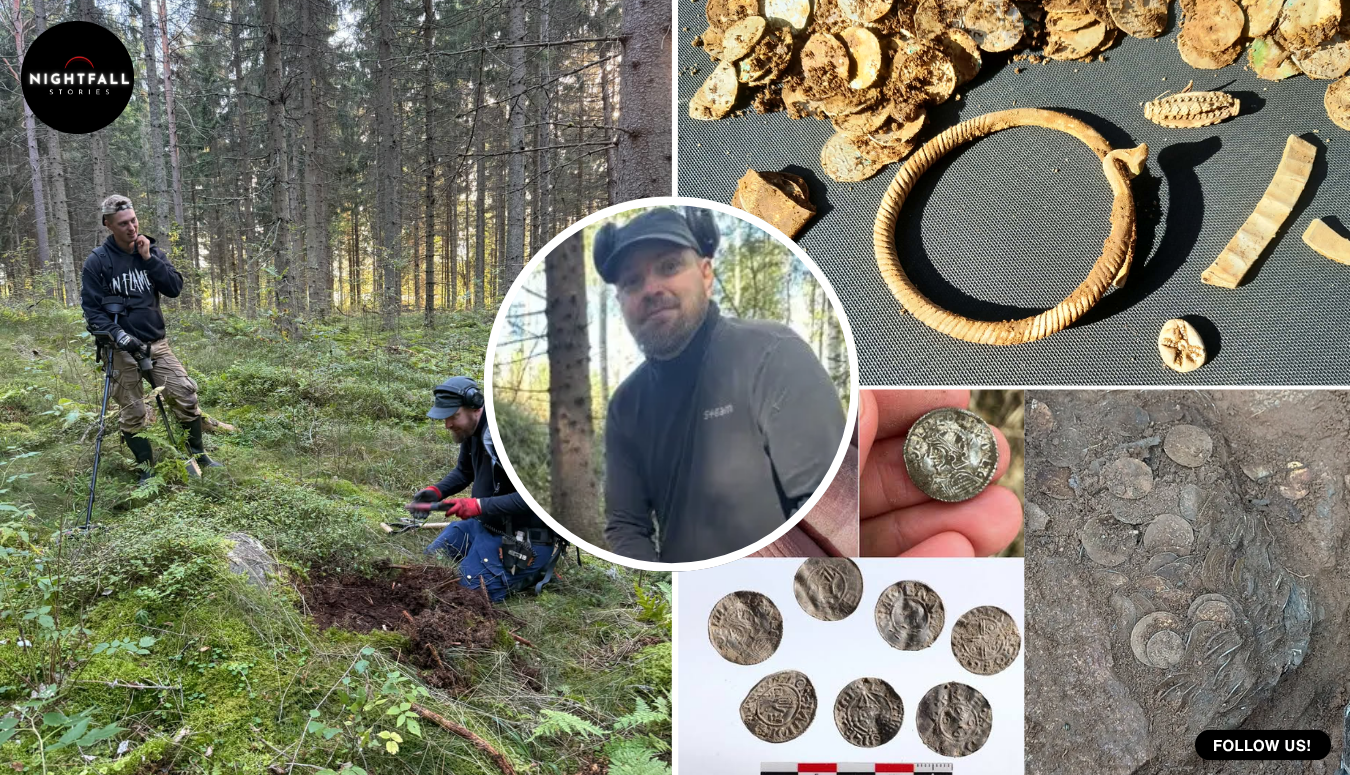
Kalle Lappinen was working ground he already knew, in the place he is from, when the machine in his hand roared. He has described the sound that way, a roar rather than a beep, because after enough years with a metal detector you stop hearing individual tones and start hearing volume, and volume means mass. He started digging through soil and cobbles beside a rock outcrop in the woods, and about eighteen inches down he reached something that was not a nail, not a bottle cap, not a scrap of a broken farm implement.
It was silver. Not a coin. Thousands of them, packed into a container made of birch bark, along with a bracelet and a handful of other worked pieces, all of it sitting where somebody had put it roughly a thousand years ago.
That would have been the story. It would have been a very good story. A hobbyist in Sysmä, a quiet municipality in southern Finland about ninety-five miles north of Helsinki, turns up a Viking Age hoard in his own home area. Photographs, a museum visit, a paragraph in the news and a nice memory for the rest of his life.
Except he did not stop. He kept going over the ground, and about forty feet away from the first hole the detector went off again. A second birch-bark container. More silver.
Together the two deposits weigh around four and a half kilograms, which is a shade under ten pounds. That is the single figure that turns this from a local curiosity into the biggest find of its kind ever made in Finland. The previous record holder was a hoard turned up at Nousiainen back in 1895, which contained somewhere north of seventeen hundred coins and weighed a little over two kilograms. The Sysmä find is roughly twice as heavy. And nobody yet knows how many coins are actually in it, because they have not been cleaned, separated or counted.
That last part is worth pausing on, because it is the opposite of how these stories usually get told. The number everyone wants is the number nobody has. The coins came out of the ground fused together by a millennium of soil, corroded, stuck in clumps, and the archaeologist handling them has said flatly that there are a great many and that he has not had time to go through them. Thousands is an estimate based on weight and on what the top layers look like. The real count will come out of a lab, slowly, over a period that will be measured in months rather than days, and the precise dating will come with it.
The birch bark itself is part of the find, and it is the sort of thing that usually does not survive. Organic material rots. Wood, leather, cloth and bark almost always vanish from a burial of this age, which is why archaeology is so heavily weighted toward metal, stone and pottery, the things that happen to last. That two bark containers held together well enough to be recognised as containers says something about the specific conditions in that patch of ground, and it gives researchers a rare look at how a hoard was actually packaged rather than just what was inside it. Birch bark was a workhorse material across the northern forests, folded and stitched into boxes, baskets and shoes, and someone reached for it here because it was what you used when you needed a container in a hurry.
Lappinen reported the find immediately, which is both what Finnish law requires and what a large number of people in his position would find surprisingly hard to do. Under Finland’s Antiquities Act, anyone who finds an object more than a hundred years old has to report it to the Finnish Heritage Agency without delay, and is specifically not supposed to keep digging around the site to see what else is there. The reporting is done through a national online service, and the practical effect is that a huge amount of Finnish Iron Age archaeology now comes from hobbyists rather than from professional excavations. Researchers there have been openly saying for years that the surge in metal detecting has reshaped what is known about the period, because detectorists cover ordinary farmland and forest that no university dig would ever have a reason to survey.
The system only works if the finders behave, and Lappinen did. An archaeologist from the regional museum in Lahti, Esko Tikkala, was on site the next day, and the excavation was done properly, with the containers recorded in position rather than emptied into a bag. That matters enormously for what can be learned. A hoard that arrives at a museum as a bucket of loose coins is a pile of objects. A hoard recorded where it lay, in two containers, twelve metres apart, at a known depth, wedged among stones, is evidence about a decision somebody made.
And the decision is the interesting part. Nobody buries four and a half kilos of silver in a forest for fun. Tikkala has offered the two obvious possibilities and been honest that neither is proven. It could have been a merchant putting wealth somewhere safe between journeys, the eleventh-century equivalent of a safe deposit box, with every intention of coming back for it. Or it could have been someone with a great deal to lose hiding it because trouble was coming, an attack, a raid, a season of unrest, with the same intention and worse luck.
Either way, the person did not come back. That is the only thing the silver proves with certainty. Somebody put it in the ground and something prevented them from ever retrieving it, and a thousand years later a man with a detector found it in two pieces, forty feet apart, because they had split the stash rather than trusting it all to one hole.
That detail about splitting it is quietly revealing. It suggests planning rather than panic. Someone thought about what happens if one cache is found, and hedged.
What is actually in the containers says something else again, and it upends the picture most people carry around of Viking Age Finland as somewhere remote and peripheral. The coins are not local. Finland was not minting its own currency at that point. The silver comes from what is now Germany, from Sweden, from Britain, with English coins that predate the Norman Conquest, and it includes Islamic dirhams, which could have been struck anywhere from Spain at the western edge of the Islamic world to the far eastern reaches of the old Byzantine frontier.
That is not a pile of loot from one raid. That is the sediment of a trade network. Silver moved north and west along the great river routes through what is now Russia and Ukraine, exchanged for furs, wax, amber and slaves, and it accumulated in the hands of people who lived along the routes. Coins in that economy were often not spent as coins at all. They were weighed. That is why hoards like this one contain hack silver, which is exactly what it sounds like, pieces of jewellery and ingots and coins deliberately cut into fragments so they could be weighed out to the exact value of a transaction. A dirham struck in Baghdad and an arm ring made in Scandinavia were, on a set of scales, the same thing.
The Sysmä hoard has that hack silver in it, alongside the intact bracelet, a fitting and a bead. So what Lappinen dug up is not really a coin collection. It is somebody’s working capital.
The question of whether any of it was plunder has been raised, and the honest answer is that nothing found so far ties this silver to a raid. The mix of origins points much more strongly toward exchange than toward theft, because loot tends to look like loot and a spread of coinage from four or five distant mints looks like commerce. But the two were never cleanly separated in that world, and the archaeologists have been careful not to claim more than they can show.
The location makes sense of a lot of this. Sysmä today is a small municipality, the kind of place that empties out in winter and fills again when the summer houses open. It sits on the shore of Lake Päijänne, which is one of the great water routes of southern Finland, and in the Iron Age that geography made it something entirely different. Archaeologists working the area describe it as having been a genuine hub, with evidence of trade connections running well beyond the region. It is not a coincidence that several hoards have surfaced around Sysmä over the past decade. Wealth was passing through, and some of it stopped.
The dating puts the burial somewhere around the year 1000 to 1050, which sits at the tail end of the Viking Age and right at the edge of a period of enormous change in the region. Within a couple of generations of whoever buried this silver, Christianity would arrive in Finland, the old trade patterns would shift, and the world that made a forest cache of weighed silver a sensible way to store wealth would be gone.
The comparison with the old record is worth sitting with, too, because the Nousiainen hoard has been the benchmark in Finnish archaeology for well over a century. It was found in the 1890s, it held more than seventeen hundred coins, and for generations it was simply the answer to the question of how much Viking Age silver had ever turned up in one place in Finland. A find that doubles it does not merely edge past a record. It changes the scale of what is considered possible, and it gives researchers a second large sample to compare against the first, which is often more useful than the object count. One rich hoard is an anecdote. Two are the beginning of a pattern.
For Lappinen, the experience seems to have been mostly disbelief followed by a hard hit of adrenaline. He has been refreshingly unromantic about what detecting is actually like, pointing out that something like ninety-nine percent of what a detector finds is rubbish or scrap metal in the ground. That is the part nobody films. The hobby is hours of walking, thousands of signals, and a hole dug for almost every one of them, the overwhelming majority producing a fragment of wire or a rusted bolt or a ring pull. He has said he was not out hunting treasure in the fairy-tale sense. He searches to help confirm where Iron Age settlement actually sat, which is a much more patient and much less glamorous motivation, and which is exactly why professional archaeologists have come to value people like him.
It also explains why the second hoard exists as a discovery at all. A person out for a thrill takes the first container, calls it the greatest day of their life and goes home. A person who is methodically covering ground keeps covering ground.
What happens to the silver now is not a treasure-hunt ending, and it is worth being clear about that rather than letting readers imagine a cheque. In Finland, finds of this age go into the national heritage system, and the silver belongs to the record rather than to the finder. The coins will be cleaned one at a time, identified by specialists who can read a worn dirham or place an English penny to a particular reign, counted properly, weighed properly and dated properly. Scientific papers will follow, on the hoard as a whole and on individual coins within it. What the finder is owed in law has not been reported in the coverage, and inventing a figure would be doing exactly the thing this story does not need.
Because the reward that has actually been reported is a different one. Tikkala and the museum have publicly described what Lappinen did as responsible and responsive detecting, which is the language the archaeological community uses for people who do not wreck the context, do not keep quiet, and do not sell. It sounds dry. Within that world it is close to the highest thing you can say about an amateur.
And there is something genuinely satisfying about how ordinary the whole thing was. No expedition. No funding round. No ground-penetrating radar survey or drone mapping or geophysics team. A man from Sysmä walked around Sysmä with a machine he presumably bought himself, in ground he already half knew, listening to noise that is almost always nothing, and on one afternoon it was not nothing. Then, instead of going home to tell everyone, he carried on walking the same ground he had just walked, and found the rest of it.
The silver has come up out of the forest floor and gone to a museum lab in Lahti, where somebody is going to spend a very long time separating coins that have been stuck together since before Finland had a written history. The count will eventually be published, and it will almost certainly be a number that gets quoted for decades. Whoever buried it went to considerable trouble to make sure nobody would ever find it. They were right for a thousand years.
They were just not right forever.