Lillian Higgins was twenty years old when she gave birth in Louisiana, and she did not get to decide what happened next. Her mother decided. The baby was surrendered for adoption at birth, the paperwork closed behind her, and for the next forty nine years Higgins had no name for her and no legal route to one. By her own account, the reason her family gave for pushing the adoption through was that the baby was mixed race.
She is about seventy now. Earlier this year a woman drove down from Oklahoma with her husband and children, parked outside Higgins’s home in Pineville, and walked up to the door. Her name is Heather Palmer. She is forty nine. She is the baby.
What connected them was not a court, not a registry and not a private investigator. It was a saliva sample in a cardboard mailer, sent off by one of Higgins’s relatives who had no idea she was solving anything.
That is the part of this story worth slowing down for, because the reunion itself took an afternoon and the machinery that kept it from happening took half a century to build and was dismantled almost by accident.
Start with 1976, and with what a twenty year old in Higgins’s position could actually do. The honest answer is very little. In the United States of that period, an unmarried young woman who was pregnant and still living inside her family’s household was, in practice, subject to whatever her family arranged. She was old enough to sign her own name and young enough to have no money of her own and no standing to argue. The adoption system of the era did not treat that as a problem to be solved. It treated it as the normal way a case arrived.
The prevailing professional theory at the time was what the literature later came to call the clean break. The idea was that everyone involved was best served by a complete and permanent severance: the child would be raised as though born to the adopting family, the birth mother would return to her life, resume it, and in the language social workers of the period actually used, go on. Grief was expected to be brief. Contact was assumed to be harmful. The record was sealed not as an accident of filing but as the point of the exercise.
And the sealing was thorough. Across most American states, adoption records were closed by legislation passed in waves from the 1930s and 1940s onward. An adopted person received an amended birth certificate naming the adopting parents as the parents. The original certificate, the one with Higgins’s name on it, went into a sealed file. Getting it out required a court order, and a court order required what the statutes generally described as a compelling reason. In practice that meant a documented medical emergency or an inheritance dispute. Wanting to know who your mother was did not qualify. Wanting to know whether your daughter was alive did not qualify either.
There were voluntary registries, and they are worth understanding because their design contains the whole problem. A registry works by mutual consent: the adopted person signs up, the birth parent signs up, and if both records are present the state confirms the match. The logic is respectful. The mathematics are brutal. Both sides have to be looking, at the same time, in the same place, with enough information to be recognised. A birth mother who did not know a registry existed, or who was never told her daughter had been adopted out of state, was invisible to it. Palmer had been registered on genealogy databases for years, by her own account two or three of them, and nothing came back.
Louisiana did eventually change its rules, and the change is real. Under a 2022 state law that took effect that August, an adopted person aged twenty four or older who was born in Louisiana can request an uncertified copy of their original birth certificate directly from the state registrar. There is no birth parent veto and no judge to persuade. Birth parents can file a contact preference form saying how they would prefer to be approached, but filing one does not block anybody’s access. On paper, that reform is exactly the key that had been missing since the 1930s.
It arrived forty six years after Higgins signed, and it is not what found her. Palmer grew up in Oklahoma and was adopted there, which puts a second state’s paperwork on top of the first, and in any case the thing that produced the match was not a record at all. It was biology, sold as a consumer product.
Here is how that works, in plain language, because the mechanism explains why it beat the legal system so completely. A consumer DNA test of the common kind reads several hundred thousand positions scattered across your chromosomes. It then compares that pattern against every other customer in the company’s database and reports, for each person, roughly how much DNA you share and therefore how closely you are probably related. Full siblings share about half. A grandparent, an aunt or an uncle shares about a quarter. First cousins share something in the region of an eighth, and the figure keeps halving as the relationship gets more distant, with a widening margin of error as it goes.
The crucial consequence is that you do not need the person you are looking for to be in the database. You need somebody in their family to be. A niece is enough. A cousin is enough. A second cousin who has never heard your name is often enough to narrow a search to a single household. Closed adoption law was written to control a document. It has no mechanism whatsoever for controlling what is in a stranger’s cheek cells.
In this case the person who tipped it over was a relative of Higgins who sent a sample to 23andMe. Palmer’s account is that the hit came from a birth niece. Once the match surfaced, Higgins took a test of her own to confirm what the family arithmetic already implied. The confirmation was not the hard part. Finding one another after forty nine years was the hard part, and it was done by somebody who was not searching.
There is a strange asymmetry buried in that. No legislature voted for it. No adoption agency consented to it. No court weighed anybody’s competing interest in privacy. A legal architecture built deliberately, over decades, to make this exact meeting impossible was rendered ineffective by millions of people independently deciding they were curious about their ancestry. Whatever you think of the outcome, and in this case the outcome is a mother and daughter sitting in the same room, it is a remarkable thing to have happened without anyone deciding it should.
It is also more fragile than it looks. The company at the centre of this particular reunion filed for Chapter 11 bankruptcy protection in the United States in 2025. Its assets, including its genetic database, were sold for a reported 305 million dollars to a nonprofit research institute led by one of its own co-founders, a process that drew sustained scrutiny from privacy regulators and from customers who had never imagined their saliva sample as an asset in an insolvency. The reunion infrastructure that closed adoption law could not withstand is not a public service. It is a commercial product with shareholders, terms of service and a balance sheet, and families now rely on it for something no public body ever built.
Which brings us to the forty nine years, and this is where the weight of the story actually sits. Not in the hug on the doorstep. In the two ordinary lives that ran in parallel and did not touch.
Palmer was raised in Oklahoma in a large adoptive family. Reporting on her case puts the number of adoptive siblings at twelve, and includes a detail that is quietly devastating in its plainness: she was the only one of them without contact with any biological family. Everyone around her had a thread back to somewhere. She had a file she could not open.
That is a specific kind of absence, and it is not mainly emotional. It is administrative. It is the medical history form at every new clinic, the one that asks about your mother’s heart and your father’s family and expects you to know. It is the school project about where your people came from. It is the mirror, and a face that resembles nobody you have ever met. Adopted adults describe this not as constant grief but as a low recurring hum, a thing that goes quiet for years and then arrives with the paperwork.
On the other side of it, Higgins was not a woman who had gone on, whatever the theory of the era had predicted. Her own account of leaving the place where she gave birth is that she looked back at it and told herself that one day she would find her daughter, or her daughter would come looking for her. That is a promise made by somebody with no instrument for keeping it. She had no surname to search and no legal standing to ask for one. She knew the birthday. Reporting on the reunion gives Palmer’s birthday as the seventeenth of September, which means Higgins had, every year for forty nine years, a date she could count but not use.
Think about what that does to a life at the practical level. Every form asking how many children you have has a wrong answer and a rude one. Every new relationship contains a disclosure you either make or carry. Any other children you raise grow up alongside a sibling whose existence is either a secret or a permanently open question. And the decision at the root of it was not even yours. Higgins did not choose this and then live with her choice, which is difficult enough. She lived for half a century with somebody else’s choice, made in a week, and with no mechanism to revisit it.
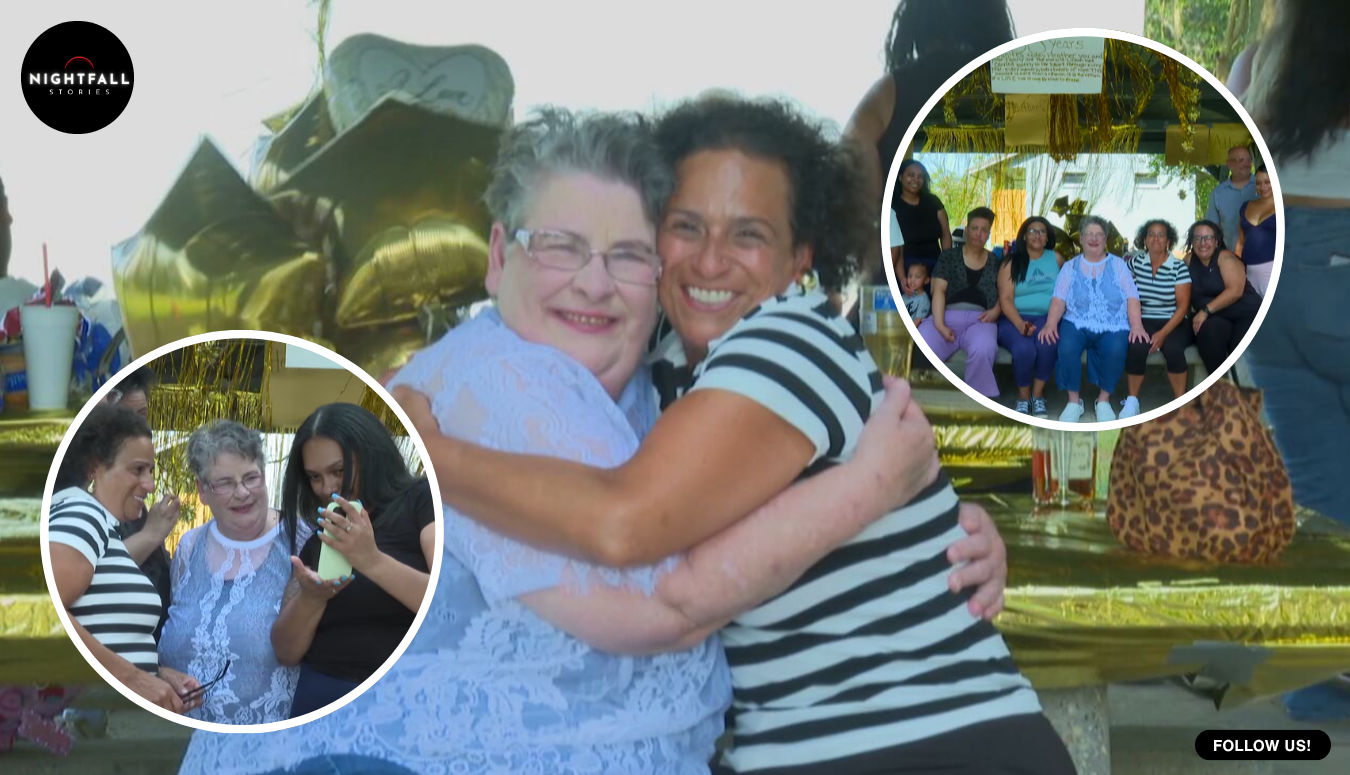
The meeting, when it came, ran the way these meetings apparently often do. Palmer drove down with her own family. By her account the talking did not feel like an introduction at all, more like resuming with old family, people she already knew. Higgins, by her account, called it one of the best moments of her whole life, and the first thing she said to her daughter was that she was beautiful. They photographed the two of them together, and then the wider group, children and grandchildren included, because a reunion at this distance is never two people. It is two families discovering they are one.
The honest thing to say next is the part that reunion coverage usually leaves out. A reunion is a beginning, not a repair.
Nothing about that afternoon gives Higgins back the forty nine birthdays, and nothing about it gives Palmer a childhood in which she knew where her face came from. The people who meet in these rooms are not a mother and her baby. They are two adults, formed elsewhere, with different accents and different ideas about how often family should call, who happen to be related in the most fundamental way there is and to share not one single memory. Researchers who follow adoption reunions over time report a wide spread of outcomes. Some become the central relationship of both lives. Many settle into something warm and occasional. Some fade, not from anger but from the ordinary friction of two full schedules and a long drive.
What they have said publicly is that they intend to keep visiting, in both directions, Oklahoma to Louisiana and Louisiana to Oklahoma. That is the realistic version of a happy ending and it is worth more than a grander one, because it is a thing people can actually do.
It should be said plainly that almost everything known publicly about this reunion comes from a single local television station in Alexandria, Louisiana, whose report was then carried by sister stations across the country. That is one piece of original reporting, republished, rather than many outlets confirming each other. The core facts have been consistent everywhere they have appeared, and both women spoke on the record, but the record is thinner than the volume of coverage suggests.
Still, one thing in it is unambiguous, and it is the right place to stop.
In 1976 a decision about Lillian Higgins’s daughter was made by other people, in a system designed to be final, and she was given no say in it. At about seventy years old, she has reversed it. She has her daughter’s name, her phone number, her face, and her grandchildren. She did it in public, on camera, in her own front room, and she said out loud what her family would not let her say the first time.
The paperwork was built to hold forever. It held for forty nine years, and then somebody’s cousin got curious about where their ancestors came from, and it did not hold at all.