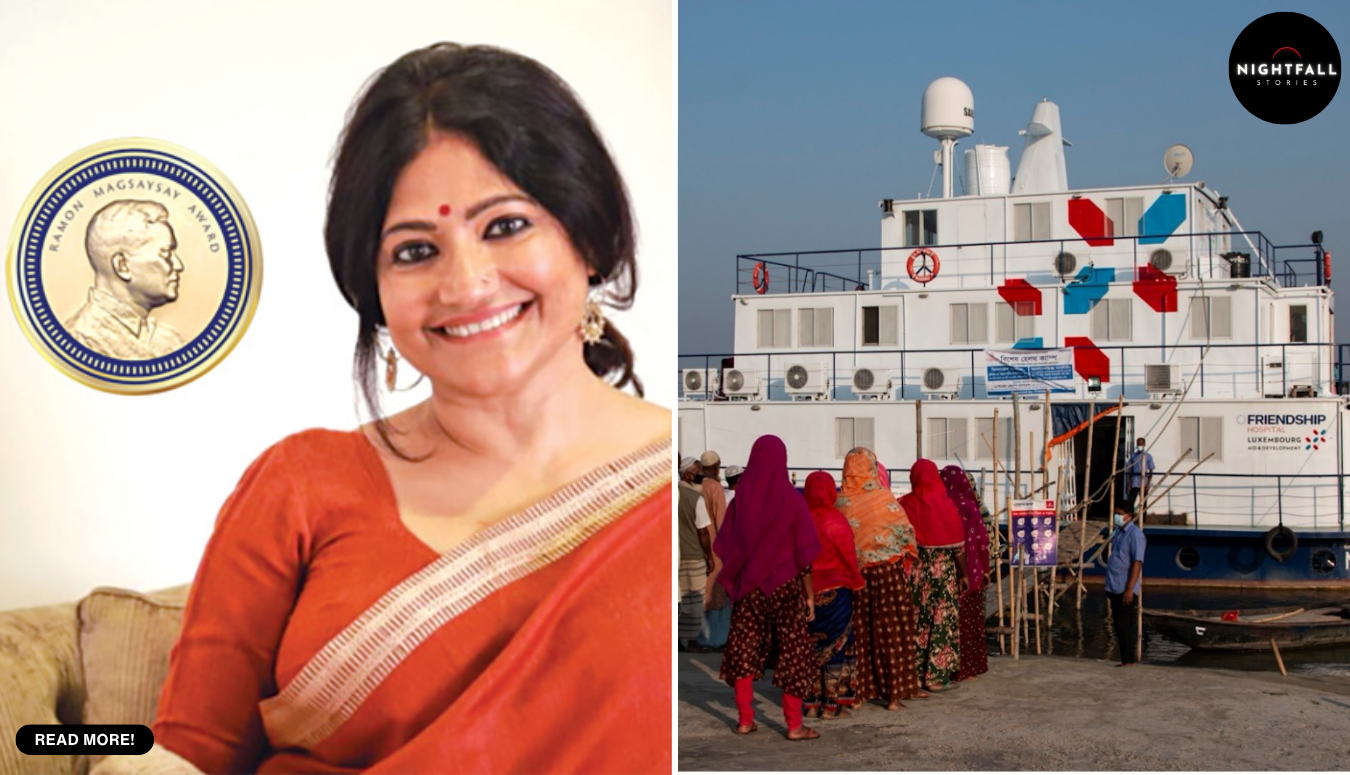
In 2002 a woman in Dhaka took a retired river barge that a French sailor had brought halfway around the world and had it rebuilt as a hospital. Not a clinic with a few beds. A hospital, with an operating theatre inside a steel hull, so that surgeons could reach people who live on land that is not on any map because it will not be there next year. Twenty four years later there are seven of those ships, two hospitals built on solid ground, and a staff of more than seven and a half thousand. Late last month, the Ramon Magsaysay Award Foundation in Manila named Runa Khan as one of its 2026 awardees, which is the closest thing Asia has to a Nobel for public service, and the citation spent most of its words on something other than the boats.
It spent them on where she came from.
To understand why that matters, and why a fleet of floating operating theatres is not an eccentric idea but the only sane one, you have to understand a char. In the north of Bangladesh the Brahmaputra arrives out of the Himalaya carrying an enormous load of silt, changes its name to the Jamuna, and then spends the rest of its journey dropping that silt in the middle of itself. The result is islands. Not islands in the sense of a rock with a lighthouse on it, but low banks of sand and clay that rise out of the braided channels, hold for a few years or a few decades, and then go. Sometimes the river takes one in a season. Sometimes it takes half of one and lays down a new one a kilometre downstream. These are the chars, and hundreds of thousands of people live on them.
They live there because the land is free and the soil is astonishingly fertile, and because the alternative is a city slum. They grow chillies and groundnuts and maize in sand that would embarrass a European farmer. They keep cattle. They build houses designed to be taken apart in a day, because a house you cannot dismantle is a house you lose. And then the water rises, or the bank starts to crumble, and a family loads the roof and the posts and the cooking pots onto a boat and starts again somewhere else that also will not last.
Now think about what that does to a person’s relationship with a state. Almost everything a government gives a citizen is attached to a place. A school is at an address. A clinic is at an address. A land title, a voter roll, a vaccination register, a ration card, a birth certificate, all of it assumes that where you were yesterday is where you will be tomorrow. When the ground itself is temporary, the paperwork never catches up. People who have lived their whole lives inside a country can end up functionally uncounted in it, not through anyone’s malice but because the filing system was never built for a moving target. The Magsaysay citation reached for a single word to describe what Friendship changed about that, and the word was recognition.
Khan’s own starting point was as far from a char as it is possible to get while staying in the same country. She was born in 1958 into a family with deep landed roots, descended on her father’s side from Bengal’s zamindars, the old landholding class, with a maternal line that reaches back to a sixteenth century dynasty. By her own account the house she grew up in was full of visitors who argued about ideas, and her father encouraged her to listen to all of them. She studied geography and humanities, taught small children from the late 1970s, and in her thirties and forties ran a string of small businesses that each had a social edge to them, a boutique set up partly to employ people who struggled to find work elsewhere, a spell in the family printing business, a security company, a venture running trips on traditional wooden boats.
That last one is the hinge. Boats were already in her life when a French sailor and aviator called Yves Marre turned up having sailed a decommissioned river barge from France to Bangladesh with the intention of donating it for medical use. The vessel was there. The question was what to do with it. Khan has said she took the idea of converting it into a floating hospital to existing organisations and was told it would not work. So she started her own, and in 2002 the first ship, the Lifebuoy Friendship Hospital, went into service on the Jamuna, backed by a corporate sponsor.
Converting a cargo barge into a surgical facility is a genuinely interesting engineering problem, and it is not just a matter of screwing beds to the deck. A barge is a flat box built to carry weight, which is exactly what you want, because it draws very little water and can sit close to a sandbank where anything with a deep keel would ground. But an operating theatre needs things a cargo hold does not have. It needs a sealed, cleanable space with controlled air. It needs power that does not flicker, which means generators and the fuel to run them, and increasingly solar. It needs clean water and a way to deal with waste, on a river that people drink from. It needs sterilisation, refrigeration for drugs and blood, oxygen, lighting bright enough to operate under, and a floor that can be washed down. It needs to hold all of that while remaining stable enough that a surgeon is not compensating for a swell. And it needs to be able to move, anchor, and become a functioning hospital again within a day.
The medicine they do on those decks is not exotic. It is the backlog of things that are completely fixable and completely life altering if nobody ever fixes them. Cataracts, which is to say blindness that can be reversed in an afternoon. Cleft lip, which is to say a child who can eat and be looked at without flinching. Obstetric fistula, an injury from obstructed labour that can quietly end a woman’s entire social life. Hernias. Tumours. The unglamorous middle of surgery, delivered to people who would otherwise need a day of travel and a month of wages to reach a district hospital.
The ships alone would not be enough, and the Foundation’s account of the model makes clear that they were never meant to be. Beneath the hospitals sit mobile clinics that run out into the villages, and beneath those sit Community Medic Aides, local people, mostly women, trained to handle the simple things immediately, spot the serious things early, and get someone onto a boat when it matters. That is the part that does the quiet work. A hospital ship that visits is a periodic event. A trained neighbour who lives two houses away is permanent, or as permanent as anything is on a char.
Here the honest caveats have to be stated, because the numbers attached to all this come from one place. The Ramon Magsaysay Award Foundation’s awardee record lists seven hospital ships, two land based hospitals, 550 mobile clinics and 700 trained Community Medic Aides. It credits Friendship with putting more than 205,000 people into work through 137 economic development hubs, reaching around 30,000 students through movable schools, training more than 10,000 volunteers for rescue and relief, and planting more than 200 hectares of mangrove. It records the staff going from twenty eight people, twenty four of them medical and four in a head office, to more than 7,500 today. Those figures were supplied to the Foundation by Friendship. The Foundation is a serious institution with a serious selection process, and the award has a sixty eight year record behind it, but a citation is not an audit. Read those numbers as what the organisation says about itself, verified to the standard a prize committee applies rather than the standard a regulator would.
One figure in particular should carry a label. The Foundation’s record states that students in Friendship’s schools average 90.05 percent in national examinations. A number precise to two decimal places invites a confidence the source does not support on its own, and it belongs to Friendship, reported by the Foundation, not to any independent examination body that has published a comparison. It may well be right. It is not independently established.
The schools deserve attention anyway, because of the adjective. They are described as movable, and on a char that is not a marketing word, it is a design specification. A school building on land that might be in the river next year is either temporary or it is a waste. So the structures are prefabricated, made to be taken down, carried and put up again, which means a community that relocates does not automatically lose a year of its children’s education. The same logic runs through the rest of it. Solar villages, because a grid needs poles and poles need permanence. Prefabricated shelter for people the organisation describes as climate migrants, which on the chars is not a projection about the future but a description of what a family has already done two or three times. Mangrove planting on the coast, where the threat is salt and cyclones rather than shifting silt, because a belt of trees is a sea wall that repairs itself.
Khan has not been unnoticed along the way, which is part of why the piece you are reading is about twenty four years rather than about one announcement. She was made an Ashoka fellow in the mid 1990s, before Friendship existed. She was a Rolex laureate in 2006, took a development prize for women’s contribution in 2008, and a social entrepreneurship award in 2012. A hospital Friendship built on the coast, designed by the Bangladeshi architect Kashef Chowdhury, won the Royal Institute of British Architects’ international prize for the best new building in the world, which is not a category that usually goes to a low cost facility in a cyclone zone. Last year she was recognised in the climate category of the Earthshot Prize. The Magsaysay is the biggest of them in Asian terms, and it is the reason this story is being told now, but it is a peg, not an event. Nothing changed on the chars in August.
What the citation added was an argument rather than a statistic. The trustees wrote about her empathy for the poorest people in her country, and about courage and tenacity in building the organisation, and then they made a point about class. In her hands, they said, privilege became a responsibility rather than an entitlement, and the family legacy she inherited was treated as something to share rather than something to defend. That is an unusually pointed thing for an award committee to put in writing, and it is the most interesting sentence in the whole record. It is also a sentence that only makes sense if you know both ends of the story, the zamindar descent and the sandbank.
Accepting the award, Khan turned the credit around, saying it belonged to the people who had let the organisation walk alongside them for twenty five years. It is the sort of line that could be polite noise, except that the model she built is unusually literal about it. The Community Medic Aides are from the communities. Most of the seven and a half thousand staff are from the communities. The economic hubs exist so that the money stays there. An organisation that flew in doctors and flew out again would be a much simpler thing to run, and it would leave nothing behind when the boat left.
She is now the fourteenth Bangladeshi to receive the award, and she will be in Manila in November for the ceremony at the Metropolitan Theater, alongside the Singaporean diplomat and scholar Tommy Koh and the Myanmar human rights advocate Bo Kyi. That is where the formal part of this ends, with a citation read out in a theatre eleven hundred miles from the river.
The better ending is somewhere else, and it is the thing the citation was actually pointing at. For a long time the people of the chars were a rounding error in their own country, not because anyone decided they should be but because the administrative world runs on fixed addresses and theirs kept washing away. What a hospital ship does, beyond the cataracts and the hernias, is create a record. Someone arrives, is examined, is treated, is written down. A child in a movable school sits a national exam under her own name. A woman trained as a medic aide has a job with a title. None of that stops the river. The river will keep taking land, and the families on it will keep loading their roofs onto boats, and that is not a problem seven ships can solve.
But being seen is not a small thing when the alternative is being uncounted, and it is the one part of this that does not float away. Twenty four years ago a woman with an inherited name and a borrowed barge decided that people without a permanent address were still people with one. Asia’s biggest prize has now said so out loud. The river, characteristically, has not commented.