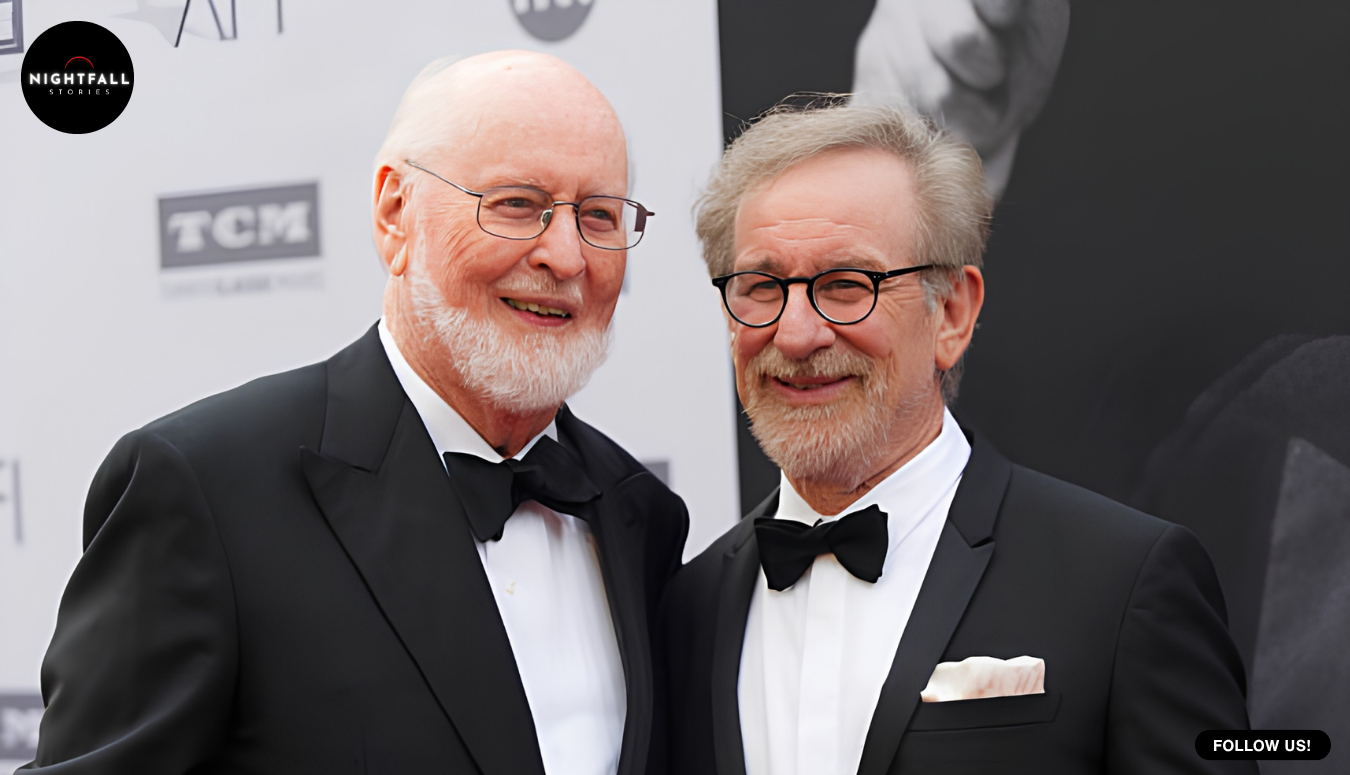
When Steven Spielberg asked John Williams to write the music for his new film, Williams said no. Not a coy, persuadable no. He named four other composers who could do the job and suggested Spielberg use one of them.
He had reason to. Williams had already indicated more than once that he was done with film scores. He was in his nineties. He had spent more than half a century doing the hardest version of a hard job, which is not writing memorable tunes but writing two hours of music to fit a picture that keeps changing underneath you, on somebody else’s schedule.
Spielberg did not accept the no. What he offered instead is the part of this story that actually explains how it happened, and it had nothing to do with charm. He rebuilt the schedule around the composer. A film score is normally recorded in a compressed block, one or two weeks of sessions, the orchestra booked solid, everyone in and out. For this film the recording was stretched across six months. Seven separate sessions, from late in 2025 through to the following February. Williams could write when he could write, and the orchestra would come back.
By the end of it he had recorded more than two hours and twenty minutes of music with an orchestra of ninety-six players in Los Angeles. He turned ninety-four during the process. He orchestrated the entire score himself, by hand, and conducted most of the sessions from a wheelchair.
That last detail is the one worth sitting with, because most people have no idea what it describes.
Orchestrating is not composing and it is not arranging. Composing is deciding what the music is. Orchestrating is deciding, note by note, which of the ninety-six people in the room plays which of those notes, in which register, with which articulation, against which other instruments. It is the difference between a piece of music and a piece of music that actually sounds like something when a hundred humans attempt it simultaneously. For two hours and twenty minutes of finished music, that is thousands of pages of decisions.
Almost nobody at the top of the film industry does this themselves any more. The normal workflow is that the composer writes sketches and a team of orchestrators turns them into playable parts, which is not cheating, it is how the deadlines are met. Williams has always done his own, and he did it here, into his ninety-fourth year. The reporting also names William Ross and Randy Kerber as having handled adaptations for the film’s edits, which is a different and narrower job, reworking existing cues when a scene changes length, and that detail comes from a single strand of coverage rather than being widely confirmed.
Then there is the conducting. Standing in front of an orchestra is a physical act. You are the timing mechanism for ninety-six people who are watching your hands and nothing else, for hours, in takes that have to line up to the frame with a picture running on a screen behind you. Doing that seated, in a wheelchair, does not make it easier. It removes most of the body you would normally conduct with and leaves you the arms, the face and the eyes. Anyone who tells you that is a minor adjustment has never tried to hold a large ensemble together.
People who were in the room reported that he brought surprising energy to it. That word, surprising, is doing a lot of quiet work.
Spielberg was at every single session. He sat near Williams, next to the music editor Ramiro Belgardt, for all seven of them across six months. Directors do not usually do this. They come to the main sessions, they approve the important cues, they leave. Sitting through the whole recording of a score is a way of spending time with somebody.
And the music he was asking for was not the kind that made either of them famous. Spielberg has described it as probably the most restrained score Williams has ever written for one of their films, with the lovely qualifier attached that it is the most restrained until it is not. He has explained what he wanted in plainer terms too. He wanted the music behind the film and underneath the film rather than out in front of it. He wanted it to nudge the picture forward slightly without leading it, which is the exact opposite of the approach on something like Close Encounters of the Third Kind, where the music is arguably the main character.
Ask a composer which of those two jobs is harder and most of them will tell you it is the second one. Writing a theme people hum for fifty years is a rare gift. Writing music that does its work while a viewer never consciously notices it, and then does not sound like wallpaper when you play it on its own, is a craft problem with almost no room for error. You cannot hide behind a big tune. Every choice has to justify itself at low volume.
Some of those choices are visible in the details that came out of the sessions. Four bassoons for one dark cue, when a single bassoon is standard and two is already a statement. Two harps instead of the usual one. These are not showy decisions. They are the decisions of someone thickening a colour without raising the volume, which is exactly what restraint at that level actually requires. You do not get quieter by using fewer players. You get quieter by using more of them, gently.
The most interesting technical choice was the choir. Thirty female voices, split evenly between sopranos and altos, with a soloist named Holly Sedillos, recorded in December with the orchestra rather than added afterwards.
That is not how this is normally done, and the reason it is not how it is normally done is that doing it the older way is harder and riskier. A choir recorded separately can be balanced, tuned, moved and replaced later in the mix. A choir recorded live in the same room as ninety-six instruments cannot be untangled from them afterwards. The voices are in the orchestra’s microphones and the orchestra is in the voices’. If the balance is wrong, you do not fix it at the desk, you do another take. If one singer is a shade sharp on a held note, that note is now permanently part of the string sound.
What you buy with that risk is a thing you cannot fake. Singers and players in the same acoustic listen to each other in real time and adjust, and the tuning and blend that results is audibly different from two good recordings laid on top of each other. The human ear catches it even when the listener has no idea what they are catching. It is the difference between a group of people making a sound together and a group of people making sounds near each other.
The film is called Disclosure Day, and most of the work on its music belongs to 2025 rather than to this year. Five of the seven sessions happened before the calendar turned. The score was finished in the February that followed, the album came out in the summer, and the detailed account of how the thing was actually made only became public months after the orchestra had gone home. That gap is normal for scoring work and it is why almost nobody notices it happening.
The shape of the schedule tells its own story. Seven sessions across six months is not a composer being slow. It is a score being written against an edit that is still moving. When a director spends that long finishing a film, scenes get shortened, reordered, cut and reinstated, and every one of those changes breaks the music written for it. That is precisely why adapters get hired. A cue that fit a two-minute scene has to fit a ninety-second scene, and the join cannot show.
Then there is the arithmetic that anyone outside the industry finds startling. More than a hundred and forty minutes of music was recorded. Eighty-two minutes of it is in the finished film.
Roughly an hour of fully orchestrated, fully recorded music by one of the most performed composers alive, played by ninety-six musicians, did not make the picture. That is not waste and it is not a failure. It is normal, and it is the cost of scoring to a moving target: you write for the film as it stands, and the film moves. Some of the unused material found a home on the soundtrack album, sixteen tracks running a little over sixty-four minutes, released in the summer, with a vinyl and CD edition following and liner notes written by Spielberg himself.
Which brings us to the thing everyone wants this story to be, and the thing it stubbornly refuses to be.
This was the thirtieth film Williams and Spielberg have made together. Their first was in 1974. That is a working relationship of more than fifty years, and there is nothing else like it in the history of film. Not a director and an actor, not a director and a cinematographer, nothing at that length and nothing at that count. Thirty films with one collaborator is not a statistic about productivity. It is most of two adult lives.
So the temptation to write the last session as a farewell is enormous. Do not believe it if you read it that way somewhere else, including in headlines that call this his final score.
Here is what is actually documented. At the final session, Spielberg made a remark to the room about it being their thirtieth film together, and said they were still in love. And then, according to the account of that day, he raised the subject of another film. Williams’ response was not a polite deflection. It was affirmative.
A thirty-first has been hinted at. It has not been announced, nothing has been confirmed, and it would be irresponsible to promise it. But the room did not sound like a room where somebody was retiring. It sounded like a room where the older of the two men had just been asked again and had not said no, which by this point is a familiar pattern. Williams had already suggested at least twice that a particular score would be his last, and each time Spielberg came back, and each time the answer changed.
Williams has been open about why, and it is the most human line in the whole story. Asked about being talked out of retirement, he has said that one thing Spielberg is not is a man you can say no to.
That is funnier and more affectionate than it looks on the page, and it is also a slightly sad admission about a particular kind of friendship. Two people who have worked together for half a century do not really have the option of a clean ending, because the work is how they see each other. Spielberg sat beside him for seven sessions over six months. Williams wrote two and a half hours of music at ninety-three and ninety-four and gave up an hour of it without complaint. Neither of those is a professional obligation. That is what the relationship consists of.
It is also worth being precise about the retirement question, because it has been reported loosely for years. Williams has never announced a retirement from composing. What he has done, more than once, is say that a particular score would probably be his last, which is a different statement and a much more honest one from a man in his nineties working one project at a time. Coverage of this score has described it as possibly his final collaboration with Spielberg, and that hedge is correct and should be kept. Anyone stating flatly that this is the last music John Williams will write for a film is going beyond what anybody involved has said, including Williams.
For what it is worth, the score arrived and it works. Spielberg’s own description of his collaborator at ninety-four was that he is as exceptional now as he was at forty, which is the kind of thing a friend says, but the recorded evidence is on the table. Two hours and twenty minutes of self-orchestrated music. A live choir. A hundred musicians managed from a chair. An orchestra that kept coming back for six months because the man writing the music needed six months, and got them.
There is a version of ageing that the film industry likes to tell, where a great figure is celebrated, honoured, applauded at a ceremony and then quietly retired into archive footage. This is not that. This is a man in his nineties doing the least glamorous parts of his own job, filling in staves by hand, one instrument at a time, because he does not trust anybody else to decide which bassoon plays what.
And when the last session ended and the obvious moment for a goodbye arrived, the conversation in the room was about the next one.