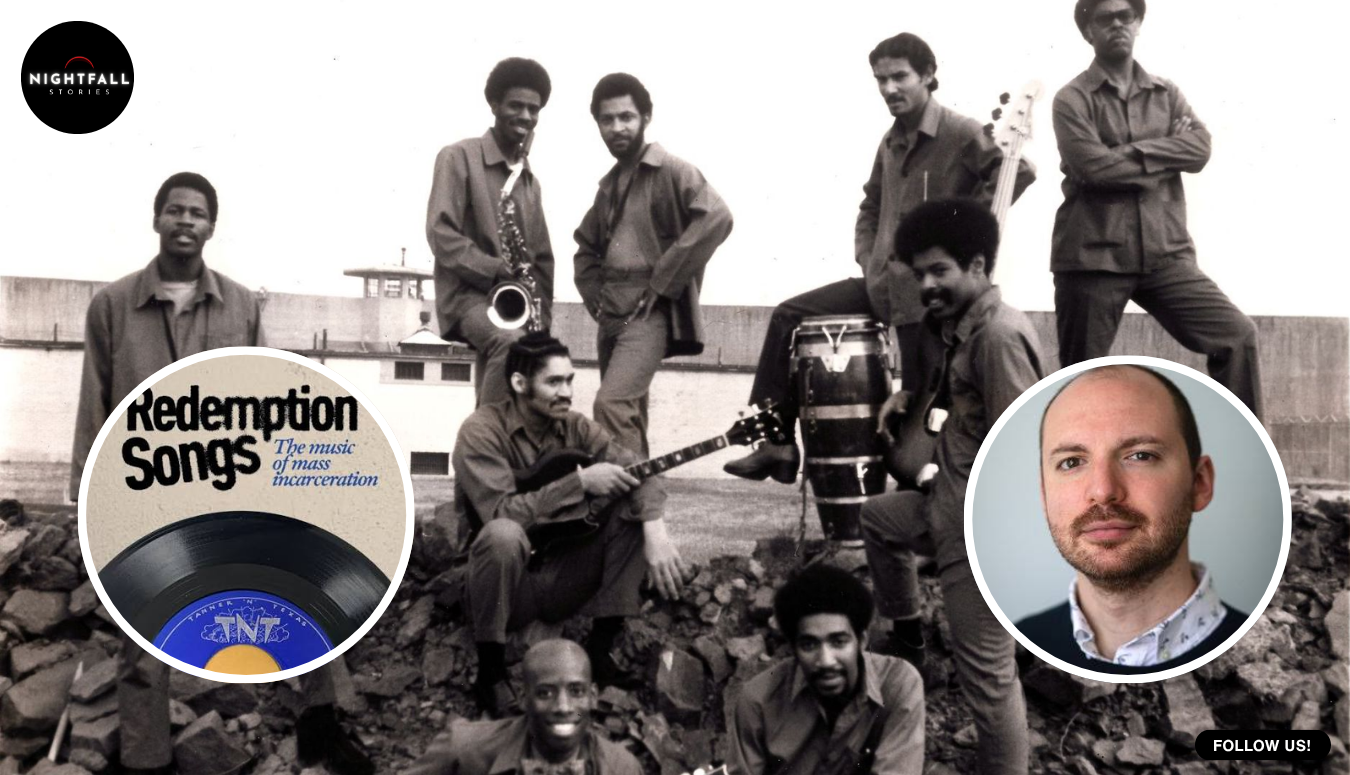
The record turned up on eBay more than ten years ago, listed without much ceremony, and the man who bought it paid somewhere around twenty dollars for it. It was an album of jazz and country, cut in Texas in the early 1970s, and the musicians on it were all prisoners. The thing had originally been sold as a souvenir at an annual prison rodeo, the way you might buy a programme or a pennant.
Maurice Chammah, a staff writer at The Marshall Project, put it on and expected, by his own account, something grim. What he got was the opposite. The playing was good. The mood was far lighter than anyone would guess from the cover. And one of the drummers on it had described his time inside in a way that stuck with Chammah for a decade afterwards: that for a musician, the place had functioned essentially like a conservatory.
That single cheap record is where this starts. What it turned into, ten years later, was an attempt to identify twenty-five songs that between them trace roughly a century of music made by incarcerated people in the United States, a body of work that is deep, strange, geographically scattered and almost entirely unknown to anyone outside a small circle of collectors. The project is called Redemption Songs. It ran as a limited newsletter from The Marshall Project, one song a week, beginning in the spring of this year and running its course over about six months. It has since reached its full twenty-five.
But the newsletter is the easy part to describe. The decade of work underneath it is the interesting bit, because identifying this music is genuinely hard in ways that are worth spelling out.
Consider what Chammah was working with. A record sold at a rodeo in the 1970s had no commercial ambitions, so it has almost no apparatus around it. Liner notes are thin or absent. Performers are sometimes credited by first name, sometimes by a nickname, sometimes by a band name attached to the prison unit they were housed in rather than to themselves. The labels involved were tiny, often one-off operations, and most of them folded long ago, which means no catalogue, no master tapes, no rights holder to call. The institutions that housed these musicians kept records for administrative reasons, not musical ones. And the performers themselves are, in the older cases, long dead, and in many cases were never asked a single question about their music while alive.
So the work is slow and unglamorous: cross-referencing a half-credit on a sleeve against a prison newspaper, chasing a radio broadcast log, finding a collector who owns the only other copy, matching a voice on one record to a voice on another. Along the way, Chammah and The Marshall Project digitised around a hundred songs from Texas prison vinyl of the 1970s and 1980s and put them online, simply so the recordings would exist somewhere a person could hear them.
What emerged from all that has a shape to it, and the shape is the story.
Go back to the 1930s and the oldest thread in the list is a radio show. Hattie Ellis was a blues singer who performed on a Texas programme broadcast out of a prison, carried under the title Thirty Minutes Behind the Walls. Her recording Desert Blues is in the twenty-five. Think about what that broadcast was: a state-run prison system putting its own musicians on the public airwaves, with an audience of ordinary listeners at home, in the 1930s. That arrangement is almost unimaginable now, and it is the earliest evidence in the collection that prison music was once something the institutions themselves were proud to show off.
The high point came later. The 1960s and 1970s are described by people who study this material as a kind of golden age, and the reason is not mysterious. Rehabilitation was the governing idea of the era, which in practice meant programming: bands, instruments, practice rooms, teachers, performances, and in some places recording operations. The rodeo record Chammah bought is a direct product of that. The Wynne Unit Band, whose track It’s Over appears in the list credited to Morgan White and the Wynne Unit Band, played the Texas rodeo in the 1970s because a prison with a band was a prison with something to put on at half time.
The most remarkable thing to come out of that period, and the one general readers are most likely to have heard without knowing it, is The Escorts. Seven singers formed a vocal group inside Rahway in New Jersey in the late 1960s. A record producer named George Kerr happened to attend a prison talent show in 1969, which at the time was open to the public, and heard them.
What Kerr did next is the kind of improvisation that makes this history worth telling properly. He could not bring a studio inside, so he cut the instrumental tracks in outside studios and brought the tapes in. He rehearsed the group in the prison. And when it came to recording the vocals, he needed a room with dead acoustics, so he set his microphones up in the psychiatric ward and used its padded walls for soundproofing. His argument to the officials who had to approve all this was pragmatic rather than idealistic: put the proceeds back into the prison and let these men pay for themselves.
The debut album, All We Need Is Another Chance, came out in the early 1970s and reportedly sold somewhere around 310,000 copies, which is a real commercial record by any measure. The seven men who sang on it were Robert Arrington, Stephen Carter, William Dugger, Lawrence Franklin, Reginald Haynes, Frank Heard and Marion Murphy. Naming them matters, because they are the people most likely to be reduced to a curiosity. The follow-up album’s title referenced how many of them had by then been released. They eventually played a live concert at Symphony Hall in Newark. As more members came out, the group carried on as a working civilian act, and Reginald Haynes was still performing with a later line-up until his death a few years ago.
Their music has had a long afterlife that almost nobody traces back to its origin. It has been sampled by J Dilla, by Jill Scott, by Public Enemy and by Ice Cube, and turned up on television soundtracks. Somebody’s favourite loop was recorded by seven men in a padded room because it was the quietest space available.
The list holds others from that stretch. Power of Attorney were a funk band of the 1970s whose cause was taken up by James Brown. Ike White was a multi-instrumentalist who recorded an album called Changin Times in 1976 inside Tehachapi in California, a record that has since acquired a devoted following among people who collect this kind of thing.
And then the thread goes quiet, which is the other half of the arc. The arts and education programming that produced all of this was dismantled over the following decades as sentencing policy hardened and rehabilitation stopped being the organising principle. You can hear the gap in the list. The music does not vanish, because people do not stop making it, but the institutional machinery that recorded it and sold it at the gate largely does.
Which is what makes the newest entry in the twenty-five worth sitting with. B. Alexis is a woman currently serving a long sentence in a prison in the southern United States. She is identified only that way, by her own choice and on the advice of those working with her, because people who speak publicly from inside can face consequences for it. She started with poetry, written while she was held in solitary confinement. She now records music through FREER Records, an operation set up to make properly produced recordings with incarcerated artists, and her album 9th and Gasoline is described as possibly the first full album recorded by an incarcerated woman in the country. Her track Black Barbie opens the Redemption Songs list.
Paraphrasing what she has said about it, because her own framing is better than any gloss: people still have a life after whatever they have been through, whatever the mistakes, whatever they were dealing with growing up. She uses music to say that she is a person with an identity beyond the worst day of her life.
The twenty-five is wider than the Texas and New Jersey thread suggests, and the breadth is deliberate. There is a Parchman Band recording out of Mississippi and a work song credited to Virgil Asbury and others, which is the oldest kind of music in the collection and the kind most people have encountered only through field recordings. There is Lifers Group, the Rahway rap project of the early 1990s. There is a collaboration between the blues musician Rita Chiarelli and prison bands at Angola in Louisiana. There is Songs in the Key of Free, and work by artists including Mac Dre, G. Dep, Chico DeBarge and Antwan Banks Williams, alongside gospel, a protest ballad and a piece made with the chamber ensemble Decoda. Choosing across that spread, rather than assembling a list of greatest hits from one archive, is what turns a collection of curiosities into an argument about a century.
The practical conditions have changed too, and not only for the worse. A musician recording inside today has no prison rodeo pressing plant and no state-run radio hour, but there are small outside operations willing to do the technical work, bring in equipment where rules allow it, and release the results properly rather than as a souvenir. FREER Records is one of them. That is a narrower pipeline than the 1970s offered, and it depends entirely on the goodwill of people outside, but it means a recording made in a cell block can now reach a listener anywhere without a state agency deciding to put it on sale at a rodeo gate.
That is also, inevitably, where this project runs into the argument it cannot avoid, and it would be dishonest to write around it. Every one of these musicians was convicted of something, and in some cases of something very serious. There are people on the other side of those convictions, families who lost someone, who did not ask for the person responsible to be presented to the world as an artist. Curating this music and putting it in front of a general audience is not a neutral act, and anyone who claims otherwise is not being straight.
Chammah’s stated position is clear and he does not hedge it. The premise of Redemption Songs, as he has put it, is to take at face value the idea that people in prison are artists as much as anyone else can be. His broader argument is that music does something arguments cannot: it closes the empathy gap that makes it easy for a public to support extremely long sentences for people they have never had any reason to imagine as human.
You can accept that and still find it uncomfortable. Both things can be true at once, and the project does not pretend to settle it. What it does is insist on a factual point that is hard to argue with: this music exists, it was made, in many cases it was good, and for decades nobody was keeping track of it. Whatever you conclude about the men and women who made it, a recording that nobody can identify is a recording that is on its way to not existing at all.
That is why the identification work is the real achievement here rather than the newsletter that carried it. Before Chammah started, the Texas rodeo records were a handful of objects circulating among collectors with no context attached. Hattie Ellis was a name on a broadcast nobody had catalogued. The Wynne Unit Band was a band name without a person in front of it. The Escorts were a sampled breakbeat.
Now there is a traced line running from a prison radio programme in the 1930s, through a padded psychiatric ward in New Jersey, through a rodeo half time show in Texas, through a funk record cut in California, to a woman writing in solitary confinement who has since made an album. Twenty-five songs, chosen deliberately to span regions, decades and genres, from jazz to opera to gospel to country to rap to a lullaby. Each one now has a performer attached to it where a performer could be found, a date, a place and a reason for being on the list.
Chammah has said what he set out to do, which was to identify twenty-five songs that meaningfully captured how music tracks against a century of incarceration. The honest measure of whether he managed it is not how many people subscribed. It is that a drummer who once compared a Texas prison to a conservatory, on a record that sold for about twenty dollars to a man who had never heard of him, is now a documented part of American musical history rather than an anonymous voice on a souvenir pressing nobody kept.
That took ten years. It is the sort of work that nobody notices until someone has already done it.