The tongs were the kind you use for a barbecue, extra long, the sort of thing you buy so you do not have to put your hand near the coals. A graduate student was using them to lower glass vials into a creek that was hot enough to scald, in a corner of a national park in northern California where the ground still remembers being a volcano. The water coming off that tributary runs anywhere from about 49 to 64 degrees Celsius, which is somewhere between a very hot bath and a temperature that will take skin off in seconds.
The sampling was not a single afternoon. The team worked that hydrothermal ground over roughly three years, going back to the same steaming features again and again, because what lives in a hot spring shifts with the season and the flow and the chemistry, and one visit tells you almost nothing. The park sits on a volcanic system that has never entirely gone quiet, and the surface of it boils and steams in patches, with mud pots and hot pools and creeks running off them. Heat is only half of what makes those places hostile. Many hot springs are also fiercely acidic, and acid is its own separate barrier to life, which is one reason the temperature question had never been cleanly answered. The stretch of water this amoeba came out of was close to neutral, above pH 6, which means the heat was doing the work on its own without acidity muddying the picture.
She was collecting water, biofilm and a little sediment, and she was not expecting to break anything. She was expecting to find bacteria, because that is what everybody finds in water that hot. What came back to the lab instead was a single-celled creature with a nucleus, an actual complex cell, cheerfully dividing at a temperature the textbooks had spent decades insisting complex cells cannot survive.
The line was 60 degrees Celsius, and it was not an arbitrary line. For as long as anyone had been sampling hot springs, the pattern held with irritating consistency. Below roughly 60, you find eukaryotes, which is the scientific word for everything built the way we are built, with a nucleus and internal compartments and machinery tucked inside membranes. Above 60, the eukaryotes vanish and you get only bacteria and archaea, the simpler lineages that have been in the heat business since the beginning. The boundary was so reliable that it stopped being an observation and quietly became a rule.
The reasoning behind it is straightforward enough that you can feel it in your own body. Heat takes proteins apart. It unfolds them, it makes them stick to each other, and once they are stuck together they stop doing the job they exist to do. Heat also thins out membranes until they leak. A bacterium has one membrane and a relatively small set of things that can go wrong. A complex cell has membranes everywhere, wrapped around the nucleus, folded into energy-producing compartments, threaded through the whole interior, and every one of those surfaces is one more thing that can fail at once. The more elaborate the cell, the more ways the heat can kill it. That was the explanation, and it was a good explanation, and it was holding up an assumption nobody had seriously tested in a while.
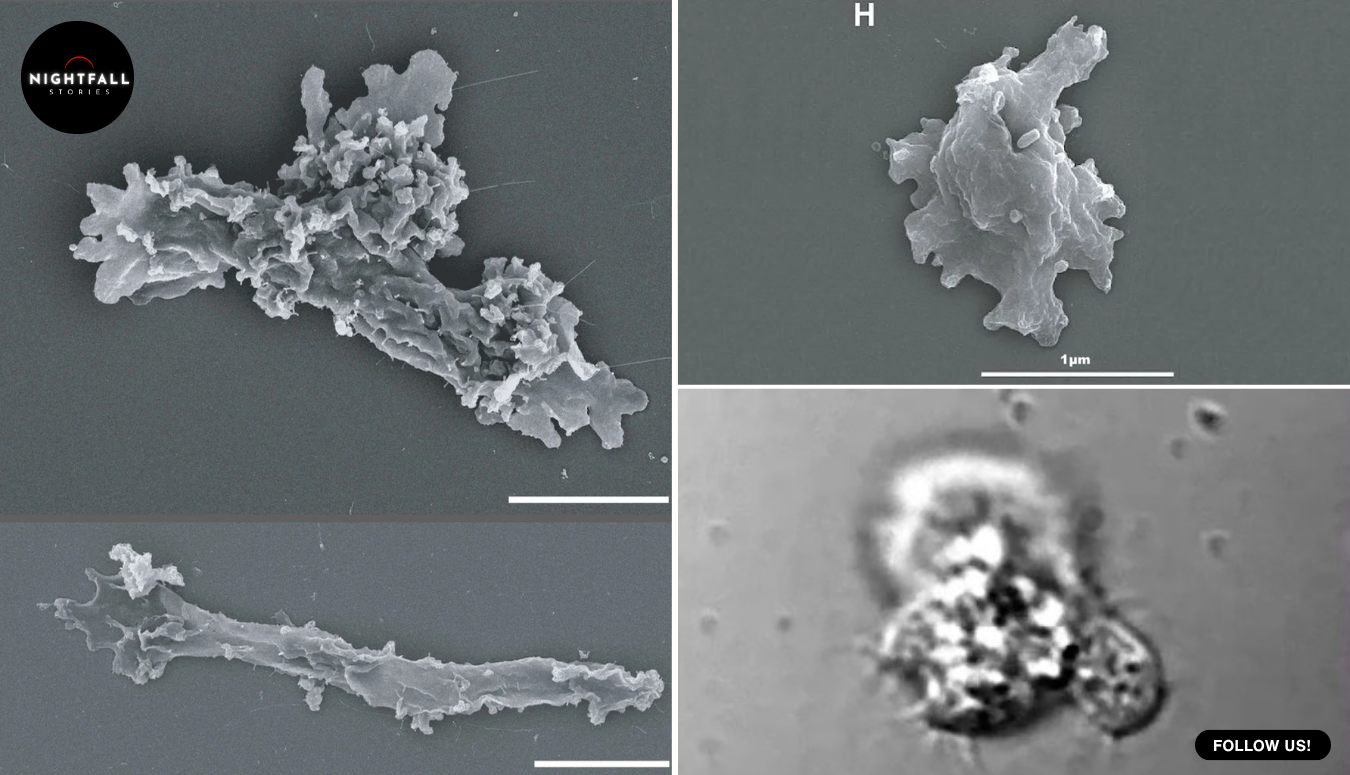
Beryl Rappaport, a doctoral student at Syracuse University, was working through the samples under a microscope, filming what she saw. Amoebae are not dramatic to watch in real time. They ooze. But when she sped the footage up, the motion became obvious, the slow shove of a pseudopod pushing out and pulling back, the whole body changing shape as it went. Something in water that hot was moving like a complex cell because it was one.
The lab, run by microbial ecologist Angela Oliverio, did the obvious thing next and started turning the heat up. They cultured it, warmed it, and watched to see where it would quit. It did not quit at 60. It was active and dividing anywhere from about 42 degrees all the way to 63, with its most enthusiastic replication happening around 57. At 64 it was still moving. Past that it stopped trying to live an ordinary life and did something else instead: it pulled itself in, sealed itself into a protective cyst, and rode out exposure to 70 degrees, roughly 158 Fahrenheit, then came back when the water cooled. Oliverio has said that this was the point at which the team’s minds were fairly well blown.
Three degrees does not sound like a revolution. If your oven is three degrees off you will never notice. But the researchers were not really measuring three degrees. They were measuring whether the wall was a wall. Oliverio’s framing of it was that the size of the increment mattered far less than the fact that the thing could be done at all. A limit that turns out to be crossable by three degrees is a different kind of object from a limit that cannot be crossed. It is no longer a law of chemistry. It is just the highest number anyone had happened to find.
They named it Incendiamoeba cascadensis, which unpacks to something like fire amoeba of the Cascades, after the mountain range the creek runs through. Under the microscope it is long and slightly worm-like, pushing out fingers of itself as it goes. Genetically it sits near the genus Echinamoeba, and its closest known relative is Vermamoeba vermiformis, a common amoeba that lives in perfectly ordinary water and has no interest whatsoever in being boiled. Which means this is not some ancient heat-dwelling lineage that has been down there since the planet was young. It is a fairly normal kind of organism that figured out how to go somewhere normal organisms do not go.
It is also worth being clear about what an amoeba actually does for a living, because it changes what the finding means. Amoebae are grazers. They crawl around engulfing bacteria, which makes them predators in the smallest sense of the word, and in ordinary water they are a significant part of how bacterial populations get kept in check. The standard picture of a hot spring above 60 degrees was a place with no such pressure at all, bacteria and archaea multiplying in peace because nothing up there was equipped to eat them. If a complex cell can live and hunt at 63 degrees, then those communities are not the simple, predator-free systems they were assumed to be, and the food webs in geothermal water may be more layered than anyone had drawn them.
The obvious follow-up question was whether they had found a freak. One creek, one oddity, a curiosity and nothing more. So the team went looking in the enormous piles of genetic data that researchers have been collecting from geothermal sites around the world for years, sequencing everything in a sample without necessarily knowing what any of it is. Matching signatures turned up in material from geothermal ground in Yellowstone and in New Zealand, thousands of miles apart. Whatever this animal is doing, it is not doing it alone in one stream in California. It has been in those databases the whole time, unread.
It is worth saying where the 60 degree figure came from in the first place, because it was never handed down from a single decisive experiment. It accumulated. Researchers sampled hot water for decades, in Yellowstone and Iceland and Japan and Italy, and kept plotting what they found against temperature. Certain fungi turned up in warm ground. A group of red algae, the ones that give some acidic hot springs their green and blue-green colouring, are commonly cited as living up towards the mid-fifties. Above that, the eukaryote signal thinned out and then stopped. Nobody wrote a law. Everybody just kept finding the same ceiling, and after enough decades a consistent absence starts being taught as a fact. The trouble with a limit built that way is that it is only ever as good as the sampling behind it, and the sampling behind it was mostly people who were not specifically hunting complex cells in scalding water.
The how of it is where the story gets genuinely strange, because the answer is partly just electrical charge. When the team sequenced the genome and went through the proteins, they found that this amoeba’s proteins have higher average melting points than the proteins of its cooler-living relatives. That difference comes down to what sits on the outside of each protein. There are fewer water-repelling patches on the surface, the sticky spots where proteins latch on to each other and clump when heat starts unfolding them, and there are more positively charged residues, which push against each other and keep the molecules apart. Proteins that repel one another do not aggregate, and proteins that do not aggregate keep working.
That is not a new trick. It is exactly what heat-loving bacteria and archaea have been doing for a very long time. Two lineages that parted ways somewhere near the root of the tree of life arrived at the same solution independently, which is what biologists mean when they talk about convergent evolution. The uncomfortable implication is that the method was never hidden. The chemistry was sitting there, available, usable by anything with proteins. Complex cells could have been doing this all along, and for all anyone knows they have been, in plenty of places, while everyone looked below 60 degrees because that was where the eukaryotes were supposed to be.
The genome held another surprise. Extremophiles often trim themselves down, shedding genes they no longer need until what is left is lean and specialised. This one did not. It carries 6,919 genes, and more than half of them do not match anything known, which is a polite way of saying nobody yet knows what most of this organism is doing. When the researchers pushed it to 61 degrees and watched which genes it switched on, it responded the way a cell under real pressure responds. Heat shock proteins went up, the ones whose whole job is grabbing unfolding proteins and refolding them before they clump. DNA repair went up. Membrane trafficking went up. Meanwhile it turned down energy production and the business of building new material, the way you would stop redecorating a house that was on fire. It is not comfortable at 61 degrees. It is coping, deliberately and expensively, and it has the equipment to cope.
Outside researchers have been careful and also clearly interested. Luke McKay, who studies life in extreme environments, has said that the gap between 60 and 63 may sound small but represents a fairly large shift in how the upper boundary for complex life is understood. That is about as excited as a scientist gets about three degrees in print.
The practical end of this is easy to see coming. A protein that holds its shape at temperatures that would wreck an ordinary one is worth real money. Industrial processes run hot, and enzymes that survive the heat cut cost and waste. Vaccines and medicines that do not need constant refrigeration reach places that cold chains do not. Researchers have raised the possibility of crops better able to handle heat, though that is a long way off and worth treating as a direction rather than a promise. More than half this creature’s genes are unidentified, and some of them are presumably instructions for doing difficult things under conditions that break most molecules.
The bigger consequence is about where anyone bothers to look at all. If you are searching for life beyond Earth, or for life in the harder corners of this planet, the temperature ceiling you carry in your head decides which places you cross off before you start. Geothermal vents, volcanic ground, the hot fringes of hydrothermal systems, anywhere sitting above the line got written off as bacteria-only territory. That was a reasonable call based on everything anyone had found. It was also, in part, a search pattern. You do not find complex cells in water at 63 degrees if you have already concluded that complex cells cannot live in water at 63 degrees and gone to sample somewhere else.
Oliverio has said she suspects other high-temperature eukaryotes are out there waiting to be found, and the lab is already hunting for its amoeba in other geothermal systems to work out how widely it has spread. The paper itself is a sprawling collaboration, with Rappaport as first author and Oliverio as the senior one, and a long list of collaborators across genome centres and university labs in the United States and Europe, which is what it takes now to describe one very small organism properly. The work first went up as a preprint late last year, so specialists have had a while to chew on it, and the peer-reviewed version has just landed in the journal Cell.
There is something worth sitting with in how ordinary the discovery was. No submersible, no drilling rig, no orbiting instrument. A creek in a national park that people walk past on marked trails, a set of long tongs, some glass vials, and a student patient enough to speed up a video of an amoeba and actually look at it. The organism had presumably been there the entire time, doing something the textbooks said was impossible, waiting for somebody to sample three degrees higher than anyone thought was worth the trouble.
That is the part that lingers. The rule was never really about the heat. It was about the last place anyone had checked.