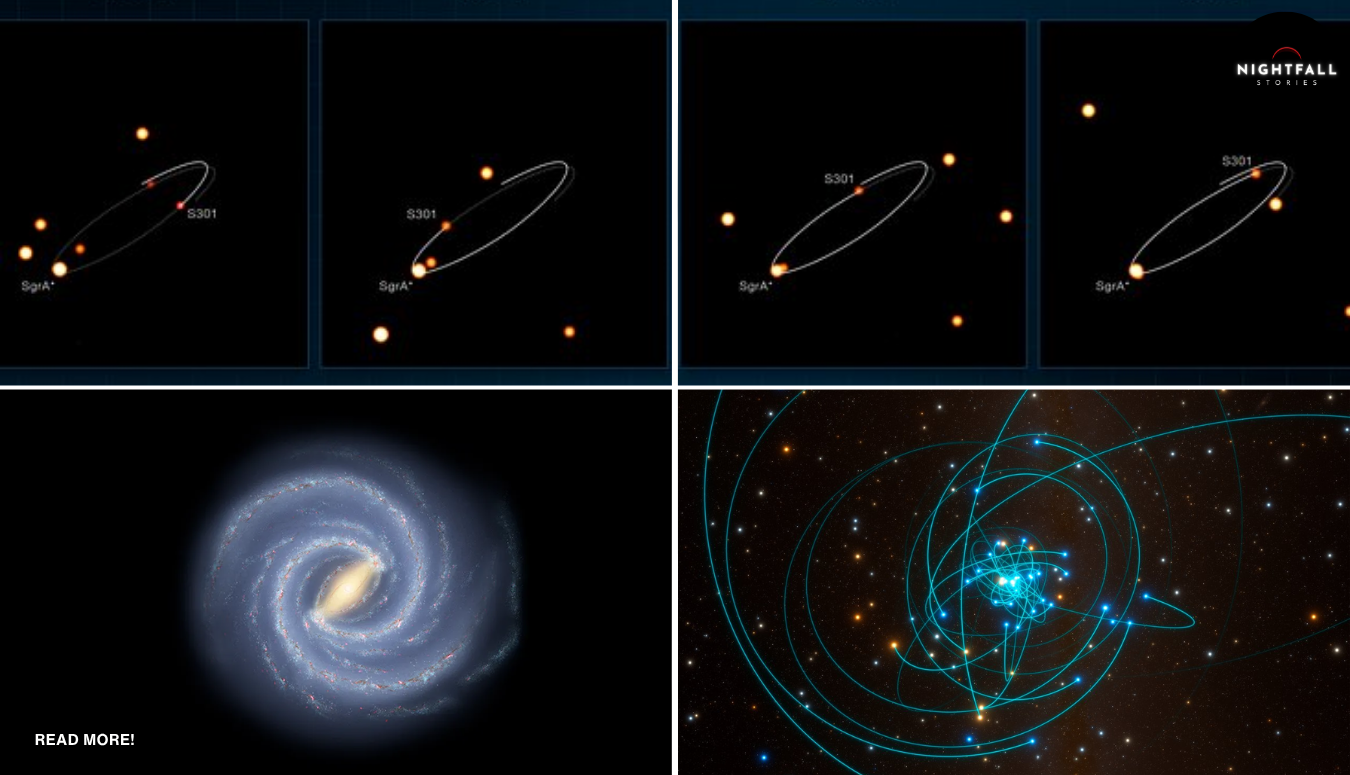
There is a star at the centre of our galaxy that goes around the black hole there once every eight and a half years or so, and at the closest point in that loop it is moving at about 25,000 kilometres per second. That is more than eight percent of the speed of light. Nothing else known in the Milky Way travels that fast.
The star is called S301, and the paper announcing its orbit was published last month in Nature by a team led by Felix Mang at the Max Planck Institute for Extraterrestrial Physics in Germany. Mang is at the beginning of his career. The observing programme he is publishing from is older than he is.
That is the part of this worth slowing down for. Measuring a star’s orbit sounds like the sort of thing you do in an afternoon with a telescope and some patience. Around Sagittarius A*, the four million solar mass black hole at the centre of our galaxy, it is closer to a generational project, and the reason S301 matters is that it is the first object in that region that fits inside one person’s working life.
Start with the problem of seeing anything there at all. The galactic centre is about 26,000 light years away and sits behind enormous quantities of dust, which means visible light from it barely reaches us. Even in infrared, which does get through, you are looking at a region so crowded with stars that in an ordinary telescope image they smear into an unresolved glow. Picking out one individual star in that crush, and then tracking its position precisely enough to trace a curve, is the actual technical achievement here. The orbit is the easy part once you can do that.
The way they do it is interferometry. At the European Southern Observatory’s Paranal site, high in the Atacama Desert in Chile, there are four telescopes each with a mirror 8.2 metres across. An instrument called GRAVITY, and now its upgraded version GRAVITY+, takes the light from all four and combines it so that the array behaves, for the purpose of resolving fine detail, something like a single telescope more than a hundred metres wide. Getting that to work means holding the light paths from four separate buildings stable to within a fraction of the wavelength of the light you are measuring, while the ground shifts and the air moves and the Earth turns. It is one of the more absurd engineering propositions in modern astronomy and it has been running for about a decade.
Behind that sits thirty years of doggedness. Teams at Max Planck have been photographing the same small patch of sky since the 1990s, watching stars crawl across it, and it was that work, combined with a parallel effort in the United States, that established that there is a supermassive black hole at our galaxy’s centre rather than merely something heavy and mysterious. Reinhard Genzel shared a Nobel Prize for it, and he is a co-author on the S301 paper, as are Stefan Gillessen and Frank Eisenhauer, who is the instrument’s principal investigator. Juan Osorno at the Paris observatory is among the more than eighty co-authors. When Mang’s name goes first on this, it goes first on top of a structure a lot of people spent careers building.
The star that made the reputation of that programme is S2, which takes about sixteen years to go around. Sixteen years is already remarkable for a stellar orbit, and S2 did enormous work: it confirmed the black hole’s mass, and its close pass produced measurable effects predicted by general relativity, including the way its orbit fails to close neatly on itself and instead slowly rotates.
S301 orbits roughly ten times closer in than S2. At its nearest approach it comes within about twelve times the distance from the Earth to the Sun, which puts it just outside where Saturn sits in our own system. Think about that geometry for a moment. A star, an actual star, swinging through a gap the size of the outer solar system around an object four million times the mass of the Sun, and getting flung back out again. Its orbit is extraordinarily stretched, with an eccentricity above 0.98, so it spends most of the eight and a half years far out and moving relatively slowly, then comes tearing through the close pass in a matter of months.
And it is not a new star. This is worth being precise about, because a lot of the coverage has made it sound like something that turned up this year. S301 was first picked out in the spring of 2023. Its most recent close pass had happened just before that, in early 2023, which means the team was not watching for it when the most interesting part of its orbit occurred. What they did afterwards was go back through their own archive and find it in earlier data, tracing its path back to 2017, when they began concentrating the instrument on that inner region. The orbit published last month is the product of about nine years of accumulated positions, three of them spent turning a suspicious dot into a solved path.
It is also worth knowing how small the movements being measured are. The precision GRAVITY works at is described in microarcseconds, and an arcsecond is already only one thirty six hundredth of a degree. Split that into a million parts and you have the scale of the position shifts that this whole result rests on. At that level, everything is a potential error: a faint star sitting behind a brighter one, a blob of gas that looks pointlike, an instrumental artefact that repeats. Part of what the three years bought was confidence that the dot was a single star and that it was the same star each time, rather than several different things being stitched into one imaginary orbit.
Three years between first sighting and publication is not slowness. It is what the measurement requires. A single position tells you nothing. A short arc can be fitted by an enormous number of different orbits, most of them wrong. You need enough curve, measured precisely enough, before the fit collapses onto one answer, and in a field where stars occasionally get announced and then quietly revised away, the incentive to wait is strong.
Now to the reason any of this is a story rather than a statistic.
There is a second reason to want something orbiting that close, beyond the spin. The closer a star passes, the more strongly it tests whether the object at the centre is really what the theory says. General relativity makes very specific predictions about how a path bends and how light from that path is stretched in the steep part of a gravitational well, and those predictions get sharper and harder to fake the further in you go. S2 already pushed general relativity into territory it had never been tested in and it held. S301 goes ten times deeper. If something about our description of gravity in extreme conditions is wrong, this is the sort of place the discrepancy would show up first.
Black holes have very few properties. Mass, spin, and electric charge, which in practice is zero. The mass of Sagittarius A* has been pinned down. The spin has not, and it is not a minor detail. How fast a supermassive black hole rotates, and which way its rotation axis points, carries information about how it grew, whether it built itself up by swallowing gas smoothly or by merging with other black holes, and how it has interacted with the galaxy around it over billions of years. It is one of the two numbers that define the thing, and we do not have it.
There is a way to get at it, and it is beautifully indirect. A rotating mass does not just curve the space around it, it drags it, winding spacetime around with it like syrup around a turning spoon. This is called the Lense Thirring effect, predicted not long after general relativity itself, and it has been measured around the Earth with satellites, where the effect is minuscule. Around a spinning supermassive black hole, close in, it is not minuscule. Anything orbiting through that dragged region has its orbital plane slowly twisted. The whole ellipse tips.
So the way to weigh a black hole’s spin is to find something orbiting close enough and fast enough that the twisting becomes visible, and then watch it long enough to see the ellipse move. That is what S301 is. It is not the discovery, it is the instrument. Its orbit is tight enough and its passes frequent enough that the dragging should eventually show up in the shape of its path.
Here is where the story has to stay honest, because it is very easy to write this as done. It is not done. The spin has not been measured. What the team has established is that the measurement is now possible, with a specific object, on a knowable timescale. Getting from here to an actual number requires continued precise position measurements through more of S301’s orbit, and it will likely also require spectroscopic measurements of the star’s motion along our line of sight, which may need the next generation of telescope, the Extremely Large Telescope now being built not far from Paranal. The team’s own framing is that the effect could become measurable within roughly the next decade.
Ten years, then, and a lot of it spent waiting. S301’s next close approach to the black hole comes in 2031. The years before that are the slow part of the orbit, the long outward arc where the star is far away and the signal builds up only gradually. You cannot hurry it and you cannot go and look at it more often than it comes round.
That is the shape of Felix Mang’s situation, and it is a strange and rather wonderful one. He has published a first result that closes a real question, which is what that fast dot in the crowd was actually doing. The bigger number, the one that would go in textbooks, arrives when he is somewhere in the middle of his career, if it arrives at all, and it will arrive because a lot of people keep pointing the same instruments at the same patch of sky for another decade. He is now part of the thing he joined.
There is a version of modern science reporting that cannot handle this. Every result has to be a breakthrough, every breakthrough has to be final, and a team saying we have found what we need and now we have to wait reads as an anticlimax. But that patience is the actual method. The reason the galactic centre programme has produced results other people trust is precisely that it has spent thirty years refusing to announce things early, and has published limits and uncertainties alongside its numbers rather than instead of them.
It is also worth noting what the published images of S301 are and are not. Almost everything circulating with this story is artist’s impression or simulation, because nobody has a photograph of a star skimming a black hole and nobody is going to. What does exist, and what is genuinely the subject here, is the hardware. Four large telescopes on a mountain ridge in one of the driest places on Earth, an instrument in a laboratory that combines their light, and thirty years of people maintaining both. The star is 26,000 light years away. The achievement is in Chile.
So the result stands like this. There is a star at the centre of our galaxy moving at more than eight percent of the speed of light, closer to a supermassive black hole than anything previously tracked, and after nine years of data its path is now known. That path runs through a region where a spinning black hole should be visibly dragging space around with it. The team that found it has said clearly that it has not yet measured the spin, and has said just as clearly what it will take and roughly how long.
Which means the next real news in this story has a date attached to it, and the date is 2031, when a star that has never once been late comes back around.