The price of the metal went from about 8 euros a kilogram to about 23. In dollars, that is roughly $9.20 to roughly $26.50, for the single raw material a bell cannot be made without. Labour is up about 30 percent since 2020. And the customers who have bought bells for four centuries, which is to say churches being built, are not being built in anything like the numbers they were. That is the arithmetic sitting on the desk of a business in Innsbruck, Austria, that has been casting bells since 1599.
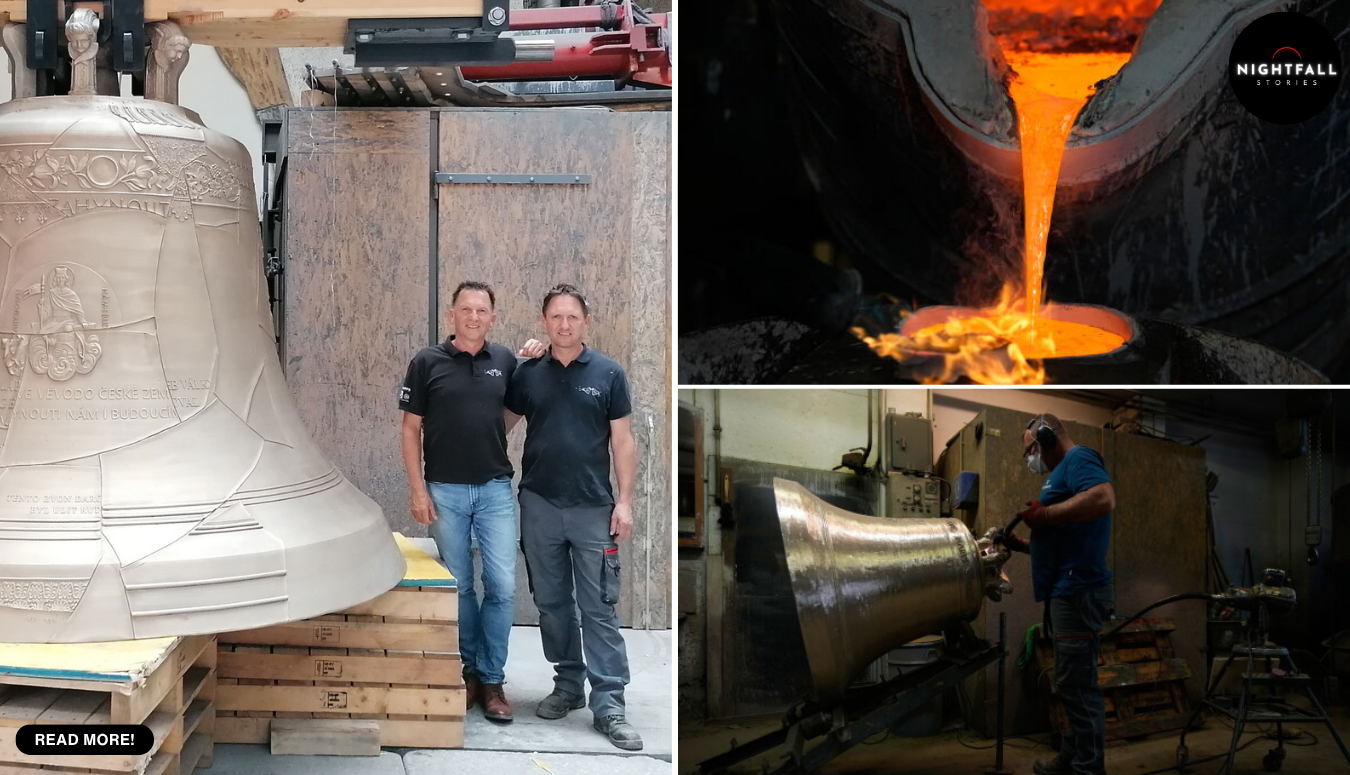
The business is Grassmayr, and it is run by two brothers, Johannes and Peter. Johannes is the fourteenth generation of his family to do this. He has said that certain things there are just as they were 400 years ago, and also that they have innovated a great deal, and both halves of that are true at once in a way that turns out to be the entire story. What the brothers did with a 3D printer and a set of lasers is not a gadget story. It is what a family trade does when two different shocks arrive in the same decade and neither of them can be argued with.
Start with the thing that has not changed, because otherwise none of the rest makes sense.
A bell is a musical instrument. Not a metaphorically musical one, an actual one, and a peculiarly unforgiving one, because it is a single piece of cast metal that has to produce several pitches at once in a fixed relationship. Strike a good bell and you do not hear one note. You hear a hum well below the note you think you are hearing, the prime, a tierce a third above it, a fifth, a nominal an octave up, and a scatter of higher partials on top. Those intervals are what makes a bell sound like a bell rather than like a bucket. Get them wrong relative to each other and the bell is not flat, it is ugly, in a way that no amount of tuning the whole thing up or down will fix.
And all of that is decided by shape. The wall of a bell is not an even thickness. It is a profile, thick at the rim and thinning as it rises, with the curve of it determining where each of those partials lands. That profile is the intellectual property of a foundry in the oldest sense, worked out over generations, and it is why bell founding survived as a family business at all: the knowledge of what curve gives what sound was not written down anywhere useful, it was held in a workshop and handed on.
So for a large bell, designing and forming the mould can take up to six months before anything is poured. The full production cycle for a bell runs three to four months. The alloy is bell bronze, about 80 percent copper and 20 percent tin, a proportion that is high in tin by the standards of most bronze, because tin is what makes the metal ring rather than thud, and also what makes it brittle enough to crack if you get anything else wrong. A large bell goes into its mould under something in the order of 125 metric tons of pressure. There is no second attempt at a pour. You either have a bell or you have a very expensive quantity of scrap that has to be melted down and done again.
It is worth knowing how a mould for a bell is actually built, because it explains why six months is not slow. The traditional method does not carve a bell-shaped hole. It builds the bell twice. First an inner core is formed, the shape of the inside of the bell. Over that, the founder builds a false bell, a full thickness replica in clay or loam, standing where the real metal will eventually be. Around the false bell an outer case is built, taking its inner surface from the replica’s outer surface. Then the false bell in the middle is broken out and removed, and what is left is a cavity between core and case that is precisely the shape and thickness of the bell that does not exist yet. Every inscription, every band of decoration, has to be worked onto the false bell in reverse thinking, because it will print into the case and appear on the finished metal. All of it has to dry evenly, because moisture left in a mould meets molten bronze and turns instantly into steam, and steam in a mould is how a pour goes wrong catastrophically.
Now the part that explains why the technology mattered.
Bells are tuned by taking metal away. Only away. Once the thing has cooled, the tuner measures the partials, works out which one is sharp, and machines metal off the inside of the wall at the precise height where that partial lives, which lowers it. You can flatten a note. You cannot sharpen one, because you cannot put bronze back. Every single cut is irreversible, on an object that took months and cannot be replaced, and each cut changes the others a little, so the order of operations is itself a skill.
That subtractive reality is why finishing work, the cleaning and polishing and dressing of a cast bell, was historically such an enormous share of the job. Founding literature and the foundry’s own account put it at about 30 percent of the whole production cycle, and with modern tooling it now takes roughly a tenth of what it did, which puts it at something in the neighbourhood of 3 percent. One report describes the polishing time as falling by about 90 percent. Whichever way you frame it, a third of the work became a rounding error.
So what did they actually bring in. Four things, and none of them touch the metal’s chemistry or the profile’s geometry. Digital scanning, which means an existing bell, including one that is 400 years old and up a tower, can be measured completely rather than approximately. Computer simulation, which means a proposed profile can be tested for what it will sound like before a mould is built, instead of after a pour. 3D printing, used for the pattern and mould work rather than for the bell, so the physical form that the sand is packed against can be produced directly from the design. And laser tools for the cleaning and cutting work where a man with an abrasive wheel used to spend weeks.
Notice the line they drew. Everything they modernised is upstream or downstream of the casting. The prediction of the sound, yes. The removal of metal, yes. The alloy, the pour, the profile philosophy, no. The sound itself is still made the way it was made, and the parts of the process that determine the sound are the parts they left alone. That is the hard choice in this story and it is a genuinely difficult one to hold, because the commercial pressure on a small manufacturer is always to modernise the expensive bit, and the expensive bit is exactly the bit that is the product.
There is a practical benefit here that is easy to miss, and it has nothing to do with speed. Simulation and scanning reduce the number of times you have to find out the hard way. In a trade where the test of the product is a several ton casting that cannot be undone and cannot be revised, every question you can answer on a screen instead of in metal is a question that does not cost you months and a furnace load of very expensive bronze. When the raw material triples in price, the value of not making a mistake goes up by exactly the same multiple. The technology and the economics are not two separate parts of this story. Each is the reason for the other.
Then there is the money, and the money is the real reason any of this was necessary.
Copper is a commodity, and it has spent the past few years being wanted by industries that did not previously want much of it. Electrification is hungry for copper. Grids, motors, batteries, data centres. Tin has its own tight supply story. A foundry buying bronze by the ton is competing for metal with sectors vastly larger than it, and it has no leverage whatsoever. Going from roughly $9.20 to roughly $26.50 a kilogram is not a line item moving. On a bell weighing several tons, it is the difference between a price a parish can raise and a price it cannot.
And the price cannot be fixed in advance, which for a business that quotes a job and then spends up to six months on the mould is close to unmanageable. Johannes Grassmayr has put it about as bluntly as a manufacturer can: he cannot even say what a bell will cost in a year. Sit with that for a moment. You are being asked to quote today for an object you will deliver next year, made from a material whose price you cannot predict, for a customer who is usually a congregation raising money in small amounts. Either you quote high and lose work you would have enjoyed, or you quote fairly and absorb whatever the metal market decides to do to you in the meantime.
Layer the second shock on top. Fewer churches are being built across Europe, so fewer new bells are needed, and the demand curve for the foundry’s original product has been bending down for decades without any prospect of bending back. There is no marketing answer to that. Nobody is going to build a church because a foundry in Innsbruck ran a good campaign.
Which is how a business that made bells became, to a real extent, a business that saves them.
The bells already hanging in Europe are a vast installed base, a great many of them very old, and a cracked or badly worn bell is not automatically scrap. It can be repaired. Grassmayr has taken on more than 300 defective bells from twelve European countries, which is an unusual and specialised line of work: you are dealing with objects that are often centuries old, sometimes carrying historical protection, cast by a foundry that no longer exists, to a profile nobody wrote down. This is where the digital scanning earns its place twice over, because to repair or replace a historic bell in a way that keeps the character of a peal, you first have to understand exactly what the old bell was doing acoustically, and you cannot do that by holding a tape measure up a bell tower.
It is also a good fit with the foundry’s reach, which is genuinely large for a family firm. Grassmayr bells hang in more than 100 countries. Among the ones people point at: eight bells for Romania’s national cathedral, the largest of them upwards of 25 metric tons, a 15 ton bell for a monastery on Mount Tabor, a peace bell in the Tyrol that is the largest swinging bell in the Alpine countries, and a tubular bell for a hospital in Denmark that is rung every time a baby is born there. A company that can do those can credibly be asked to fix anything hanging anywhere.
Here is where it would be easy to overclaim, so it is worth being straight about what did and did not happen. Nothing was saved in a dramatic sense. There was no last-minute reprieve. A very old family business looked at a material cost that nearly tripled and a shrinking market for its founding product, and responded by squeezing a third of the labour out of its process and shifting the centre of its work from making new bells to keeping old ones alive. That is not a triumph. It is competence, applied steadily, over a period long enough that the business was still standing at the end of it.
And competence of that specific kind is rarer than triumph. Most trades that meet two structural shocks at once do not adapt. They hold their process sacred because the process is their identity, and then they close, and everybody writes fondly about them afterwards. The other failure mode is the opposite one: modernise everything, including the bit that was the actual product, and end up making something cheaper that nobody particularly wants. What the Grassmayr brothers worked out, and it required knowing their own craft well enough to identify which part of it was load-bearing, is exactly where the line runs. The profile and the pour are the trade. Everything else is just how you get there, and how you get there is allowed to change.
The bell that comes out of that workshop this year will be tuned the same way a bell was tuned there in 1599, by someone taking metal off the inside of the wall and knowing they cannot put it back. It will just have got to that point rather faster, and the foundry doing it will still be open.