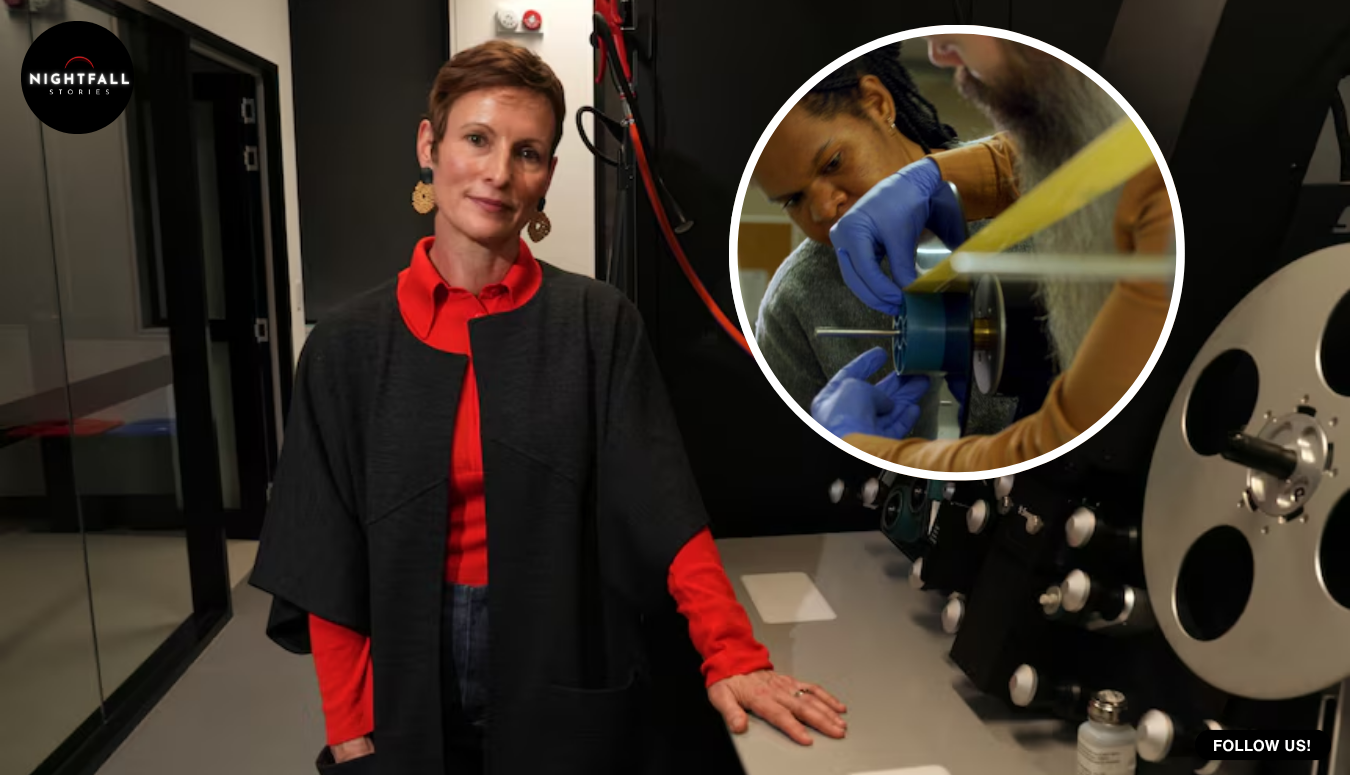
In a building in Goroka, in the Eastern Highlands of Papua New Guinea, there are more than 1,300 film reels and video tapes that hold most of what a country has on film of itself. Weddings and funerals. Independence celebrations. Men talking to a camera about a copper mine. Village arguments about money. Children in classrooms that no longer exist. The films are there, the shelves are labelled, nobody has stolen them, and the collection has been slowly turning into something unwatchable anyway, because the air in that part of the world is warm and wet and getting warmer, and film does not care whether you meant well.
The archivist who has been in the room with that problem is Zoe Baru, film archivist at Papua New Guinea’s National Film Institute. She has said plainly what the physical situation is: with a changing climate, the place is getting hotter. That is not an abstraction in an archive. Heat and humidity are the two things that turn a film collection into a smell.
If you have never handled old film, the way it dies is worth understanding, because it explains why this story needed an actual plan rather than good intentions. Most of the twentieth century’s non-professional and documentary film stock is cellulose acetate, and acetate reacts with moisture. Water in the air breaks the plastic down, and one of the things the reaction produces is acetic acid, which is what gives vinegar its smell. Archivists call it vinegar syndrome for exactly that reason. Once it starts, it speeds itself up, because the acid it releases attacks the film around it. The reel shrinks. It buckles. It warps into a shape that no longer matches the spacing of the sprocket holes, so a projector or a scanner cannot pull it through evenly. It goes sticky, then brittle, then it fuses into a solid disc of plastic with a picture locked somewhere inside it that no machine can now read.
Magnetic tape fails differently and just as completely. The picture on a tape is not printed into the plastic, it is a coating of magnetic particles stuck onto a base with a binder, and in humid heat the binder absorbs water and loses its grip. The coating starts shedding. Play the tape and it leaves powder on the heads, and each pass takes a little more of the image off. Tape also has a habit of printing itself through, so a bright image bleeds faintly onto the layer wound against it. Neither problem announces itself. A tape can look perfect in its case on the day it becomes unplayable.
What makes all of this hard to fight in Goroka is not carelessness. It is physics and electricity. The standard answer to acetate decay is cold, dry, stable storage, and cold and dry are expensive everywhere. A climate-controlled vault is a machine that has to run continuously for decades, in a highland town, through every power interruption, in humidity that wants back in every time a door opens. Fail for a season and you have not lost a season, you have accelerated a chemical reaction that does not run backwards. There is no restoring a reel that has gone. You can only get to it before it does.
So the National Film Institute had a collection that was legally intact, properly catalogued, and on a timer. What it did not have was the equipment to copy the films to digital, or staff trained on the specific machines that handle degraded film, because those machines cost a great deal and the training to use them is not something you pick up from a manual.
The partnership that changed this ran for four years, and the shape of it is the reason this is worth writing about. The Institute worked with the National Film and Sound Archive of Australia, supported by the Australian government’s International Cultural Diplomacy and Arts Fund. The figure reported for the grant is about $200,000, given in Australian dollars, which is somewhere around $130,000 at recent rates. That is a real amount of money and a very small one next to 1,300 items. Jacqui Uhlmann, the Australian archive’s deputy chief executive, has been the counterpart on the other side of it.
It would be easy, and wrong, to write this as a rescue. The films in Goroka were not found by outsiders. Many of them were made by the National Film Institute itself, which has been a working production house as well as a repository, and the collection is the Institute’s own output and its own acquisition. Baru is described in the reporting from Papua New Guinea as the project lead, not as a beneficiary of one. Her own framing of the collaboration is that it gave the Institute the practical support it needed to preserve and digitise its films, which is a careful sentence and an accurate one. The expertise that was missing was technical and specific. The ownership never moved.
That distinction matters because of the thing that usually happens next in stories like this, and did not happen here.
Before any of that, though, somebody had to choose. This is the part of every archive project that nobody puts in the press release, and it is the genuinely difficult part. You have 1,300 items and a budget that will handle a fraction of them. Selected films were flown to Australia for assessment, cleaning and digitisation. Selected. Which means that in a room in Goroka, a list was made, and everything not on the list stayed on the shelf in the heat for longer.
There is no good way to make that list. Condition is one axis: the reels furthest gone are the ones that will be lost first, but they are also the ones that take the most work per minute of picture recovered, so saving the worst can mean saving the fewest. Uniqueness is another: if only one copy exists anywhere, it outranks something the Australian archive already holds a duplicate of. Then there is what the material actually is, which is where it stops being a technical decision. A feature film with a known director and an international festival history is easy to argue for. A reel of a village meeting in a language spoken by a few thousand people, shot by a crew who are no longer alive, with no title and a handwritten can label, is harder to argue for and may well be the more irreplaceable thing. Nobody outside the country is going to make that call correctly, which is the strongest practical argument for the archivist making it being local.
It helps to know what the National Film Institute actually is, because the name suggests a vault and it was never only that. It has been a production house. It made films, in country, for people in country, at a time when almost nothing on a screen in Papua New Guinea had been made by anybody local. That is why the collection is what it is: not a set of things collected from elsewhere but a record produced from inside, which is a rarer kind of archive than it sounds and a much harder one to replace. When people talk about a national collection they usually mean a national purchase. This one is closer to a national output.
Institute staff went to Canberra for training, in conservation, preservation, digitisation, archiving and digital access. Even now, the reporting from Papua New Guinea is candid that the training is unfinished, because handling 16mm and 35mm film specifically requires machines that are expensive and instruction that is deep, and that part of the job has not been fully transferred yet. That honesty is more useful than a declaration of success would be.
And then there is the piece of engineering that separates this from a donation.
Here is what normally happens. A collection in a hot country is at risk. A wealthier institution steps in, the films are shipped out, they are cleaned and scanned to a high standard, and they are preserved. Genuinely preserved. The files then live on servers in the wealthier country, because that is where the servers and the bandwidth and the staff are, and the country the films came from ends up with a promise, an email address and a request form. Its own history becomes something it has to ask permission to see. Nobody intends this. It is simply what happens when you solve the preservation problem and leave the access problem alone.
So the Australian archive designed and built something specifically to stop it: a studio called Remote Onsite Digital Access, shortened to RODA, purpose-built and shipped to Goroka. The point of it is unglamorous and it is the whole point. It lets the National Film Institute reach and share its own digitised films from its own headquarters, in Papua New Guinea, without going through anyone. Not a viewing copy on request. Not a licence. The material, in the building, under the control of the institution that made most of it.
That is a design decision about power, dressed up as a hardware decision, and it is the part of the story most coverage moves past quickly.
It is worth saying too that digitising a film is not the same as finishing with it, and any archivist will tell you so before you ask. A scan is a file, and files need looking after in their own way. They have to be stored in more than one place, because a single drive is a single point of failure. They have to be checked, because data quietly corrupts. They have to be moved forward every so often onto whatever storage and whatever format the next decade uses, because a video file written for the machines of twenty years ago is already awkward to open today. Preservation is not an event, it is a standing commitment, and the institution holding the files has to be resourced to keep making it. Which is one more reason the files sitting in Goroka rather than somewhere else is the substantive point and not a courtesy.
Which brings it to one film. In 1982, the National Film Institute produced Tukana: Husat i Asua, directed by Chris Owen with Albert Toro, who wrote it, co-directed it and played the lead. It came out of a consultation project with communities in what was then the North Solomons, and it dramatised what people there were actually worried about, which was money and change and what the two of them together do to obligation.
The story is a young man who drops out of university and goes home to his village in Bougainville. His family wants him to marry a schoolteacher, a steady and sensible match. He goes to Panguna instead and takes work as a driver for the copper operation, and he takes up with a woman who has her own ambitions, an education she intends to finish and a clear idea of the life she wants. Nobody in it is a fool and nobody in it is a villain, and the pressure on him comes from both directions at once: the village wants what the village has always wanted, and the mine pays in cash. It does not end happily. It was the first feature from Papua New Guinea to travel internationally, and it played at festivals abroad in the years after.
Consider what that film is, sitting on a shelf in Goroka in the 2020s. It is a portrait of the Bougainville copper economy made while that economy was running, before the conflict that came later, by the people living inside it. There is no substitute footage. You cannot reshoot 1982.
It was digitally restored by the Australian archive, working with Spectrum Films, and then it was given back. Formally gifted to the National Film Institute to mark fifty years of Papua New Guinean independence, and screened in Port Moresby at the end of last year with a simultaneous screening in Canberra. A film the Institute made, returned to the Institute, watchable again in the country it is about, in the year that country turned fifty.
That is a real ending and it is worth being precise about why it is a good one. Not because outsiders were generous, though money was spent and skill was shared. It is a good ending because of the direction everything ended up facing. The films stayed the Institute’s. The choosing was done by the archivist who knows the collection. The training went to Goroka. The studio went to Goroka. The restored feature went to Goroka. What was imported was capability, and capability is the only kind of help that does not need renewing.
The rest of the collection is still on the shelves, and the air is still warm, and most of those 1,300 items have not been through a scanner yet. Anyone who tells you that problem is solved has not counted. But the difference between a collection waiting for someone to come and save it and a collection whose own archivist now has the machine, the training and the authority to work through it is not a small difference. It is the difference between a country being the subject of its films and being the keeper of them.
Zoe Baru is still in that room. What changed is what is in the room with her.