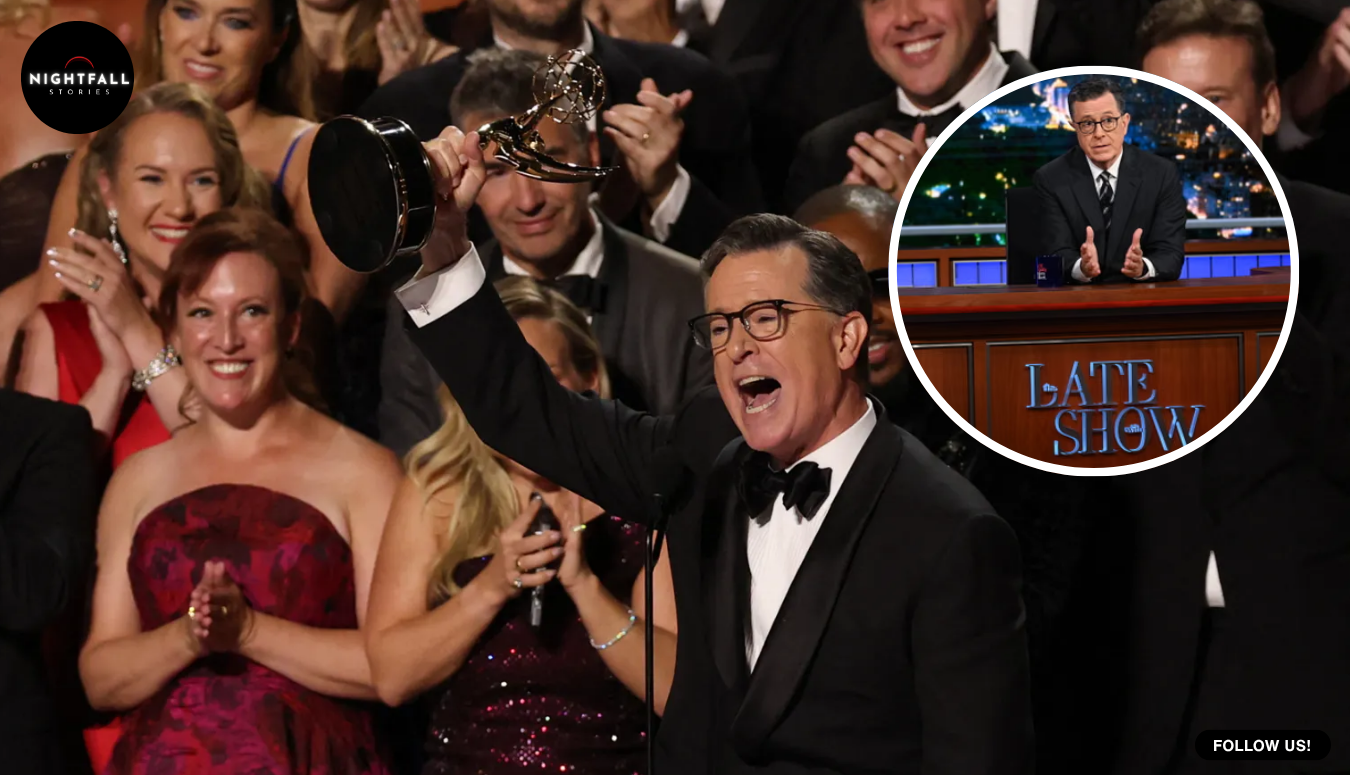
The show had been off the air for four months. The set was gone. The staff had scattered. And on a Monday night in September, the Television Academy handed The Late Show with Stephen Colbert the award for Outstanding Variety Series anyway, which meant Colbert had to walk up to a microphone and say something about a job that no longer existed.
What he said, more or less, was this: if you laughed at anything tonight, my old writers wrote it. They are all available. Hire them.
That was the speech. Not a political broadside, not a swipe at the network, not a farewell aria. A pitch. He stood on the stage at the 78th Primetime Emmy Awards with a crowd of his former staffers around him and used the most valuable ninety seconds of airtime he was ever going to get again to try to find them work.
If you want to understand why that landed the way it did in the room, you have to go back further than most of the coverage did. Because this story did not start in September, and it did not start in May either.
It started in the summer of 2025. On the seventeenth of July that year, CBS announced that The Late Show would end. Not be retooled, not move platforms, not get a new host. End. The network said the decision was purely financial, that the show was losing somewhere in the region of forty million dollars a year, and that the entire franchise would be retired when Colbert’s contract ran out. The Late Show had been on CBS since 1993, first with David Letterman and then with Colbert from 2015. It was not being replaced. The lights were going off on the whole thing.
The timing set off an argument that never fully died down. The announcement came days after Paramount, the network’s parent company, settled a lawsuit brought by President Trump, and Colbert had spent years making the administration a central target and had criticised the settlement on air shortly before the news broke. CBS held its line throughout: money, not politics. Late night as a business had been shrinking for years, ad rates had collapsed, and the production costs of a nightly hour with a band and a staff of two hundred no longer made arithmetic sense. Plenty of people in the industry found that explanation entirely plausible and still thought the timing was awful. Both things could be true at once, and there is no version of this story where anyone outside a handful of rooms knows for certain which weighed more.
What is certain is the gap that followed, and the gap is the part that matters.
CBS did not pull the show off the air. It let it run. Colbert and two hundred people kept making a nightly comedy show for ten more months knowing exactly when the ending was coming and exactly what it meant for every single one of them. That is a strange and specific kind of working life. You show up, you pitch jokes, you build sets, you book guests, you cut packages, and the whole time there is a date on the calendar past which none of it exists.
The final episode aired on the twenty first of May, 2026. More than six and a half million people watched, which made it the most watched weeknight episode in the entire history of the programme, a fact that says something uncomfortable about the business logic of cancelling it. The guest list was less a booking than a gathering. Bryan Cranston, Paul Rudd, Ryan Reynolds, Paul McCartney, Neil deGrasse Tyson, Jon Stewart, Andy Cohen, and the four other late night hosts who had spent a strike sitting around a microphone together, Jimmy Kimmel, Jimmy Fallon, John Oliver and Seth Meyers. NBC and ABC both declined to run new episodes opposite it that night. In a business that competes for every eyeball, two rival networks stepped aside so their competitor could have the room.
Colbert opened that last show by thanking the audience and the crew and giving them credit for whatever the show had been. He closed the monologue with a joke about going back to public access television in a small town in Michigan, a running gag from years earlier. Twenty four hours later he actually did it, hosting a special edition of that tiny local programme with Jack White and Steve Buscemi turning up as if this were a perfectly normal thing to happen on public access.
There was even a small strange postscript. A dispute over music from the Peanuts specials used without clearance in the finale got settled quietly, with the proceeds going to World Central Kitchen. It is the kind of detail that does not fit anywhere in a tidy narrative and is probably the most human thing in the whole file.
And then everyone went home, and two hundred people started sending out resumes into an industry that was cutting, not hiring.
It is worth sitting for a second with what those ten months were actually like, because nothing in the public conversation about the cancellation touched it. A nightly comedy show is not a thing you can coast through. The monologue has to be written on the day, against the day’s news, and thrown away by the next afternoon. The band rehearses. The graphics get built. Somebody books the guest, somebody preps the guest, somebody cuts the tape. All of that has to happen at full effort or the show is visibly bad, and a visibly bad show in its final months is a humiliating way to end eleven years. So the staff kept it at full effort. The evidence that they did is the writing Emmy, which is not a sentimental award and was voted on by people who watched the work.
There is also the plain economic fact underneath it. Two hundred jobs in one building, most of them not glamorous, many of them held by people with mortgages and children and no public profile at all. When a scripted series ends, its crew moves to the next production. When the last show in a format ends, there is no next production in that format to move to. That is the difference between a cancellation and a contraction, and the people in that building were on the wrong side of it.
That is the context Colbert walked into on Emmy night. The category he won had just been reunified for the first time since 2015, folding talk shows and sketch variety back into one race, so The Late Show was up against The Daily Show and Jimmy Kimmel Live and won anyway, for the second year running. The show also took Outstanding Writing for a Variety Series. A web spinoff called Colbert Before Air won for short form comedy. Before the main ceremony even started, the programme had collected five Creative Arts Emmys across directing, technical categories and writing. For a cancelled show, it cleaned up.
The reunification of the category is a small technical detail that quietly raised the stakes. For about a decade the Television Academy had split variety into separate talk and sketch races, which meant nightly hosts mostly competed against each other and scripted variety competed in its own lane. Folding them back together made the field wider and the win harder. Colbert’s show did not get a soft trophy because it was ending. It won a combined category in a year when everyone in it was still on the air and it was not.
Colbert’s framing of the speech was the thing that made it work. He did not treat the award as a vindication or a rebuke. He talked about what a late night show actually is as an employer, which is a rare thing in television: a steady job. Not a gig, not a six week shoot, not a contract that ends when the season wraps. A place where a writer can learn to write on a deadline every single day for years and where a lot of the people who later run the industry learned how to do it. Then he made the ask, and the ask was not charity. He told the room that hiring these people would make their shows better and their days easier. He was not asking anyone to do his staff a favour. He was telling them there was value sitting in front of them that they were about to miss.
He made the ask in the industry’s own language, too, which is part of why it worked. In television scheduling shorthand, a performer or crew member who is free to be booked is described as tech avail, technically available. It is the phrase a production office uses when it is checking whether it can hire someone. Colbert said his people were all tech avail. It was a joke, and it was also precisely the correct term of art, and every producer in that room heard it as an actual availability notice rather than as sentiment.
He thanked more than two hundred people who had worked on the show across nearly eleven years. And he finished by thanking his wife, saying she was the only audience he really cared about, which got the room the way it always does.
There is a version of this story that is only about a famous man and a network and a president, and that version got written a lot. It is not the interesting version. The interesting version is about two hundred people who are not famous, who did skilled work for a decade, who knew for ten months that it was ending, who kept doing it well enough to win the award after it ended, and who then had to go and find something else in a business with fewer somethings else in it than there used to be.
Late night is not collapsing because one show got cancelled. It has been shrinking for a decade for reasons that have nothing to do with any individual host. Audiences moved to clips, then to feeds, then to formats that never needed a studio at all. The advertising that used to pay for a house band and a writers room follows attention, and attention left. What that looks like from the inside is not a dramatic implosion. It is a slow reduction in the number of rooms where a person can build an actual career, get health insurance, and learn a craft by doing it five nights a week.
Colbert, for what it is worth, seems to have landed somewhere unexpected. Asked what he has been doing, he has talked about writing a Lord of the Rings film for Warner Bros, reportedly with his son Peter and with Philippa Boyens, who co-wrote the original trilogy. He is a lifelong obsessive about the books, which anyone who watched the show already knew, and he has described the work as a genuine full time job rather than a hobby. He had announced the project a couple of months before the final episode aired, and has since been back and forth to New Zealand. It would follow Andy Serkis’s Gollum film, which is due at the end of next year. No release date has been set for Colbert’s.
So he is fine. That was never in doubt. A host with eleven years of a network show behind him was always going to be fine.
The people standing behind him on that stage are a different question, and he clearly knew it, which is why the speech went the way it did. There is a tradition in awards acceptance of thanking the crew, and it is usually a formality, a list read fast against a play off. This was not that. This was a man with a live microphone, a captive room full of the exact people who do the hiring, and a very short window, using it as a labour market intervention.
Whether it worked is not the kind of thing that gets reported. Nobody writes a follow up piece about a staff writer who got a meeting three weeks later because somebody in that room remembered the speech. But it is the only outcome that would actually matter, and it is the reason the moment felt different from the usual awards night sentiment.
The award itself is a strange object. It is for a show you cannot watch any more, made by a team that no longer exists, produced by a network that decided it was not worth the money. It proves the work was good and changes nothing about the decision. Trophies do not reverse cancellations.
But a trophy does buy you a microphone, and a microphone in front of the right room is worth something real if you are willing to spend it on somebody other than yourself. Colbert spent his. That is the whole story, and it is a better one than the argument everybody was expecting him to restart.