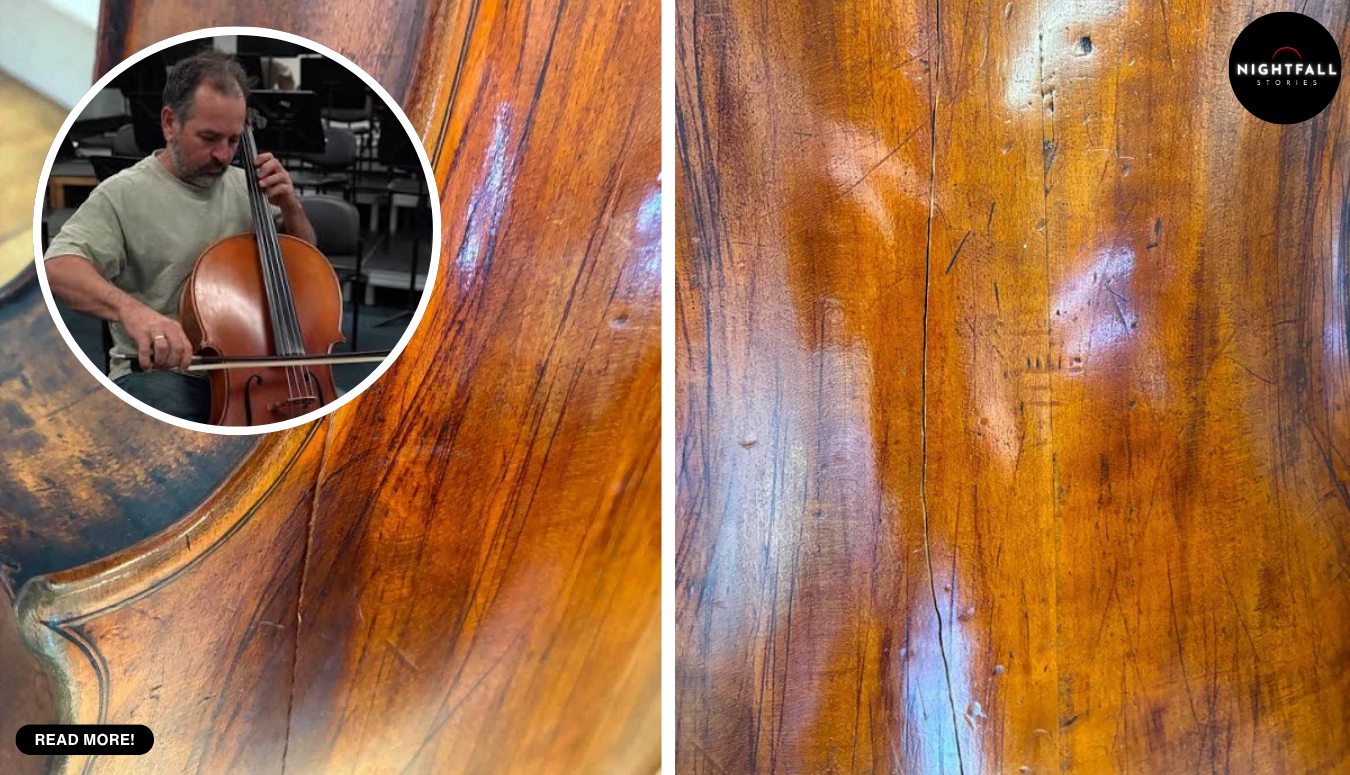
The flight case was perfect. That is the detail that keeps snagging on people who hear this story. Jon Tooby’s cello had travelled from Western Australia to the north of England inside a Presto case, the double-thick fibreglass kind that touring string players buy precisely because they expect the worst. It was still wrapped in bubble wrap when it came off the belt. Not a scuff on it. Not a crack, not a dent, not a smear of grease from a loader’s glove.
Then he opened it, and there was a long crack running down the back of a Tyrolean cello that is more than two hundred years old.
Tooby plays with the Darlington Quartet, a group based in Perth that had just flown halfway around the world to start a tour of the UK and Greece. They landed in Manchester at the beginning of this month with a concert schedule already locked in, including the Elgar cello concerto, which is not a piece you busk your way through on a borrowed instrument. What they had instead of a working cello was a beautiful wooden object with a fault line in it and a set of questions nobody wanted to answer.
The crack was the visible damage. The more telling damage was invisible from the outside, and it is the part of this story that actually explains what happened in the hold.
Inside every cello, standing upright between the back and the belly, there is a small wooden dowel called the sound post. It is not glued. It is not screwed. It is held in place purely by the tension of the instrument’s own body pressing in on it from both sides, which is why violin makers in some languages call it the soul of the instrument. Move it a millimetre and the whole voice of the cello changes. Knock it out of true and the instrument goes dead. Luthiers spend careers learning to set one properly with a long bent tool through the f-hole, by feel, because there is no other way to reach it.
Tooby’s sound post was cracked.
Think about what that requires. A sound post does not crack because a case slides across a floor, or because a stack of suitcases leans on it, or because the cabin got cold. It is a short, thick piece of spruce standing on end, braced at both ends, in the most protected spot inside a sealed box that was itself inside a hard fibreglass shell with bubble wrap on top. For it to fracture, a force had to arrive through the back of the instrument, travel the full depth of the body, and keep going. That is an impact, not a jostle. It is the difference between somebody leaning on your car and somebody driving into it.
Tim Toft Violins in Staffordshire, the shop that examined it, put it plainly enough. Their assessment was that the cello had been through excessive handling in transit. Tooby’s own reading, and it is hard to argue with the physics, is that a case that strong and that completely untouched on the outside leaves only one explanation on the table. Something that heavy was dropped, and it was dropped from a decent height.
So the cello tells you, quite precisely, what kind of event happened to it. What it cannot tell you is where.
And that, rather than the crack itself, is where this turned into a genuinely modern kind of nightmare.
The journey ran from Perth to London on Qantas, and then from London up to Manchester on British Airways. Two carriers, one ticket, one bubble-wrapped case that nobody in the quartet saw again from the moment it left their hands in Australia until it reappeared in Manchester. It was never unwrapped in between. Nobody flagged it at Heathrow. There is no moment in that chain where someone can point and say, it was fine here and broken there.
Qantas declined the claim. Their stated ground was a rule that anyone who has ever filed a lost-luggage form will half recognise: the airline that operates the final flight of a customer’s journey is the one responsible for reporting and managing damaged baggage. That is a real policy, it is written down, and under the international conventions that govern this sort of thing it is not an invention. If your bag arrives broken, the carrier that handed it to you is the one you file with.
British Airways, which operated that final flight, has not responded.
It would be easy to write those two sentences as though they were the same sentence. Plenty of coverage has, reaching for a line about both airlines denying liability, because it scans nicely and fits the shape people expect from airline stories. But they are not the same thing at all, and the difference matters for anyone who ever has to do this themselves.
Qantas gave an answer. It was not the answer Tooby wanted, but it was a position, stated on a ground he can now test, argue with, escalate, or take to a regulator. A refusal with a reason attached is a door. It might be locked, but it is a door, and it has a handle on it.
Silence is a wall. There is nothing to appeal, nothing to contradict, no clause to read back to anyone. You cannot dispute a position that has never been taken. And crucially, silence is not a denial of liability. It is not a denial of anything. It is the absence of a decision, which in practice functions like a denial while carrying none of the accountability of one, because nobody has had to put their name to it.
This is the quiet trap in how multi-carrier journeys work. The rules are genuinely designed to stop passengers being passed around forever, by naming one airline as the point of contact. The system assumes the named airline picks up the phone. When it simply does not, the passenger is left holding a pile of broken wood and a rule that points at a door nobody is standing behind. The first carrier has correctly followed procedure by pointing down the corridor. The second has not done anything wrong in any documented way, because it has not done anything at all.
There is a further sting buried in the rulebook, and it is one most travellers never learn until they need it. Under the international convention that governs damaged checked baggage, a complaint has to be made within about a week of receiving the bag, which is a brutally short window when the object in question needs a specialist to even assess it. And the carrier’s liability for baggage is capped, at a figure the aviation authorities revise upward every few years and which currently sits at roughly two thousand dollars. Unless a passenger makes a formal special declaration of value at check-in and pays a supplementary charge, that cap applies no matter what was in the bag. A cheap suitcase and a two-hundred-year-old cello are, in the eyes of that number, the same object. So even a claim that succeeds perfectly, against a carrier that accepts fault immediately and pays without argument, would not come close to covering what has happened here.
It is worth saying that this is not a story about villains. Nobody at either airline woke up wanting to break a two-hundred-year-old instrument. Baggage systems move an extraordinary number of objects every day with a failure rate that, statistically, is remarkably low. The problem is that the system is built around a statistical view of luggage, and a cello is not luggage in any sense the system understands. It is a single irreplaceable object with no equivalent anywhere in the world, moving through a process designed for interchangeable rolling suitcases full of interchangeable clothes.
And the loss does not work like luggage either. When an airline breaks a suitcase, it buys you a suitcase. When an airline breaks an old cello, there is no shop to send you to. The shop that examined Tooby’s instrument said the repair will take months, that the damage severely devalues the cello, and, most painfully, that no repair can guarantee the instrument will sound the way it used to.
That last part is the one non-musicians tend to underestimate. A cello of that age is not valuable because it is old. It is valuable because two centuries of specific wood, specific varnish, specific thickness and specific playing have produced a particular sound that exists nowhere else. The maker is gone. The trees are gone. A luthier can close the crack with skill and glue and time, and can cut and fit a new sound post, and the cello will very likely be playable again. Whether it will still be that cello, in the only sense a player cares about, nobody can promise.
Players talk about this in terms that sound sentimental until you have watched one of them work. An instrument you have played for years is not a tool you own. It is something you have negotiated with. You learn where it resists, which notes bloom and which ones need coaxing, how it responds to a dry hall or a wet one. That knowledge is stored in your hands, not in the wood, and it is calibrated to one specific object. Hand a professional a different cello of equal quality and they will play it beautifully and still feel, for months, like they are speaking a language they know with somebody else’s mouth.
Which is roughly what Tooby had to do, on about a day’s notice, with the Elgar concerto on the schedule.
Here is where the story turns, and it turns because of people rather than policy.
The same shop that delivered the bad news, Tim Toft Violins, loaned him a French cello. Not as a transaction, not as part of any claim, just because a cellist had turned up in Staffordshire with a wrecked instrument and a concert coming. He played the Elgar on it. The quartet played their scheduled concert. Then they got on another plane and went to Greece and carried on with the tour, which, given what the first week looked like, is not a small thing.
Other offers came in too, from players and shops who heard what had happened and simply wrote to say they had an instrument sitting available if it would help. The quartet’s response to all of it was gratitude, and the thing they kept coming back to was not the cello at all. It was that a genuinely awful week had been made survivable by strangers, quickly, with no conditions attached.
There is something clarifying about that contrast. On one side, a claims process built to allocate blame, in which one party has correctly directed you elsewhere and the other has not picked up. On the other, a small business in the English midlands that looked at a problem, handed over an expensive instrument to someone they had just met, and got a concert played. One of those responses took weeks and resolved nothing. The other took an afternoon.
None of it fixes the cello. The repair is still months away, the devaluation is real, and the question of who pays remains exactly as unresolved as it was on the day the case came off the belt.
Touring musicians have been raising this for years, and the pattern is familiar enough to have its own grim rhythm. Two years ago, another Australian musician’s double bass was damaged beyond repair on a Qantas flight. Cellists trade advice about buying a second seat for the instrument, which costs a fortune and which some carriers make awkward, or about which airlines have staff who understand what is in the box. None of that advice would have helped here. Tooby did what the guidance says to do. He bought the strongest case on the market, wrapped it, and checked it, and the case came back flawless with a broken instrument inside.
What the story leaves behind, more than anger, is a useful piece of knowledge for anyone who ever hands something precious to a system that measures success in bags per hour. Get a response in writing, even a bad one. A refusal you can read is worth more than a silence you cannot. A stated reason can be challenged, corrected, escalated, or simply shown to a regulator later as evidence that a position was taken. Nothing at all is not a position. It is just an absence with your loss inside it.
And the cracked sound post is the reason this is not simply a shrug about bad luck. That small piece of spruce, wedged inside the body, is the closest thing the instrument has to a witness. It cannot say who or when. But it says, with more authority than any claims form, that this cello did not arrive in Manchester tired. It arrived having been dropped. Somebody, somewhere along the way, knows exactly when that happened, and has not said so.
Tooby is still playing. The borrowed French cello did its job, the tour went on, and the Elgar got its performance. The old Tyrolean is in a workshop in Staffordshire, open on a bench, waiting for the long slow work of being made whole enough to try again.