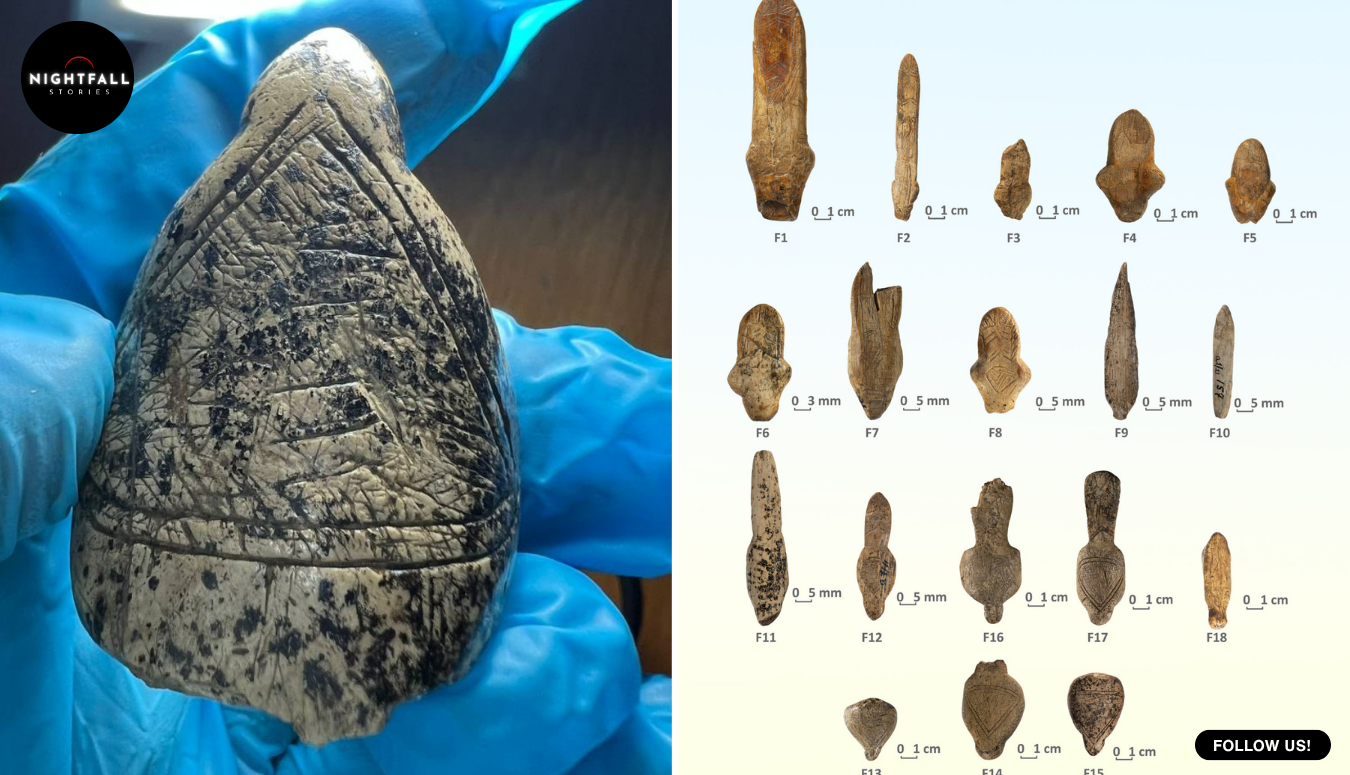
There are eighteen of them, small enough to close your hand around, carved from mammoth ivory by people living on a cold northern plain something like eighteen thousand years ago. They are human figures, stripped back to almost nothing: a suggestion of a body, a narrowing where a waist would be, no face. What they are famous for is the decoration. Zigzags. Meanders. Parallel lines that run and turn and run again, cut into the ivory with stone tools, and so confidently done that for a century everyone who studied them treated the patterns as pure invention, the first flourishes of abstract design, geometry pulled out of a human head.
A team led by a Ukrainian archaeologist now based in Norway has just published work suggesting that is only half right. The carvers were not only inventing. They were, at least partly, copying. The zigzags follow a pattern that was already in the ivory before anyone touched it, a hidden structure inside every mammoth tusk that only becomes visible if you cut the tusk a particular way. And the thing that makes this land oddly in the present is that the same internal pattern is now used by customs officers to catch ivory smugglers.
The figurines come from Mizyn, a Palaeolithic camp in northern Ukraine. Eleven of them were dug up in the first decade of the twentieth century near one dwelling structure built from mammoth bone, and seven more came out a few years later near a second. A few were reportedly found beneath or inside a mammoth skull, which is the kind of detail that has kept archaeologists arguing about their purpose ever since. They have been in the National Museum of the History of Ukraine in Kyiv for generations, studied, drawn, re-drawn, published, and reproduced in textbooks as a standard example of Ice Age abstraction.
They are also, right now, extremely difficult to get to. The war has made physical access to the collection limited, which is the reason this study exists in the form it does. Simon Radchenko, at the Museum of Archaeology at the University of Stavanger, worked with Oleksandr Naumenko at the museum in Kyiv, and the team’s way in was digital. In 2022 they were granted limited access to build high-resolution photogrammetric models, essentially three-dimensional digital copies accurate enough to substitute for the objects themselves. That work was undertaken partly as preservation, on the grim logic that a digital record survives things the original might not.
So the analysis was carried out on models rather than in a room with the figurines, and this turned out to be an advantage rather than a compromise. On a screen you can rotate a piece to any angle, light it from any direction, and measure it in ways you cannot easily do by eye with something fragile in your hand. Combined with digital microscopy, the team worked through 97 individual engravings and tool marks across the set.
To understand what they found, you have to know what is inside a tusk.
Mammoth ivory is not uniform. It has a hidden architecture, and it comes in two parts. The first is a crosshatch, a lattice of fine lines that appear when the tusk is cut across its width, produced by the way the dentine tubules spiral as the tusk grows. These are Schreger lines. The second is a set of concentric rings running the other way, growth lines laid down over the animal’s life much as a tree lays down rings. These are Owen’s lines. Neither is visible from outside. A whole tusk looks like a smooth curve of cream-coloured material. The pattern only appears once you cut, and it appears differently depending on where along the tusk and at what angle you cut.
Here is the part that connects to the present. The angle of the Schreger crosshatch differs between mammoth ivory and elephant ivory, reliably enough that it is used as a forensic test. Trade in mammoth ivory, which comes from animals that died tens of thousands of years ago, is legal in most places. Trade in elephant ivory is not. Smugglers have every incentive to pass one off as the other, and a customs inspector with a magnifier and a protractor can measure the angle where the lines intersect and tell which animal it came from. It is one of the simplest and most effective tests in the wildlife-crime toolkit.
The same structure that is now evidence in a smuggling prosecution was, eighteen thousand years ago, functioning as a design brief.
What Radchenko’s team did was work out, for each figurine, where in the tusk it had been cut from. Ivory’s internal geometry is systematic enough that you can read backwards from the shape and structure of a finished object to its original position in the raw material. Doing that for all eighteen produced the first result: they all came from the central portion of the tusk, with their long axes aligned the same way relative to the ivory’s own growth direction. That is not chance. Eighteen out of eighteen means somebody knew what they were looking for and went to the same part of the tusk every time.
Then they compared the carved decoration to the natural structure of that same region. The zigzag ornaments on several of the figurines resemble Schreger lines. The meanders and parallel lines echo Owen’s lines. The engraving was concentrated where the natural pattern would have been most visible, which is to say the carvers were not decorating a blank surface, they were working with what the ivory was already showing them.
There is a version of this finding that sounds deflating, as though it takes something away from the people who made these objects. That reading gets it backwards, and the researchers are clear about it. Noticing a structure that only appears under particular conditions, understanding it well enough to predict where in a tusk it will show up, selecting your raw material accordingly, and then amplifying it by hand with a stone blade is not less sophisticated than inventing a pattern from scratch. It is a different and arguably harder kind of attention. It requires you to have spent a long time looking at the inside of mammoth tusks and to have drawn conclusions from what you saw.
Aimée Little, at the University of York, has framed it as a window onto how Palaeolithic people perceived and engaged with the material world around them, and that is the useful way to hold it. These were not people imposing ideas onto inert stuff. They were reading the stuff.
The tool-mark analysis fills in the physical reality. Cross-sections of the carved lines show back-and-forth sawing and repeated cutting with sharp-edged stone tools, which is slow, deliberate work on a hard, dense material that punishes a slip. Some of the figurines are noticeably thinner than others, because they were cut from different ivory blanks, and thinness is part of why some survived intact and some did not.
One more thing about the raw material is worth spelling out, because it explains why this was possible at all. A mammoth tusk is not a bone and not a horn. It is a tooth, an enormously elongated incisor that grew continuously throughout the animal’s life, laid down in layers from the inside out. That growth history is what produces Owen’s lines, and the spiral arrangement of the microscopic tubules running through the dentine is what produces the Schreger crosshatch. Because both are products of how the tusk grew, they are systematic rather than random, which is exactly why a modern inspector can use them as a test and exactly why a Palaeolithic carver could learn to predict them.
Learning them would not have been quick. It would have meant breaking and cutting a lot of ivory, noticing what appeared and where, and passing that on. Mammoth ivory was not a rare curiosity to these people. It was a structural material. The camp itself included dwellings built from mammoth bone, so the animal was food, shelter, fuel and raw stock all at once, and a working familiarity with what happens inside a tusk when you cut it is exactly the kind of knowledge a community like that would accumulate and hand down.
The other conclusion is about art history, and it quietly rearranges something.
Simplified, near-abstract human figures of this general kind do turn up in central and western Europe, but later, roughly seventeen thousand to thirteen thousand years ago, in what specialists call the Lalinde and Gönnersdorf tradition. Because the western examples were better known and more studied, Mizyn had often been slotted in as an early or provincial version of the same thing, a precursor sitting at the start of a line that ran westward.
There is also a gap in the record that makes Mizyn matter more than it might otherwise. Female figurines are a recurring feature of Ice Age Europe going back well before this, the objects usually filed under the catch-all label of Venus figurines, and some of the most famous of them, the ivory carvings from central Europe, are several thousand years older again. Then, during the worst of the Last Glacial Maximum, roughly twenty-three thousand to twenty thousand years ago, the evidence for them thins out dramatically. Conditions were brutal, populations contracted into refuges, and a great deal of what people had been doing simply stops showing up.
So what comes after that gap is not a continuation. It is a restart, and the question of what the restart looked like and where it happened first is a real one. The team went back through around 650 published radiocarbon dates to place Mizyn properly in that sequence, which is the unglamorous half of the work and the half that makes the argument stick.
The dating undercuts that. The Mizyn figurines fall between roughly 18,800 and 17,400 years ago, which puts them among the earliest anthropomorphic images known in Europe after the Last Glacial Maximum, the coldest phase of the Ice Age. They are not early members of a later western tradition. They predate it, and their method, which is built around the properties of mammoth ivory specifically, is its own thing. The team’s reading is that eastern Europe had an independent artistic development, not a derivative one.
Andy Needham, also at York, has made the distinction plainly: the eastern European figurines used the tusk’s internal patterns in a way the western European ones did not. That is a difference in method, not just in style, and method is usually the better guide to whether two traditions are related or merely resemble each other.
That matters beyond the objects. The story of Ice Age art has often been told from west to east, because the French and Spanish cave sites were found early, excavated thoroughly and reproduced everywhere. Eastern European material has tended to be described in relation to that centre. A finding like this, coming from a Ukrainian researcher working on a Ukrainian collection, pushes back on the geography of the narrative as much as on the chronology.
There is something worth sitting with in the fact that this was discovered now, on objects that have been in a museum case for over a hundred years and drawn by specialists again and again. Nobody had to dig anything up. The evidence was on the surface of the figurines the entire time, in plain view, and what changed was the question being asked and the technology available to ask it with. Generations of researchers looked at the zigzags and saw decoration. Somebody looked at them and wondered where in the tusk the piece had come from.
It is worth being honest about how modest the individual observations are. Nobody found a new object. Nobody unearthed a site. What happened is that a set of well-known pieces were measured properly, in three dimensions, against the known internal geometry of the material they were made from, and a correlation showed up that was too consistent to be coincidence. Eighteen for eighteen on tusk position, plus decoration that tracks the natural lines, plus engraving concentrated where those lines would show. Each of those on its own would be suggestive. Together they are an argument.
It also says something about digital archaeology, which is often sold as a preservation measure or an access measure and turns out here to be a research method in its own right. The models were made because the originals were hard to reach and might not be safe. They then produced a finding that hands-on study over a century had not. Naumenko, at the museum in Kyiv, has pointed out that projects like this deepen understanding of the past and open new research possibilities, which is a careful sentence from someone whose institution is doing this work under conditions no museum should have to work under.
The paper appeared in npj Heritage Science, with co-authors across Ukraine, Norway, Germany and the United Kingdom, including Dmytro Kiosak at the Leibniz Centre for Archaeology in Mainz, Anja Mansrud at Stavanger, and Andy Needham and Little at York. Radchenko’s own position is that this is a beginning, and that further digital work on the collection should tell us more about how artistic expression emerged and developed in Europe.
The figurines are still in Kyiv. They are still eighteen small pieces of ivory carved by people whose names nobody will ever know, working in a landscape of mammoth-bone houses on a plain that was colder and emptier than anything in Europe today. What has changed is what we understand them to have been doing.
Somebody held a piece of tusk and saw a pattern hiding in it that most people would never have noticed, and instead of covering it over with an idea of their own, they cut along it and brought it out. That is a recognisable impulse. Anyone who has ever worked with wood and followed the grain rather than fighting it knows exactly what that is. It has been sitting in a display case for a hundred years, waiting for somebody to recognise it.