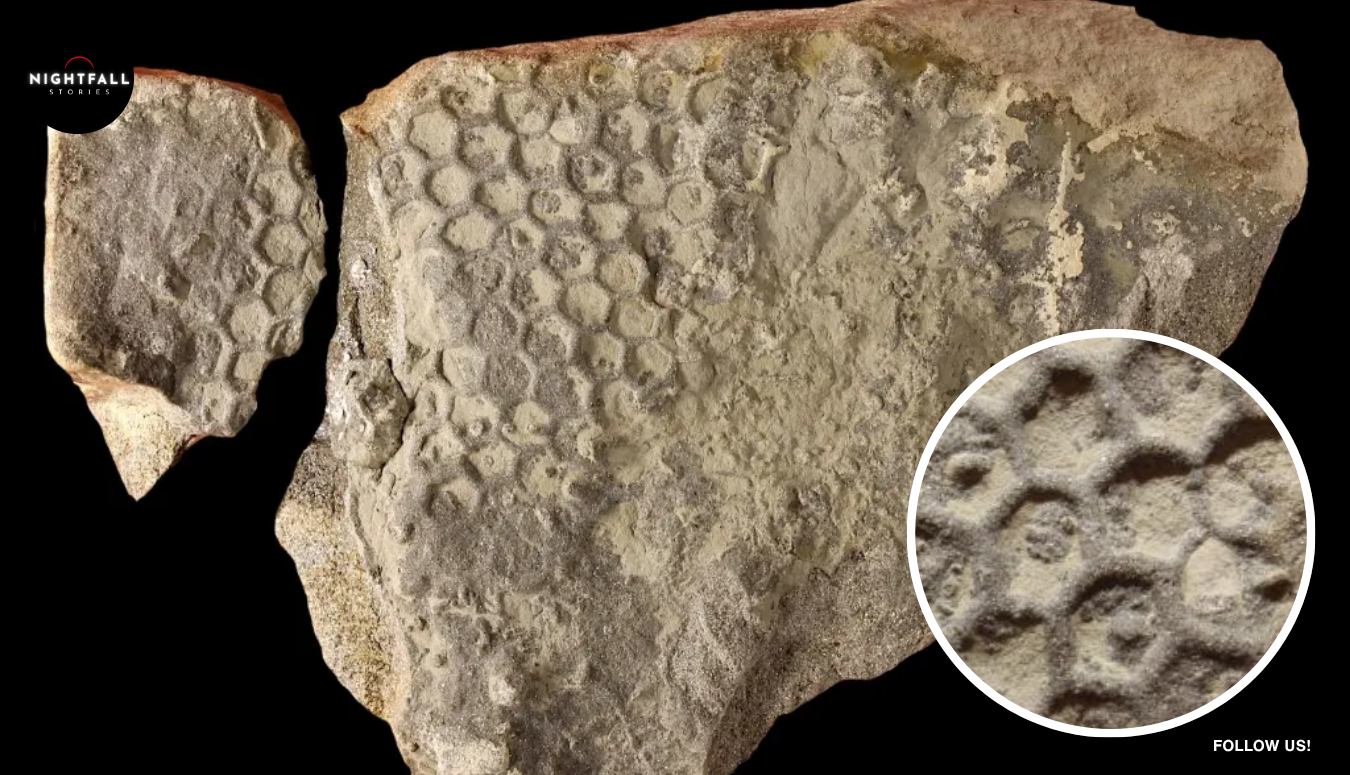
There is a pattern on the floor of the deep ocean that looks like somebody drew it. Rows of tiny holes, arranged into a honeycomb, hexagon after hexagon, each cell about the size of a fingernail, laid out with a regularity that feels like it belongs on graph paper rather than on mud three and a half kilometres beneath the Atlantic. It turns up in rock hundreds of millions of years old, pressed into stone that is now halfway up an Italian mountain. And it turns up, still fresh, in photographs taken by remotely operated vehicles in the last few years.
Nobody has ever seen the thing that makes it.
That is not a figure of speech. In roughly 175 years of scientific attention, across dozens of deep-sea dives, submersible sampling runs, sediment cores and DNA tests, no researcher has ever laid eyes on, filmed, netted or otherwise laid hands on whatever is responsible for the honeycomb. They have the pattern. They have never had the animal. It is the closest thing palaeontology has to a cold case with a signature and no suspect, and a team of scientists has just published an argument about who the suspect is, based on nothing but the geometry left behind.
The pattern has a name, Paleodictyon, given to it by the Italian geologist Giuseppe Meneghini in 1850, although he was not the first person to notice it. Leonardo da Vinci appears to have sketched it around 1500, presumably while looking at the same kind of Italian rock that everyone since has looked at, and presumably with the same reaction anyone has on seeing it for the first time, which is that this cannot possibly be natural.
For most of the time since, the guesses have been all over the place. Some early workers thought it was a chemical artefact, a pattern that emerged as soft sediment hardened and cracked. Others put it down to algae. One Italian geologist floated the idea that the honeycombs were fossilised beehives, which tells you how far people were willing to travel to explain the regularity of the thing. Tadpoles have been proposed. So have several kinds of worm.
By the second half of the twentieth century the field had converged on something more sober. The German palaeontologist Dolf Seilacher, who spent a career reading the marks animals leave in sediment, argued in the 1970s that Paleodictyon was a burrow system, and that the network was doing a job. Maybe it was a trap, a web of tunnels a soft-bodied animal patrolled to collect whatever wandered in. Maybe it was a farm, with the tunnel walls seeded and tended so that bacteria would grow on them and the resident could graze. Either way, the assumption underneath was that the builder was worm-like, because worms are what usually make burrows in deep-sea mud and because a soft body could squeeze through tunnels that narrow.
Then the story moved from the rock into the water. In the mid 1970s, cameras towed over the Galapagos Rift brought back photographs of the same hexagonal pattern on the living seafloor, at depths between about 2,400 and 3,700 metres. That changed everything. This was not a fossil curiosity. Something was still doing it, right now, in the dark.
The person who made it his business to find out was Peter Rona, an American oceanographer who had already earned a place in the history of the field. In the 1980s, working for the US ocean agency, Rona located hot springs on the Mid-Atlantic Ridge, the chimneys known as black smokers, and with them whole ecosystems nobody had known existed. He was not a man who lacked for achievements. And for the rest of his life, the honeycomb was the one that got away.
Rona and his colleagues went down in the submersible Alvin and brought up samples of the pattern from the Mid-Atlantic Ridge at depths between roughly 3,430 and 3,575 metres. What they found, in physical terms, was elegant and frustrating in equal measure. The top of the structure is a shield-shaped patch of seafloor with rows of holes about a millimetre across, meeting at neat 120 degree angles. Underneath, vertical shafts two to three millimetres wide run down and connect into the buried mesh. The whole array can sprawl across a square metre of mud.
What was not in the samples was a tenant. Empty tunnels. No body, no shed skin, no droppings that settled the question.
So Rona proposed something different. Maybe there was no burrowing animal at all. Maybe the honeycomb was the fossilised outline of a xenophyophore, one of the strange giant single-celled organisms that live on the deep-sea floor and build structures far larger than a cell has any business building. Or a sponge. In that reading, the pattern is not a set of tunnels dug by a creature. It is the negative space around a body that has since rotted away.
The trouble with that idea is that the xenophyophores anyone can actually go and look at do not produce anything with this symmetry. They are irregular. They sprawl. They do not do hexagons.
Meanwhile the farming hypothesis picked up a problem of its own. If the tunnels were being cultivated as a bacterial garden, you would expect more bacteria inside them than in the mud around them. When researchers counted, the numbers did not budge. Sediment inside, sediment outside, same microbial load. What they did find in the burrows were the tiny shells of foraminifera, which looks a lot more like a trap catching prey than a farm growing crops. DNA sampling turned up genetic material from various single-celled organisms, but nothing that could be pinned to the builder rather than to everything else drifting through deep-sea mud.
Part of Rona’s search ended up on screen. A large-format documentary about the hot vents, made with his colleague Richard Lutz, followed the hunt for the honeycomb along with the rest of the deep-sea work, and the film has the peculiar honesty of showing a scientist looking very hard for something and not finding it. Audiences got the ridge, the chimneys, the impossible animals living on chemistry instead of sunlight, and then a patch of mud with holes in it that nobody could account for.
It is worth being clear about why the animal is so difficult to catch, because the obvious question is why nobody has simply gone down and waited. The honeycombs sit kilometres below the surface, which means every hour of observation costs a research vessel, a crew and a vehicle capable of operating under enormous pressure. Ship time is rationed in days, not seasons. When a submersible does find a patch, the act of approaching it stirs the sediment, and anything living in millimetre-wide tunnels is not going to be standing on the doorstep. Sampling means pushing a tube into the mud and pulling up a slice, which destroys the structure in the process of collecting it. And the tunnels come up empty often enough that some researchers think the builder may not live in them at all, but visit, build, and move on.
Rona died in 2014, still without his animal. Another researcher, Mark McMenamin, has suggested the mesh might be a nursery, a nest of microburrows that empties out once the young are grown, which would neatly explain why the tunnels are always vacant by the time anyone arrives.
This is the state of the argument that a team led by the palaeontologist Andrea Baucon, at the University of Cagliari, has now walked into. Their paper, published in the journal Earth-Science Reviews, is titled as a question rather than an answer, which is worth knowing before anything else. It asks whether arthropods can produce Paleodictyon. The team’s position is that they can, and that they probably did, and the reasoning is a genuinely nice piece of detective work, but the title is not modest by accident.
Their approach was to stop waiting for the animal and interrogate the crime scene instead. Working with fossil specimens from the Apennines, from Portugal and from Poland, many of them held at the natural history museum in Piacenza, they took 1,314 measurement points off the hexagons and asked what kind of body could produce those numbers.
Two things came out of it. The first is the precision. Within a single hexagonal cell, the six sides differ from each other by about half a millimetre on average. Think about what that means for a blind animal working in mud in total darkness. It is not just building hexagons, it is correcting as it goes, keeping each cell honest rather than letting small errors compound across the mesh until the pattern drifts into nonsense. Whatever this is, it is building to a tolerance.
The second is the corners. Paleodictyon tunnels are straight, and they meet at sharp angles. A soft-bodied animal does not dig that way. A worm makes progress by pushing and squeezing, which only works in weak sediment and which produces curves, because a hydraulic body cannot hold a hard edge. Sharp corners and straight runs suggest something with a rigid frame and jointed limbs, scraping sediment away rather than shouldering through it. One of the co-authors, Alfred Uchman, makes exactly that point, that this is the signature of a digger working with legs and an exoskeleton.
Which puts the team’s money on an arthropod. Specifically, they suggest a small crustacean of the kind called peracarids, the group that includes isopods and amphipods. The everyday comparison is the woodlouse or pillbug you find under a flowerpot, the little armoured thing that rolls into a ball. Somewhere in the deep sea, on this reading, a distant relative of that animal is patiently drawing geometry in the mud and has been doing so, in one form or another, since the Cambrian. The oldest specimen in the study, from Portugal, is around 530 million years old. That is older than trees. It is older than anything with a backbone that walked on land.
The team also has a new idea about why. If the farming hypothesis does not survive the bacterial counts, what is the mesh for? Their suggestion is communication. A hexagonal network radiates outward evenly in every direction, which makes it a rather good medium for passing a signal through, chemically, hydraulically or as vibration. In that picture the honeycomb is not a larder and not a trap. It is infrastructure for a colony, a way of staying in touch in a place with no light and very little of anything else.
It is a lovely idea, and it is exactly as unproven as everything else in this story.
That is the part worth holding onto, because the coverage of this research has had a tendency to round it up into a solved case, and it is not one. Stephen Hasiotis, a researcher at the University of Kansas who works on trace fossils, has pushed back in public, and his objection is hard to argue with. Without direct evidence, he says, there is no way to rule out that other animals, segmented worms among them, are responsible for the pattern in some settings and across some stretches of geological time. The traces span more than half a billion years and turn up in a range of marine environments. It is a large assumption that one kind of animal made all of them.
There is also a broader caution built into this kind of science. A trace fossil is a behaviour, not a body. Palaeontologists give these things Latin names like Paleodictyon and it is easy to forget that the name belongs to the pattern, not to a species. Two entirely unrelated animals can leave a similar mark, in the same way that two unrelated people can leave a similar footprint. The Baucon team’s argument narrows the field considerably by saying that the tracemaker had to be stiff-bodied and limbed, and that is a real contribution. It does not put a creature in a jar.
Hasiotis said something else, though, that gets at why this is worth caring about at all. Whatever else the new work does, it sends everyone back onto the trail. For decades the assumption that a worm did it was so settled that nobody was really looking for anything else. Now there is a live argument again, a specific kind of animal to hunt for, and a reason for the next research vessel that finds a patch of honeycomb to sit on it a little longer and watch.
What would actually settle it is not complicated to describe, only to do. Somebody needs to catch the builder at work, or find a body in the tunnels, or recover genetic material from the burrow lining that clearly belongs to the resident rather than to the general traffic of the deep sea. Any one of those would end the argument in an afternoon. The Baucon team’s contribution is that it tells the next expedition what to look for, and roughly how big it ought to be, which is more than anyone had before.
There is also a decent chance the answer is already sitting in a specimen drawer somewhere, mislabelled. That happens more often in this field than outsiders expect. Museums hold enormous quantities of deep-sea material collected decades ago by people who had no idea what they had, and the Piacenza collection that supplied much of the new measurement work is a reminder that a regional natural history museum in a small Italian city can be holding the evidence at the centre of a global scientific argument.
Because the strangest thing about this whole story is not the geometry. It is the timescale. The pattern in the 530 million year old Portuguese rock and the pattern photographed by a robot on the Mid-Atlantic Ridge a few years ago are the same pattern. Continents have moved. Five mass extinctions have come and gone. The dinosaurs arrived and left. And through all of it, on the floor of the ocean, something has been quietly drawing the same hexagons, at the same tolerance, in the dark.
It is still down there. Somebody is going to see it eventually.