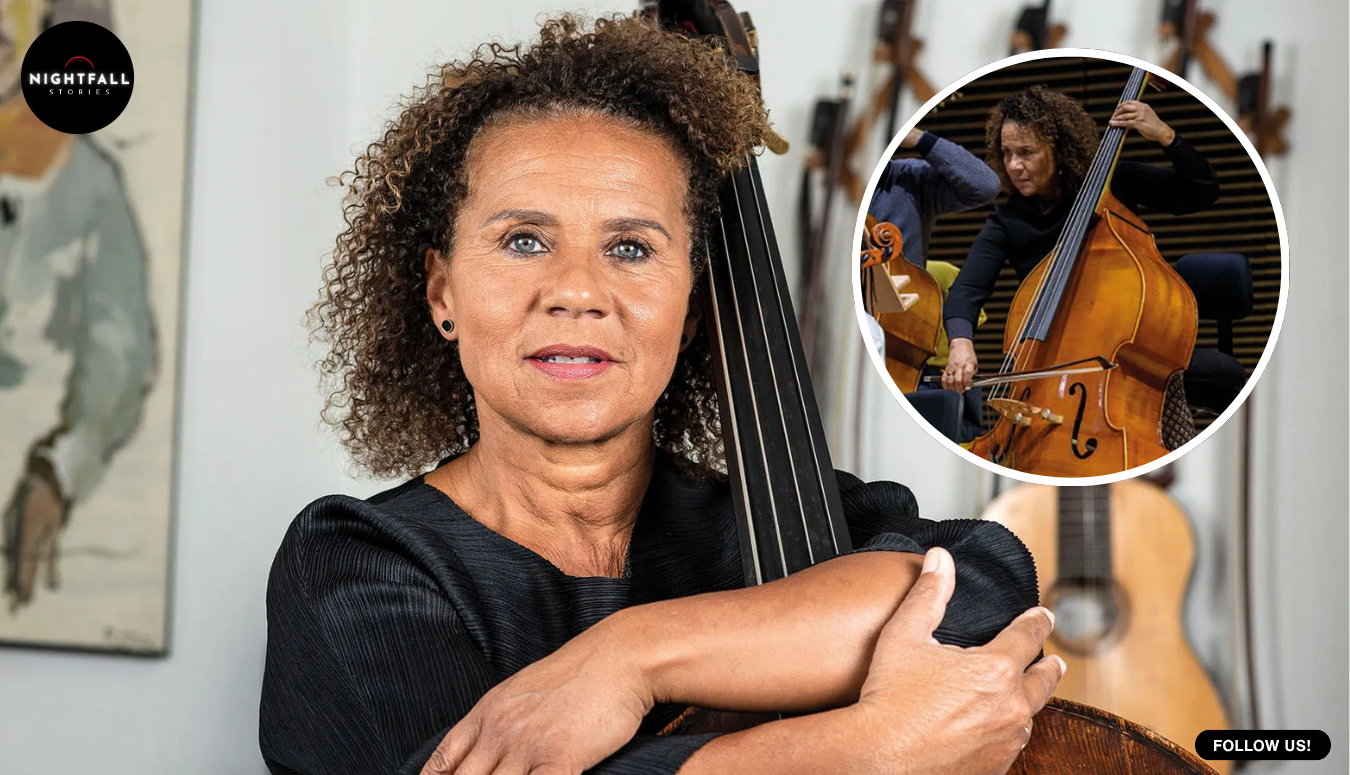
Chi-chi Nwanoku spent roughly thirty years as a professional double bassist looking around concert halls and finding nobody who looked like her. Not on the platform. Not in the audience. Not in the management office, not in the box office, and not, for the most part, on the music stands, where the composers were almost uniformly white and almost uniformly dead. She has described it plainly over the years: she was usually the only person of colour in the entire building. So a decade ago she built a different building, or at least a different orchestra to put inside one. She has now announced that she is stepping down as artistic director of it.
The orchestra is Chineke!, and the announcement landed this week with the kind of quiet that big news in classical music tends to land with. Nwanoku is leaving the artistic leadership of the ensemble she founded. The conductor Jonathon Heyward, music director of the Baltimore Symphony Orchestra, is holding the role on an interim basis while a search runs for a permanent successor. No end date has been attached to her departure in the announcement, and no permanent name has been put forward. What has been made clear is that she considers the work she started to be unfinished, and that she intends to keep pushing on representation in whatever she does next.
That is the polite summary. The interesting part is what it actually tests. Chineke! was built, unavoidably, on one woman’s stubbornness. Organisations that start that way tend to carry the founder’s fingerprints on every decision, every hire, every programme, and the hard question is always whether the thing can outlive the person. Nwanoku has spent ten years arguing that classical music should look like the world it is played in. The next few years will show whether she built an argument or an institution.
To understand how unlikely any of this was, you have to go back to a teenager who had no intention of being a musician at all. Nwanoku was born in London to a Nigerian father and an Irish mother, the eldest of five, and spent part of her early childhood in Nigeria before the family settled in England. She found the piano at seven, at a neighbour’s house, and went back every single day until the neighbours simply gave it to her. That is a good story on its own, but it is not the story that made her a bassist.
The story that made her a bassist is a sprinting career. She was fast, fast enough to be spotted by a coach and trained seriously in the hundred metres, fast enough to compete at national level and to think realistically about an Olympic team. Then her knee went. She has put the injury at eighteen, and at least one interview has attributed it to a game of football rather than to the track, so the precise circumstances are less settled than the outcome. The outcome was not in doubt. The running was over.
What happened next is the sort of thing that sounds invented. A teacher at her school pointed her at the double bass, on the reasonable grounds that bass players are always in demand and there were almost none of them around. She had never touched one. She was eighteen, which in classical music is roughly a decade late to be starting a string instrument, and the double bass is not a forgiving object for a beginner. She took it up anyway, got into the Royal Academy of Music, went to Rome to study with the Italian bassist Franco Petracchi, and turned herself into one of the busiest players in the country.
She became a founding member of the Orchestra of the Age of Enlightenment and sat in its principal bass chair for around three decades. She held principal positions with other ensembles. She ended up as a professor at the Royal Academy of Music, teaching historical double bass studies, which is a long way from a knee injury and a school teacher’s shrug. Along the way she collected an MBE, then an OBE, then a CBE, for services to music.
And for the whole of it, she was alone in a way that is easy to describe and hard to sit inside. Being the only person of colour on a platform is a manageable oddity for a night. Being the only one for thirty years, in every rehearsal room and every green room and every audience you scan from the back of the string section, is something else. She has said she was not particularly interested in spending a career playing only the work of dead white composers, and that the point of being there at all had to be more than being there.
The idea for Chineke! came from two places, by her own account. One was seeing an orchestra from Kinshasa, a self-taught symphony orchestra in the Democratic Republic of Congo that had become internationally known, and understanding that the shortage was never of talent. The other was a conversation with a culture minister, Ed Vaizey, who asked her the obvious question about why British orchestras looked the way they did, and did not get a comfortable answer.
The orchestra took its name from the Igbo word for the god of creation, borrowed from the novel that gave the world Things Fall Apart, and it gave its first concert at the Queen Elizabeth Hall in London a decade ago. Sixty-two musicians, thirty-one nationalities, a programme that included Samuel Coleridge-Taylor, a composer of mixed English and Sierra Leonean heritage who was enormously popular in his own lifetime and then allowed to drift almost entirely out of the standard repertoire. The point was made before a note was played, just by the look of the stage.
It did not stay a single concert. Chineke! became an associate orchestra at the Southbank Centre from the beginning and was upgraded to resident orchestra a few years ago, which in practical terms means regular slots at the Royal Festival Hall and the Queen Elizabeth Hall rather than an annual guest appearance. It made its debut at the BBC Proms two years after it started. It picked up the Royal Philharmonic Society’s Gamechanger Award as the first ever recipient. It has recorded Dvorak and Sibelius and Rachmaninov and Gershwin alongside the repertoire almost nobody else was programming, and it has commissioned and premiered new work from living Black composers rather than treating the whole project as an exercise in rediscovery.
Coleridge-Taylor is worth pausing on, because he explains the whole problem in one life. He was a Londoner with a Sierra Leonean father and an English mother, trained at the Royal College of Music, and by his twenties he had written a choral work so popular that amateur societies performed it constantly for decades. He toured America, was received at the White House, and was spoken of in the same breath as the biggest names in British music of his day. Then he died at thirty-seven, and over the following century the standard orchestral repertoire quietly closed over him. He was not suppressed so much as allowed to slip out of the rotation, which is how most of these disappearances actually happen. Putting him on the stand at a debut concert was not a gesture. It was an argument about what the word standard has been doing all this time.
The part that matters most for the long run is the least glamorous. Alongside the professional orchestra, Nwanoku set up the Chineke! Junior Orchestra in the same year, for Black and ethnically diverse players aged eleven to twenty-two, with senior members of the main orchestra mentoring them. Players audition at roughly grade eight standard and above, rehearse and perform at the Southbank Centre a few times a year, and get pointed towards conservatoire auditions by people who have already made that journey.
That is the whole theory of the thing, compressed into one ensemble. A professional orchestra changes what an audience sees once. A junior orchestra changes who is in the profession in fifteen years. Every argument about representation in classical music eventually runs into the same wall, which is that orchestras recruit from conservatoires, conservatoires recruit from advanced youth ensembles, youth ensembles recruit from children who got an instrument early and a teacher who believed in them, and by the time anyone notices the shortage at the professional end the decisions that caused it were made when the musicians were nine. Nwanoku went after the nine-year-olds.
She has also been quite specific that the orchestra was never meant to be a separate room. The first couple of concerts were made up entirely of Black and ethnically diverse musicians; since then the ensemble has included white players too, which some people found confusing and which was entirely the point. The goal was never a permanently parallel institution. The goal was to change the composition of the ordinary ones, and to prove, as loudly as possible, that the talent pool people claimed did not exist was sitting right there.
So what does her departure actually mean for it. In the narrowest sense, less than the headline suggests. Artistic directors are not the whole of an orchestra. Chineke! has a foundation behind it, a staff, a board, a resident slot at one of Europe’s busiest arts complexes, a recording catalogue and a junior orchestra that has been feeding players upward for a decade. Those things do not evaporate when a founder’s name comes off the letterhead. Heyward, who is holding the artistic role in the interim, is not a caretaker in the ceremonial sense either. He is a working music director of a major American orchestra, trained partly at the same Royal Academy of Music where Nwanoku teaches, and he arrives with a serious programming reputation of his own.
Heyward’s own path is not unrelated to the argument Chineke! has been making. He grew up in Charleston, South Carolina, studied at the Boston Conservatory and then in London at the Royal Academy of Music, spent four years as chief conductor of a German orchestra, and took over one of the better-known American symphony orchestras while still comparatively young. His contract in Baltimore has since been extended well into the next decade. A generation ago that career would have been described as remarkable mainly because of who was living it. The ambition behind Chineke! was to reach a point where it is described as remarkable only because of how good he is at the job.
In the wider sense, this is the test every founder-led organisation eventually faces and most of them fail. The pattern is familiar in charity, in tech, in the arts. One person’s conviction holds the thing together, the funding is partly a bet on that person, the press interest is partly a bet on that person, and when they step back the whole structure has to discover whether it is a movement or a personality. Chineke! has ten years, an institutional home and a pipeline of young players, which is a stronger hand than most founder-led projects hold when the founder stands up. It also has a mission that is nowhere near finished, and a sector that has a long record of announcing progress and then quietly reverting.
That is presumably why she framed the exit the way she did. She did not describe it as a retirement or a farewell to the cause. She talked about founding the orchestra on the belief that classical music ought to reflect the world it exists in, and about the job of improving representation still being incomplete. It is a departure phrased as a continuation, which is either a comfortable formula or a statement of intent, and her record suggests the second. This is a woman who responded to a career-ending injury by picking up the largest instrument in the string family from scratch.
There is a version of this story where the interesting thing is loss, where a founder leaves and everyone worries. There is a better version, and it is probably the true one. An orchestra founded by one person because nobody else would do it has arrived at the moment where it stops depending on that person. If it works, the ten years were not a campaign led by Chi-chi Nwanoku. They were the construction of something that no longer needs her, which is the only outcome that would actually count as winning.
The junior players are the ones to watch. The eleven-year-olds who walked into the first season of the Chineke! Junior Orchestra are in their early twenties now, old enough to be auditioning for professional seats, and the ones who came after them are still coming. They will spend their careers in orchestras that look at least somewhat different from the ones Nwanoku spent thirty years being the only Black face in, partly because of what she built and partly because they will now have to keep building it themselves.
She is not leaving the field. She is leaving the chair. Those are not the same thing, and the difference is the whole point of having built something bigger than yourself in the first place.