Here is a fact about foster care that most people never hear until it happens to a family they know. When children are removed from a home, they are very often removed from each other at the same time. Not out of malice, and not usually because anyone thinks it is a good idea. It happens because a sibling group of three or four needs a foster home with three or four free beds, and on the night the call comes, that home frequently does not exist. So the children get split. One goes here, one goes there, the youngest goes somewhere else entirely, and the last familiar face any of them had is now a scheduled visit on somebody’s calendar.
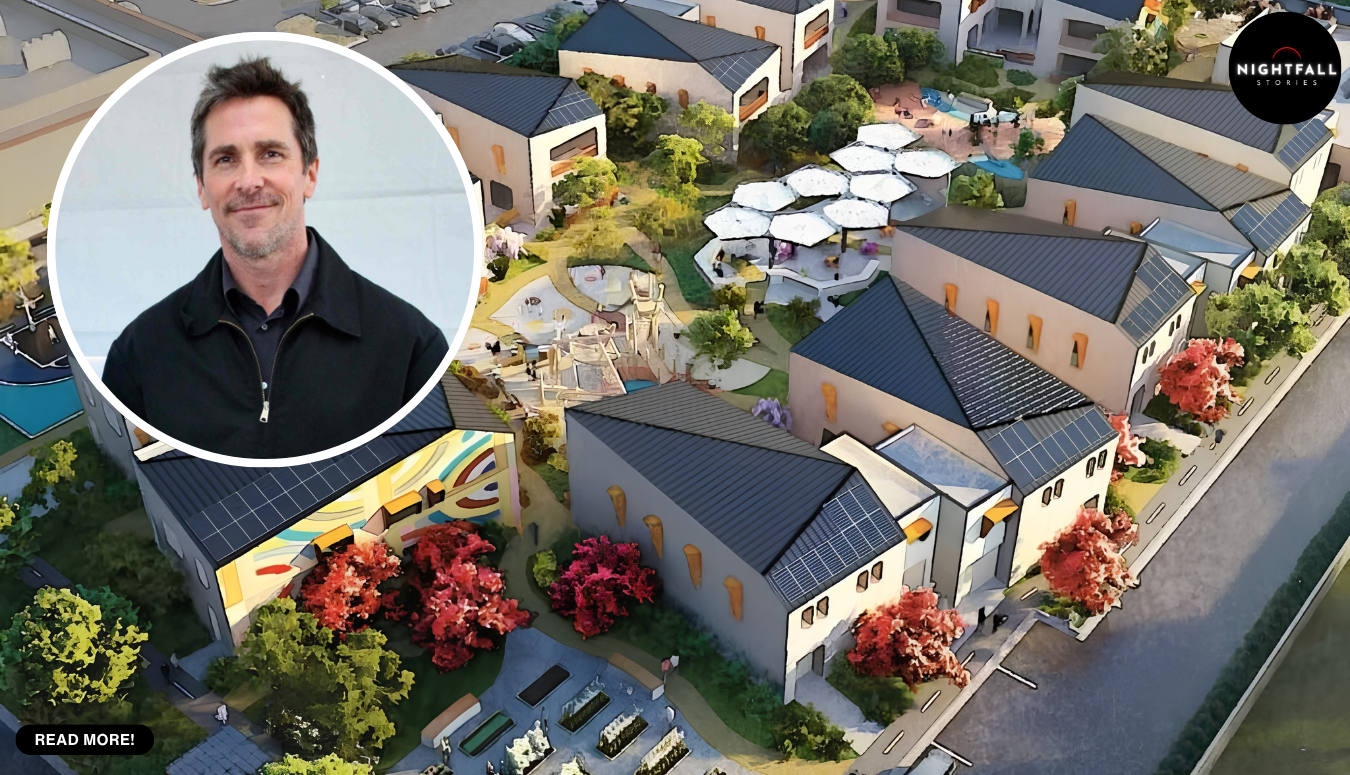
That is the problem a new village in the high desert north of Los Angeles was built to solve. Twelve homes on a four and a half acre site, each one with room for a sibling group of up to six children, each one with trained foster parents living in it full time rather than rotating through on shifts. There are two studio apartments set aside for birth parents who are working toward getting their children back, and two more for young people ageing out of the system who would otherwise be walking into adulthood with nothing behind them. In the middle there is a community building with a kitchen, a learning lab and a multi purpose room, plus a citrus grove, gardens, play areas graded for different ages and murals painted across the walls.
It opened this month. The first families are due to move in shortly. And the idea behind it is roughly eighteen years old.
The actor Christian Bale co-founded the organisation behind it, Together California, with his wife Sibi and the physician Dr Eric Esrailian, and the celebrity involvement is the part that made the story travel. It is also the least interesting thing about it. The genuinely striking detail is the gap between the date somebody first started asking questions and the date anybody got a key, and what that gap says about how hard it is to build something obvious.
The origin story, as Bale has told it, is unglamorous. Around 2008, when his daughter was a toddler, he and his wife read about the state of the foster system in California and started looking into it. That is it. No dramatic encounter, no personal history with the system. Two parents of a small child reading something and deciding not to put it down. What they found, reportedly, was that the sibling separation issue kept surfacing in everything they read, and that the model they eventually wanted to copy already existed and had done for decades. It came out of Austria after the Second World War, where the original children’s village concept was developed for children orphaned by the war: a cluster of family homes with permanent house parents, held together by a wider community on the same site, rather than an institution with dormitories and a rota.
Adapting that to Los Angeles County took sixteen years before a single shovel went into the ground.
Some of that was money. The project has been reported at a cost in the region of $22 million, raised through donations, and the fundraising is a story in itself. An Austrian American organisation, drawn to the project precisely because the model originated in Austria, is reported to have raised close to $9 million of it. Public money came in too, with the city and the county contributing millions between them across several approvals. But money was not the only obstacle, and probably not the slowest one.
Building housing for children in the care of the state means clearing every layer at once. Land has to be found and zoned. A county has to agree that the model is one it will place children into, which means licensing, inspections, and reassurance that a site with twelve homes on it does not legally or practically amount to the kind of congregate group facility that child welfare policy in the United States has spent twenty years trying to move away from. Foster parents have to be recruited to a model that asks them to make it their full time job and to live on a campus. Architects have to design something that does not look like an institution, because children who have already been through the worst week of their lives should not arrive somewhere that feels like a processing centre. Every one of those steps involves an agency, and agencies do not move at the speed of good intentions.
Meanwhile, children kept coming into care. That is the uncomfortable arithmetic sitting underneath the ribbon cutting photographs. California has tens of thousands of children in foster care at any given time, and Los Angeles County has more than any other county in the country. Reporting around the opening put the county figure at more than 30,000. Every year those eighteen years ran, a fresh cohort went into the system and a fresh cohort came out the other end at eighteen, and none of them were helped by a building that did not exist yet. The village opening now is good news. It is also a measure of how long the delay was.
The scale is worth being honest about as well. Twelve homes is twelve homes. Even at full capacity, with up to six children in each, this is a site that serves a number of children you could fit into two school classrooms, in a county with tens of thousands in care. The organisation says the village will serve hundreds of children over time, counting the turnover of placements and the reach of the community programmes, but nobody involved is pretending this fixes Los Angeles County. It is a demonstration. The unstated argument is that if this one works, and if it can be shown to work, the model gets built again somewhere else, and that is where the numbers would eventually start to matter.
The site sits in Palmdale, in the Antelope Valley, about an hour north of central Los Angeles and over a mountain range from it. That location was not incidental. Land there is affordable in a way land closer to the city has not been for decades, and a project that needed several acres in one piece could realistically buy it. The trade off is distance, and it is a real one, since a child placed there may be a long drive from the school, the neighbourhood and the birth family they were taken from. The campus design leans hard into making the place feel like somewhere rather than a facility: solar panels on the roofs, drought tolerant planting suited to a desert climate, shaded outdoor gathering areas, and the murals, which were commissioned on themes of hope, unity and resilience rather than left as blank stucco.
Even the community building was argued over. Reporting and the architects’ own project description differ on its size, with some accounts putting it at around 7,000 square feet and others at about 11,000, which likely reflects a design that grew between the groundbreaking and the finished structure. What it contains is consistent across sources: a large multi purpose room, a learning lab for tutoring and homework, a kitchen, and offices for case managers and administrators, so that the people supervising placements are on site rather than visiting.
Does it work? That question deserves a careful answer rather than an enthusiastic one, because the village has not housed anyone yet.
What can be said is that the underlying principle, keeping brothers and sisters together, has a substantial body of research behind it. Work collected by child welfare researchers associates joint sibling placement with fewer disrupted placements, higher rates of children reaching a permanent home, fewer emotional and behavioural difficulties, better school performance and stronger family connections into adulthood. Those are associations drawn from studies of children in ordinary foster placements, not proof that any particular building produces those outcomes, and researchers are careful to note that children placed together may differ in other ways from children placed apart. Still, the direction of the evidence is consistent enough that federal and state policy in the United States already requires agencies to make reasonable efforts to place siblings together. The gap is not in the policy. The gap is in the beds.
How wide that gap is can be seen in the placement data. One study of a large state system found that children in care with siblings spent under half of their time in care placed with all of their brothers and sisters. For a child with a single sibling the figure was better, around three fifths of the time. For a child with several siblings it dropped sharply, to roughly a third. The more brothers and sisters a child has, the less likely the system is to be able to keep them together, which is the exact inverse of what anyone would want, and it is a capacity problem rather than a policy failure. A home with two spare beds cannot take four children no matter how strongly the law prefers it.
That is the specific hole this campus was designed to fill. Every home on the site was built with a sibling group in mind rather than a single placement, which is why the homes have three bedrooms and are described as able to take up to six children. The full time professional foster parent model is designed to address the other half of the problem, which is that recruiting and keeping foster carers who can handle a large sibling group is extremely difficult when fostering is something a person does on top of a job.
The studio apartments for birth parents are the part that surprises people. The stated intention is reunification: the organisation’s model includes supporting the parents children were removed from, on the basis that for many families the goal is to get the children home safely rather than to place them permanently elsewhere. Whether that works in practice is, again, something that can only be judged years from now, and it is fair to be sceptical of any programme that has not yet been tested. But it is a notably different design brief from the one most people imagine when they hear the words foster facility.
The two studios for young people ageing out deserve a mention of their own, because that is the part of the system with the worst numbers attached to it. In most of the United States, support ends somewhere between eighteen and twenty one, and a young person who has spent years in care is expected to find housing, work and stability with no family safety net and often no savings. The outcomes that follow are well documented and grim: high rates of homelessness, interrupted education, and unemployment far above their peers. Two studio apartments will not change any of that at a population level. For two people at a time, it is the difference between leaving care with an address and leaving care without one.
There will be no photographs here of the children who move in, and there should not be anywhere else either. Children in care did not choose to become a story, their circumstances are usually the worst thing that has ever happened to them, and their privacy is not ours to spend. The organisation has been clear that it is protecting that, and coverage that respects it is doing the bare minimum rather than something admirable.
What is fair to report is the thing the adults involved have said. Bale, at the opening, described the job of everyone connected to the place as turning the heartbreak and pain children arrive with into love, hope and some sense of a future. The executive director talked about wanting somewhere that keeps families together and builds a community around them. Those are statements of intent. They are not results, and it would be dishonest to present them as results before a single child has slept there.
It is also worth noting that this story had already gone around the internet more than once before it was true. Viral posts circulated for years claiming the village was open, built, and full of children, at points when it was a set of drawings, then a construction site, then a half finished campus. Fact checkers had to address it repeatedly. That is its own small lesson about how the internet treats a good idea, which is to declare it finished the moment it is announced and then lose interest during the years when the actual work happens.
The actual work, in this case, was eighteen years of meetings. Zoning hearings. Fundraising dinners. Licensing paperwork. Architectural revisions. County budget votes. Nobody makes a film about that part, and it is the part that determined whether any of this happened at all.
There is one more thing in here worth sitting with. The reason a place like this has to exist is not that anyone designed a system to separate siblings. It is that a system built out of individual households, each with their own spare room and their own limits, will always struggle with the arithmetic of a family of four arriving at once. Solving it means building capacity on purpose, in advance, before the night the call comes. That is expensive, slow, unglamorous and almost impossible to fundraise for, because it means paying for empty beds that exist only so they are there when they are needed.
Twelve homes now sit in the high desert with nobody in them, waiting for exactly that. In a few weeks, brothers and sisters will come through the doors together, and stay together, and that will be the first time anyone finds out whether eighteen years of paperwork produced what it was supposed to.