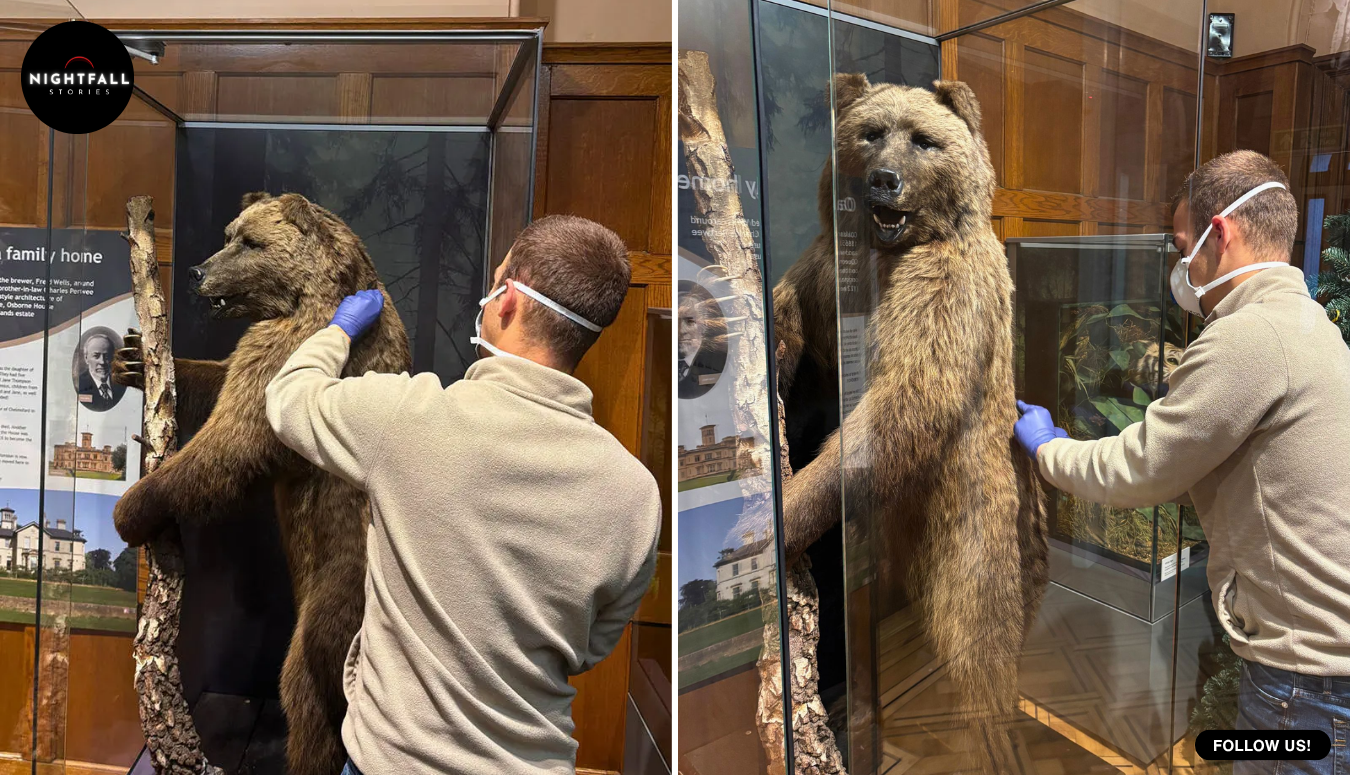
For most of a century, the brown bear standing in a small English museum has been the least serious object in the building. Children have hugged him. Toddlers have been named after him, sort of, because the museum’s under-fives club is called Boris Bear Cubs. He has been in the same room since 1932, watching school groups file past, and nobody who patted his flank on the way to the cafe ever thought of him as evidence of anything.
He is evidence now. A forensic science researcher asked the Museum of Chelmsford whether she could take hair from him, the museum thought about it and said yes, and those hairs are being turned into a reference library that could eventually help identify bear poaching across Europe using nothing more expensive than a microscope.
That last part is the whole point, and it is worth slowing down on, because it explains why a 120-year-old taxidermy bear in a municipal museum suddenly matters. When wildlife officers seize a bag of fur, or find a tuft snagged on a fence, or open a crate at a border post and find something that might be bear and might be dog, the gold-standard answer is DNA. DNA is reliable, DNA is accepted in court, and DNA is also expensive and slow and requires a functioning laboratory with trained staff and a supply chain of reagents. A great deal of the world’s poaching happens a long way from any of that.
A microscope is different. A decent comparison microscope is a one-off purchase that lasts decades, needs no consumables, and can sit in a regional office in a country where sending a sample abroad for sequencing would eat a year’s enforcement budget. If you can look at a hair down a microscope and say with confidence that it came from a brown bear rather than a boar, a dog or a cow, you have a screening tool that works where the expensive tool does not. You can triage. You can decide which seizures are worth sending for full analysis and which are not.
The catch is that this only works if somebody has already done the boring, unglamorous work of building the reference. Microscopic hair identification is a comparison discipline. You are not reading a barcode, you are matching what is in front of you against what is known, and the known part has to exist first. For domestic animals it largely does. Hayden Leigh, the researcher behind the project, has pointed out that there are hundreds of studies on dog hair and cat hair and the general run of household species, because those are the animals that turn up in ordinary criminal casework. Somebody’s jumper has cat hair on it. A burglar’s car has dog hair in the footwell. The forensic literature followed the caseload.
It helps to know what an examiner is actually looking at, because hair down a microscope is not the featureless thread it appears to be in daylight. There is an outer cuticle covered in overlapping scales, and the pattern those scales make differs between species in ways that are consistent enough to be diagrammed. There is a medulla running down the core, sometimes continuous, sometimes fragmented, sometimes absent altogether, and its structure is one of the strongest species indicators there is. There is pigment distribution, banding along the length, the shape of the hair in cross section, the way it tapers, the root. A trained examiner reads those features together rather than relying on any single one, and with a good reference set the species-level call can be made quickly and cheaply.
There is a caution attached to all of this that the field has learned the hard way. Microscopic hair comparison has a bruised reputation in human forensics, because for decades examiners in some jurisdictions testified that a hair from a crime scene matched a specific person, and a major review in the United States later concluded that a large share of that testimony had overstated what the science could support. The lesson was not that microscopy is worthless. It was that microscopy cannot individualise. Saying this hair came from that one particular human being is a claim the technique cannot carry. Saying this hair came from a bear rather than a dog is a completely different order of question, and it is the question the method is genuinely good at. Work like this stays carefully on the right side of that line, which is also why the reference set has to be built properly rather than assembled from whatever was lying around.
Wild species did not get the same treatment. The animals most likely to be trafficked are, in many cases, the animals least likely to have a published reference set, which is an absurd situation when you think about it for more than a second. Brown bears live across Romania, Bulgaria, Russia and a scatter of other countries, they are protected in most of them, and they are still killed illegally for parts and trophies. The hair is there at almost every stage of that trade. The reference to match it against largely is not.
Which brings the problem back to a very practical question. Where do you get bear hair to study, in quantity, without harming a bear?
You cannot walk up to a wild one. Zoo animals are possible but limited and heavily managed. Confiscated material is tied up in live cases and often degraded. The obvious remaining source is the one nobody thinks about, which is the enormous quantity of dead animals already sitting in museum cabinets, killed long ago by people with very different attitudes, and now doing nothing except being looked at.
Leigh’s argument, made when she approached the museum, was that taxidermy specimens can do real forensic work. They let you examine authentic animal hair in a controlled and ethical way. Nothing new dies. The animal in the case was killed generations ago by somebody else for reasons that have nothing to do with science, and this at least turns that into something useful.
The museum did not say yes automatically. Taxidermy collections sit awkwardly in modern museums, and the staff were conscious that Boris is not a specimen to the people who visit him, he is a character. Sampling a beloved object is not a small ask. After some consideration, they agreed, and a small amount of hair came off a bear who has been standing still since before most of the people in the building were born.
The research question underneath it is narrower and more interesting than it first sounds. Leigh is not simply cataloguing what brown bear hair looks like. She is asking whether it looks the same everywhere on the same bear.
That matters enormously in real casework, and it is the kind of thing that only becomes obvious when you imagine the actual moment of seizure. An officer does not recover a complete pelt with a map attached. They recover a tuft. A few strands. A clump from the inside of a container. Nobody knows whether that came from the shoulder, the belly, the rump or the face, and if hair characteristics vary significantly across an animal’s body, then a match against a reference built from one region might fail against a sample taken from another. The whole method would be quietly unreliable in exactly the situation it was built for.
So the work involves comparing hair from different parts of the same animal, measuring how the microscopic features shift, and working out how wide a reference set has to be before it can be trusted. It is slow and it is repetitive, and it is the difference between a technique that stands up to cross-examination and one that does not.
There is a second practical wrinkle that the work has to account for. Museum hair is old hair. It has been treated with whatever preservatives were normal at the time, exposed to a century of light and dust, and handled by an unknown number of hands. Any reference built from historic taxidermy has to be honest about how those decades might have altered the features being measured, and about which characteristics survive that treatment unchanged and which do not. Structural features like scale pattern and medulla tend to be more robust than colour, which is one reason the emphasis falls where it does. It is another slow question with no shortcut around it.
Leigh graduated with first-class honours in forensic science and has carried the work forward into doctoral research at the University of Staffordshire, supervised by Professor Claire Gwinnett, who leads the university’s forensic fibre and microplastic research group. Gwinnett’s career is a good illustration of how narrow trace evidence expertise turns out to be weirdly portable. She works on fibres, hair, glass and paint, and the same skills that let you say which jumper shed which thread also let you count microplastics in seawater, which is why her group ended up doing environmental pollution work alongside criminal casework. She teaches wildlife crime investigation, and has collaborated with a wildlife forensic academy in South Africa, where the gap between what a court needs and what a field officer can actually produce is not a theoretical problem.
There is an honest limit to state here, and it should be stated before anybody gets carried away. This is research in progress. There is no peer-reviewed paper yet, no validated protocol published for other laboratories to adopt, and no case that has gone to court on the back of it. Nobody has been convicted of anything because of Boris. What exists is a well-framed question, a growing reference set, and a plausible route from one to the other. That is how forensic methods actually begin, and most of the techniques that now look inevitable in a courtroom spent years at exactly this stage, being checked by somebody in a lab coat who was not yet allowed to claim very much.
The museum, meanwhile, got an unexpected second story out of the whole thing. Going back through their own files while the research was being arranged, staff turned up paperwork suggesting that Boris may not have been a male bear at all, and may have been a juvenile rather than an adult. The name has been on him since long before anyone currently working there arrived, and the records behind it are thin. Settling the question properly would mean intrusive genetic testing on a historic specimen, which is not something a museum does casually to an object that generations of visitors think of as a friend. So the mystery sits there, unresolved, and the museum seems fairly relaxed about it.
That tension is running quietly through the entire project. A taxidermy bear is a relic of an attitude to animals that most museums now find difficult, and Chelmsford has not pretended otherwise. A council representative involved in the decision acknowledged the discomfort directly while making the obvious point in its favour, which is that if a bear killed a century ago can help stop bears being killed now, that is about the best available outcome for an object that cannot be undone. It highlights, as she put it, the scientific value of historic taxidermy collections in a century that did not create them.
The museum has leaned into it rather than hiding it. This autumn it is running a public talk with Leigh and Gwinnett called Behind the Case: A Bear Poaching Investigation, and the hook is not a slideshow. Visitors get to look at Boris’s hairs under a microscope themselves. Whatever else that does, it collapses the distance between a display case and a laboratory in a way that no amount of interpretive signage manages, because the thing under the lens is the thing in the corner of the room they just walked past.
It is also a small correction to how people think about museum collections generally. The usual assumption is that a specimen in a case is finished, a closed book, an object whose job is to be looked at. In practice a very large amount of modern science runs on material collected by people who had no idea what it would later be used for. Natural history collections have been mined for evidence of pesticide accumulation, historic disease, shifting body size under climate change and shrinking ranges, all of it recoverable from animals gathered by Victorian collectors with completely different intentions. The collector’s purpose does not constrain the specimen’s usefulness. It just determines what happened to be kept.
Boris is now part of that. A bear shot somewhere in Europe around 120 years ago, stuffed, sold, installed in an English market town in the 1930s, and stood in the same spot ever since while the world rearranged itself around him, has become a physical standard against which future evidence might be measured. He did not do anything. He never does. That is rather the point of him.
What happens next is undramatic and will take years, which is the usual shape of anything that ends up being genuinely useful. The reference set grows. The variation between body regions gets measured and written up. If it holds, the work gets published, and other researchers try to break it, and if they cannot, it eventually filters into training material and then into the toolkits of people who investigate wildlife crime for a living in places where the nearest sequencing facility is a plane ride away. Somewhere down that chain, an officer looks at a hair through a lens and knows what they are holding.
The bear will not be there for that. He will be in Oaklands Park, in the same room, being photographed by children who have no idea, and who will keep calling him Boris regardless of what the files eventually say.