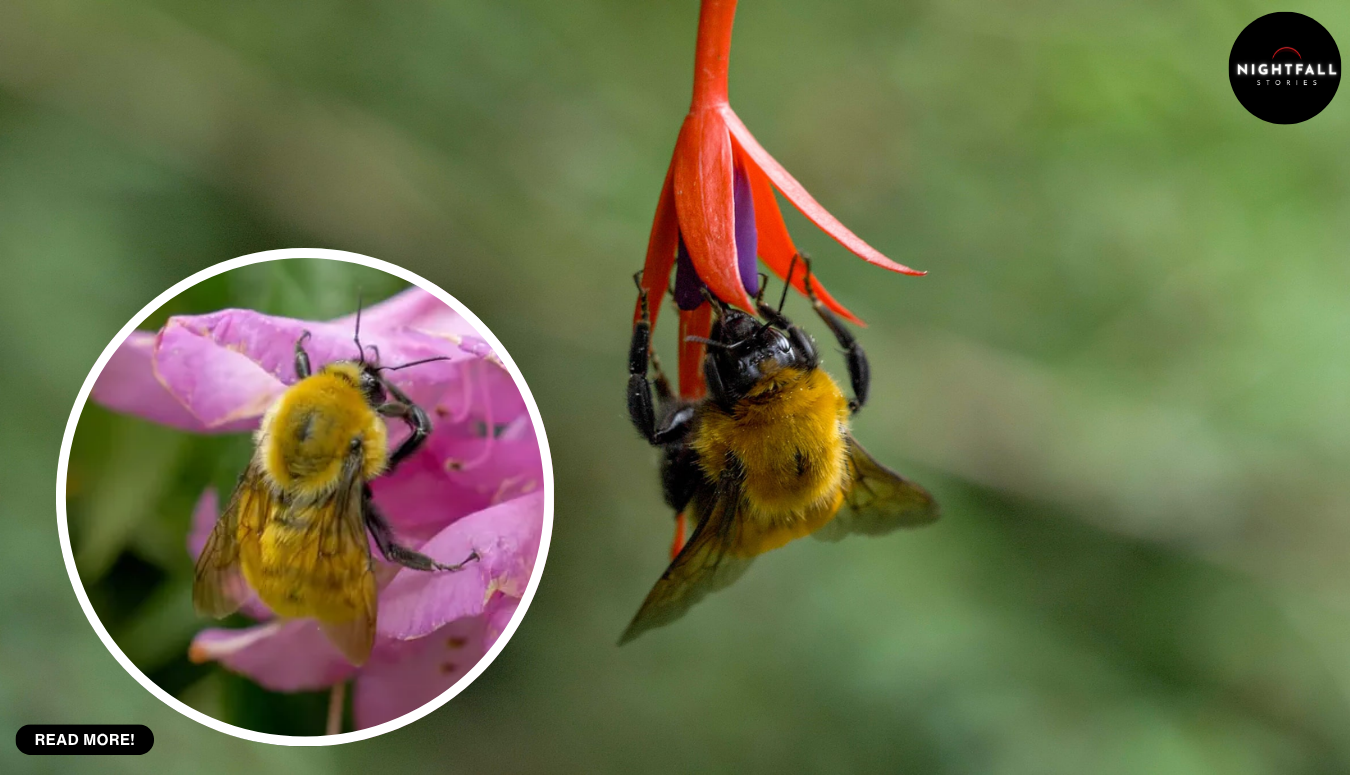
Start with the animal, because once you can see it the rest of this matters more. Patagonia’s native bumblebee is enormous. A queen is roughly the length of a AA battery and considerably rounder than one, covered in dense ginger fur that looks less like markings than like a coat she is wearing. People who have held one describe something closer to a small mammal than an insect. It is the only bumblebee the southern cone of South America ever had, and it has a different name in every language that grew up around it: mangangá in Argentina, moscardón in Chile, and duillin or diwmeñ in Mapuche. Its scientific name is Bombus dahlbomii.
Marina Arbetman has spent thirty years in Patagonia and has been working on bumblebees since 2005. She is a biologist at the Institute of Research on Biodiversity and Environment, a joint institute of Argentina’s national research council and the National University of Comahue, based in Bariloche. For most of that time her job has included mapping where the giant still is. The map keeps getting smaller, and she is now facing a decision that she does not want and cannot avoid: whether to take the last wild individuals she can find and try to breed them in captivity.
How it got to that point starts with berries.
In the 1980s a Belgian veterinarian named Roland de Jonghe worked out how to breed bumblebees commercially. That sounds minor. It was not. Bumblebees are better than honeybees at pollinating certain crops, particularly the ones grown under cover, because of the way they vibrate their flight muscles against a flower to shake pollen loose. Greenhouse tomatoes, blueberries, raspberries and cucumbers all respond to it. Once a bumblebee colony could be bred, boxed and shipped, the pollination of high value crops became something you could buy by the unit. De Jonghe’s work became an industry, and one of the companies that grew out of it, the Belgian firm Biobest, is now a major supplier. Its research director is one of the voices arguing that the bees are not the problem, which is worth knowing when you weigh what he says, because the company sells them.
The species the industry standardised on is Bombus terrestris, the buff-tailed bumblebee, a common European animal. In 1997 Chile’s agriculture and livestock service authorised its import. The following year the country approved its use at scale, with a condition attached: the bees were to stay inside greenhouses. Within a few years growers were releasing them into open fields anyway, and by 2001 the colonies were being sold commercially inside the country.
The scale is hard to take in. One count of the official import records puts the total brought into Chile between 1997 and 2022 at more than one point six million colonies and queens. A 2018 scientific paper that went through the same records found that up to 2016 the country was taking in an average of about sixteen and a half thousand colonies every year, plus some eight hundred and sixty thousand queens cumulatively since the trade began. What nobody has is a record of how many were released, because no such record was ever kept.
A buff-tailed bumblebee in a cardboard box in a berry field near Osorno does not know it is a commercial product. It is a wild animal that has been handed a continent with no competitors adapted to it. It walked out, and it kept going.
The first time anyone recorded it living wild in northwest Argentine Patagonia was 2006. By 2017 it had been documented on Navarino Island, at fifty five degrees south, which is close to the bottom of the inhabited world. That is most of the length of a continent in roughly a decade, across the Andes, through steppe and temperate rainforest and over mountain passes, by an insect whose queens found new colonies one at a time. The figure that gets used for the pace of the advance is about two hundred kilometres a year, and when you set it against those two dated records it stops sounding like a rounded guess and starts sounding like arithmetic. Two hundred kilometres is further than most people drive in a week. It is a front line moving faster than a conservation agency can hold a meeting about it.
Here is the part that is most often got wrong, and it is the part worth slowing down for. The European bumblebee is not killing the giant in a fight. They do not fight. There is no predation and no aggression to photograph. What happens is quieter and much harder to stop.
Start with the simplest mechanism: there is a fixed amount of nest space and a fixed amount of food. Bumblebees nest in cavities, in abandoned rodent burrows, under tussocks, in hollows. The buff-tailed bumblebee is noticeably smaller than the giant, it builds up colonies faster, and it arrives in numbers. It takes the holes and it takes the nectar and the pollen. A giant queen emerging from hibernation into a landscape where the cavities are occupied and the flowers have already been worked over that morning is not under attack. She is just too late, every day, for the rest of her life.
Then there is what the European bee does to the flowers themselves. It is a nectar robber. Rather than entering a flower the way the plant evolved to be entered, it bites a hole in the side of the corolla and drinks from there, which gets the sugar without doing the pollination. In some places the native bees have learned the trick by watching, which means the plants lose on both sides of the exchange. That reshapes the flowering landscape that the giant depends on, and it does it invisibly, flower by flower.
And then there are the diseases, which the researchers who have worked on this longest treat as the most serious mechanism of all. Commercial colonies carry a load of parasites, fungi and viruses. The ones that have been identified in this system by name include the gut parasite Crithidia bombi, the fungal pathogens Nosema bombi and Nosema apis, the parasite Apicystis bombi, deformed wing virus and Ascosphaera. These organisms can move into a colony through its larvae, through foraging workers, or through an overwintering queen, and they move between species on shared flowers, which is the one piece of territory that a native bee and an introduced one cannot avoid sharing.
Arbetman was the lead author on a 2012 paper in the journal Biological Invasions that found Apicystis bombi had arrived in Patagonia along with the imported bees. The image the researchers reach for is the arrival of a pathogen in a population that has never met it, which is how an animal with no evolved defence against something can collapse without anything visibly happening to it. The honest position, and the one the authors took themselves, is that finding the parasite does not prove it caused the collapse. They described their own evidence as circumstantial, and said plainly that the presence of the parasite alone does not let them conclude it is responsible.
That caution matters, and it should be carried through. Competition for nests and food, disease spillover, nectar robbing and the general loss and conversion of habitat are all implicated in what has happened to the giant, and no one has ranked them. The collapse is not in doubt. The weighting is.
The collapse itself is documented in a way that is unusually grim for an invertebrate, because invertebrates are mostly not counted. In northern Chiloé, an island where the before and after could be measured, the native bee’s relative abundance fell by 99.4 percent. In the Chalhuaco valley in Argentina, where researchers had been monitoring for more than twenty five years, it has not been recorded since 2007. The International Union for Conservation of Nature lists the species as endangered, and its assessment records a loss of more than 54 percent of the animal’s range in a single decade. By the time journalists went back to the subject last year, the working estimate for the overall decline was close to 90 percent.
Somebody did try the legal route. In 2018 a group of scientists led by Cecilia Smith-Ramírez, an ecologist at the Universidad de Los Lagos in Osorno, published a paper in the Chilean journal Gayana setting out eleven reasons why the country should stop importing the commercial bumblebee and start controlling the ones already loose. The list is not sentimental. It covers the risk of new genotypes establishing themselves across Chile’s range of climates, the risk of importing fresh strains of disease, the damage done to native plants by nectar robbing, the threat to honey production, the possibility of the invasion spreading further across South America, the cultural loss to Indigenous peoples for whom the giant is not a data point, and the blunt practical objection that you cannot control a species while you are still importing it. It also notes something that undercuts the commercial case directly: the bought colonies do not consistently increase yields.
Later that year, working with an environmental lawyer and alongside José Montalva of a campaign group set up to save the native bee, Smith-Ramírez filed a complaint with Chile’s environmental prosecution body. It cited a provision of the national penal code that makes it an offence to introduce organisms that endanger animal or plant health. Chile’s environmental police investigated. When it reached a judge, it was dismissed on procedural grounds: because the conduct complained of dated to 1998, when large scale importation began, the five year limitation period had expired. Smith-Ramírez’s answer was that the complaint described imports that were continuing year after year, which would make it an ongoing offence rather than a historical one. The dismissal stood. The imports continue, in the tens of thousands of colonies a year.
There is a counter-argument from the science that is more interesting than simply banning things, and it has started to show up in the fields. Smith-Ramírez’s own research found that native bees, the giant among them, are better pollinators of blueberries than the imported species is. One farmer who stopped buying commercial colonies reported a crop increase of about 20 percent the following season. That is a single farm and one season and it should not be oversold, but it points at something awkward for the industry: the animal being displaced may have been doing the job better than the animal that displaced it.
Meanwhile Arbetman and her colleagues have been trying to find out where the giant still is, which is harder than it sounds in a landscape the size of Patagonia. One of the more inventive answers is acoustic. Bumblebee species have different flight tones, and if you can teach a machine to tell them apart you can leave boxes out in the field and let them listen. Arbetman has been working on this with Anton Gradišek, a physicist at the Jožef Stefan Institute in Ljubljana who works on identifying bees by sound, using an open source acoustic monitoring device developed by Patrick Chwalek at MIT. A graduate researcher, Victoria Campopiano Robinson, is part of the same effort. It is a way of finding an animal that is now rare enough that you cannot reliably find it by walking around looking for it.
And that is what brings the decision forward, because finding the last ones is only useful if you know what you intend to do with them.
The National Geographic Society has funded a dedicated breeding facility. The building exists. The plan was to go out in the southern spring, catch queens and start a captive population, which is the standard move when a species gets this thin. Two things make it a far worse bet than it sounds.
The first is purely technical. Breeding bumblebees in captivity is genuinely difficult, and the know how that exists is for the European species, developed commercially over four decades and held privately. Nobody has an established protocol for the giant. A bumblebee’s life cycle runs through a hibernating queen, and getting her to come out of hibernation, mate, found a colony and produce new queens under artificial conditions is a chain of steps where any one failure ends the attempt for a year. The most recent attempt at this had to be put on hold before it started, because bumblebee numbers generally were low that spring and the researchers did not want to take breeding queens out of a population that was already having a bad year.
The second is the one with no good answer. Every queen taken into the facility is a queen not founding a colony in the wild. If the wild population is thin enough that removing a handful of queens tips it over, then the removal was the thing that finished it. Marcelo Aizen, an ecologist at the same institute, put the logic of it as directly as it can be put: if taking a few out of the ecosystem this year dooms the population, then it was already doomed. That is true, and it is not comforting, because it works in both directions. It means the removal probably is not what kills them. It also means that by the time you are willing to risk it, you may be well past the point where a captive population could ever be put back.
Arbetman’s own version of it is shorter. If this is the last chance, she has said, then perhaps it is already too late.
So she is standing in front of two options, neither of which she can test in advance. Leave the last giants in the wild, where the thing that is displacing them is still arriving by the tens of thousands of colonies a year with the law on its side, and hope that enough of them hold on in some valley the front has not reached yet. Or go out in the spring, catch the queens, bring them into a building nobody has ever successfully bred this species in, and accept that if it fails she will have spent the last ones finding out.
She has not decided. The spring is coming round again, which means she will have to.