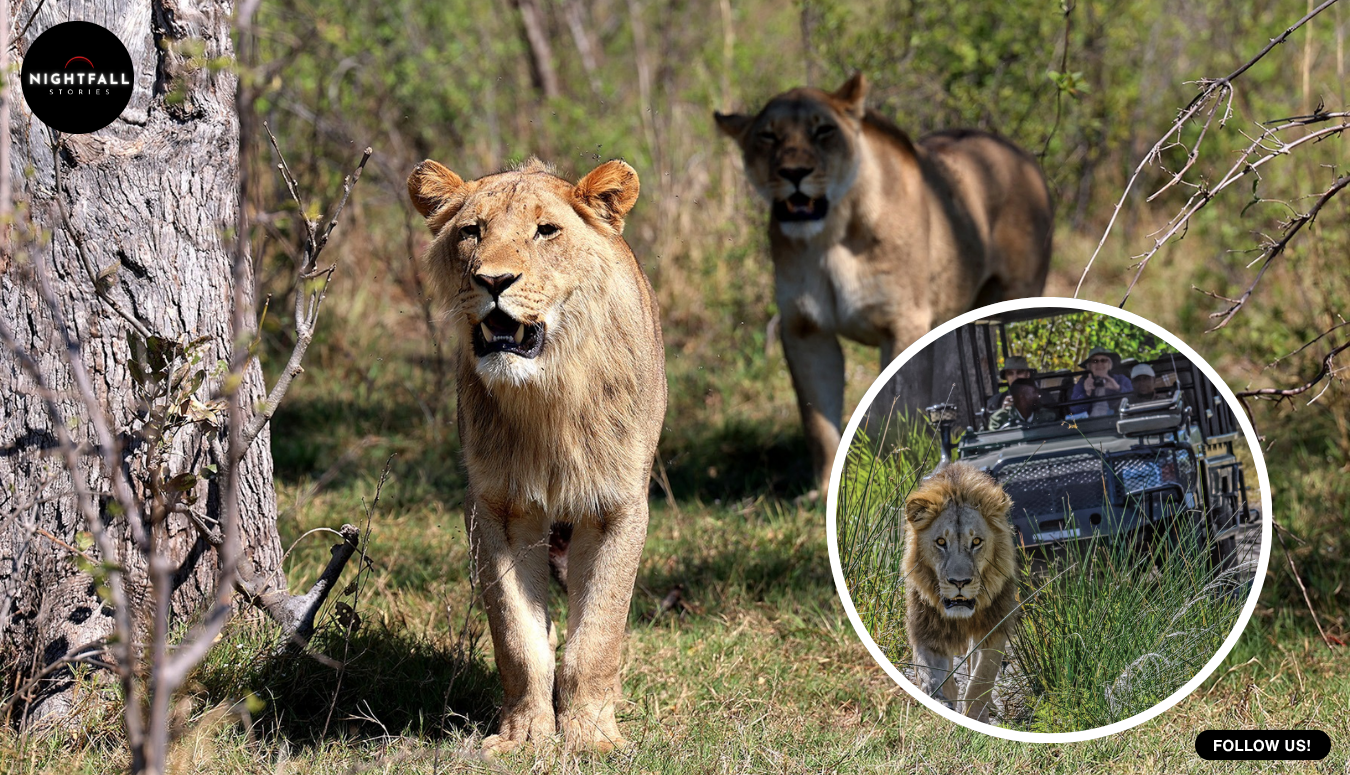
Kutlwano Teko’s phone tells him the name of the lion. Not that there is a lion nearby, which he could have guessed, but which lion, and how far away it is. The names are in the local languages of the eastern Okavango panhandle, chosen by the villages themselves, so a herder reading a text message at dusk is not being warned about vermin. He is being told that a particular animal, one he could probably describe, is a few kilometres out and heading his way.
Teko is a herder from Gunutsoga, a village on the strip of farmland that runs along the eastern edge of the Okavango Delta in Botswana. His family has farmed cattle for generations. He says plainly that he was a farmer and his grandfather was a farmer, which is the only credential that counts in a conversation with another herder. He is now the lead ecoranger for a project called CLAWS Conservancy and the person who trains everybody else, which means that when a new herder wants to know whether any of this works, Teko is the one who has to answer.
The reason the project exists is not a happy one and should not be smoothed over. In 2013, in this one stretch of country, about half the local lion population disappeared. Researchers identified twenty eight of them as having died from poison. Andrew Stein, the American big cat biologist who went on to found CLAWS, has put the figure at twenty five to twenty eight lions in a single year and called it completely unsustainable, which it was, for the lions. The poison was laid in bait, and bait does not read collars. Hyenas, jackals and vultures died alongside the lions.
It is tempting to write that year as a crime, and easier to write it than to sit with what was actually happening. A cow in this part of the world is not an asset on a spreadsheet. It is school fees, a funeral fund, a daughter’s wedding, the thing you sell when the maize fails. There is no insurance adjuster. Government compensation for animals killed by predators exists, but it moves slowly and pays less than the animal was worth, and a household that has lost three cattle in a month is not in a mood to wait on paperwork. Lions came out of the Delta at night, took cattle from unfenced kraals, and came back. Poison was cheap, available and effective, and it required nobody to sit up all night with a torch. The people who used it were not monsters. They were farmers who had run out of options and reached for the one that worked.
What CLAWS proposed instead sounds, at first hearing, far too soft for the problem. Put satellite collars on the lions. Let the villages name them. Push the collar data out as text messages to anybody who signs up. Then train local people as ecorangers, pay them a real salary, and have them walk the cattle through the day and close them into a portable enclosure at night.
The alert system was built with the University of Siegen in Germany, and the mechanics are deliberately unglamorous. A collared lion crosses into the farming zone, the system works out which subscribers are close enough to care, and their phones ring with the lion’s name and its distance. In 2022 it generated roughly twenty thousand of these messages, nearly double the twelve thousand of the year before. By the middle of last year Stein was describing more than fifty thousand alerts over six years to a membership of around 389 people. By the time a journalist visited the panhandle for the Daily Maverick late last month, the figures given were around 380 farmers enrolled and more than seventy thousand alerts over seven years. The small discrepancy between 389 and 380 is the kind of thing that happens to a membership list over a year and is worth noticing rather than hiding.
Naming the lions was not sentimentality, or not only that. Stein’s argument is that a named animal becomes an individual with habits, and an individual with habits can be predicted. Herders started to know that one particular lioness tended to come through a certain gap, and that a certain young male was the one causing the trouble, which is information. A generic lion is a threat you can only respond to after the fact. A specific lion is a problem you can get in front of.
The herding half matters more than the technology, and anyone who writes this story as an app story has missed it. Communal herding started in the village of Eretsha in 2018 and spread from there. Cattle that used to graze unsupervised and drift wherever they liked are now walked out in a managed herd by trained ecorangers, grazed on rotated ground so the rangeland gets a chance to recover, and brought back at dusk into a mobile boma, a movable corral that is shifted around the landscape so that the dung fertilises ground that needs it instead of poisoning one spot. Nobody is sitting outside with a rifle. The cattle are simply somewhere a lion cannot easily get at them, and somebody competent is with them all day.
The ecorangers are trained in rangeland ecology, basic veterinary work and conflict mitigation, and they are paid. That last part is not a footnote. Teko’s own arc is the project in miniature and he is honest about how it began, which is that in 2019 most farmers said no. They did not want strangers walking their animals. They did not believe the lion thing. What changed their minds was not an argument but a comparison: the early adopters’ cattle came home, every night, and the holdouts’ did not. The herding project now has about 96 farmers in it, far fewer than the 380 who take the alerts, and that gap is itself informative. Signing up for free text messages is easy. Handing your cattle to a communal herd is a different order of trust.
The numbers on losses are good and should still be handled with care. Four herds totalling about 700 cattle have reportedly lost three animals to lions across four years. In the certifying body’s announcement last year, Stein was quoted saying participating farmers had not lost a single head of cattle to lions in three years. Those two statements do not quite agree, and the most likely explanation is that they are counting different herds over different windows, but a reader is entitled to know that the headline figure is not nailed down to the animal. The lion population, meanwhile, is said to have gone from around forty to more than a hundred, and the last confirmed poisoning in the area was in 2019. Both of those are the project’s own counts rather than a government census, which does not make them wrong, but it does mean the organisation being judged is also the organisation keeping score.
There are smaller inventions in the panhandle that deserve a mention because they show what the place actually looks like. Elephants are a bigger threat to crops than lions are to cattle, and farmers have improvised against them: tins filled with rocks and strung on wire, which rattle and bang when something large walks into them, and the smoke of burning chillies, which is a serious irritant and persuades an elephant to go round rather than through a field of seedlings. None of that came from a grant proposal.
And then there is the part of the story that changes its shape, which is that someone started paying for it.
Last year the cattle from these herds were certified by the Wildlife Friendly Enterprise Network, the first cattle in Africa to carry the label. Then Wilderness, the conservation tourism group that runs lodges in the Delta, bought fourteen of them for its Vumbura Plains and Little Vumbura camps, followed later in the year by a second purchase of roughly fifteen more, about three tonnes of beef, and agreed to take a quarterly supply. The chef at Vumbura Plains, Kebadiretse Kanjenje, known as KB, is himself from a panhandle village, and he is now cooking for guests the meat of cattle raised a few hours’ drive from where he grew up, under rules that exist because lions used to eat them.
That is a satisfying sentence and it is also where the careful work starts, because a premium for certified beef only works if three separate things hold at once: the certification has to mean something, the buyer has to keep paying, and the animal has to physically get to a place where it can be turned into meat.
Take the certification first. Certified Wildlife Friendly is a label run by a non profit, established in 2007 and used in around a dozen countries. Its criteria are reasonable: the product has to contribute directly to conserving a species where that species actually lives, it has to have a positive effect on the local economy, the community has to be involved in production, and there has to be an enforcement mechanism with immediate consequences, including losing the economic reward, if a producer breaks the rules. The network belongs to ISEAL, the international body for sustainability standards. But its compliance is verified by second party assessment, which means the organisation that owns the label is also the organisation that checks you are complying with it. That is not fraud and it is common in small schemes, where an independent audit can cost more than the whole premium is worth. It does mean that nobody outside the arrangement is currently signing off on it, and a buyer who one day decides to be strict about supply chain assurance would notice.
Now the money, as precisely as the public record allows. Farmers on the eastern panhandle who sell into this arrangement get a ten percent premium on median price. That is the headline, and it is not the most important part. The more important part is in the buyer’s own announcement: Wilderness pays within thirty days, against a conventional wait of roughly six months at a lower commercial rate. For a household that sells a beast when it needs cash, being paid in a month rather than half a year is not a bonus, it is a different financial instrument. Ten percent more, five months sooner, is the actual offer.
Between the herder and that payment sits Beef Boys, a citizen owned butchery in Maun. The cattle are trucked there, about 150 kilometres away, which on the panhandle’s gravel takes something in the order of ten hours. Ten hours in a truck costs money, costs the animals condition, and is the single most fragile link in the chain. CLAWS has just finished a feasibility study for a slaughter facility in the village itself, and Stein’s own comment on it is the most useful thing anybody has said about this project: running such a facility is a whole other business, and there is a reason it has not been done before. He has also said they are still working out the supply chains with a business consultant, to build a proper model for scaling up. Separately he has listed the obstacles to the night response side as vehicles and torches, which is to say equipment and fuel.
So, the honest answer to the question a reader should be asking. If the funder walked away tomorrow, what survives?
The beef agreement probably does, for as long as the lodges want the product, and demand has reportedly been running ahead of supply. Wilderness is the exclusive buyer, which is efficient and also a single point of failure, since tourism revenue is weather, exchange rates and other people’s holiday plans. The certification survives as paperwork but would need somebody to keep administering it. What looks least safe is the machinery: the collars, the satellite subscriptions, the alert servers, the vehicles, and above all the salaries of the ecorangers, which are the reason the cattle come home. Nothing in the public record suggests that twenty nine cattle a year of premium beef pays for any of that. The premium rewards the farmers for behaving differently. It does not yet fund the system that makes behaving differently possible. That is the gap, and the feasibility study and the business consultant are both attempts to close it, and neither has closed it yet.
Which leaves the thing that is hardest to put a number on and might be the most durable part. In 2013 a lion in the panhandle was an anonymous animal that ate your savings. Today a lion in the panhandle has a name in your own language, a known route, and a price attached to leaving it alone. Teko spent his first season being told no by his neighbours. Last month he was in a room in Maun where chiefs, a butcher, a safari company and a conservation biologist all sat down to talk about selling beef, which is a strange outcome for a story that started with poisoned bait.
He still gets the alerts. The lions are still out there, more of them than before, which is the point and also the problem. The difference is that when the phone goes, somebody now knows which one it is, where the cattle are, and who is paid to walk out and move them.