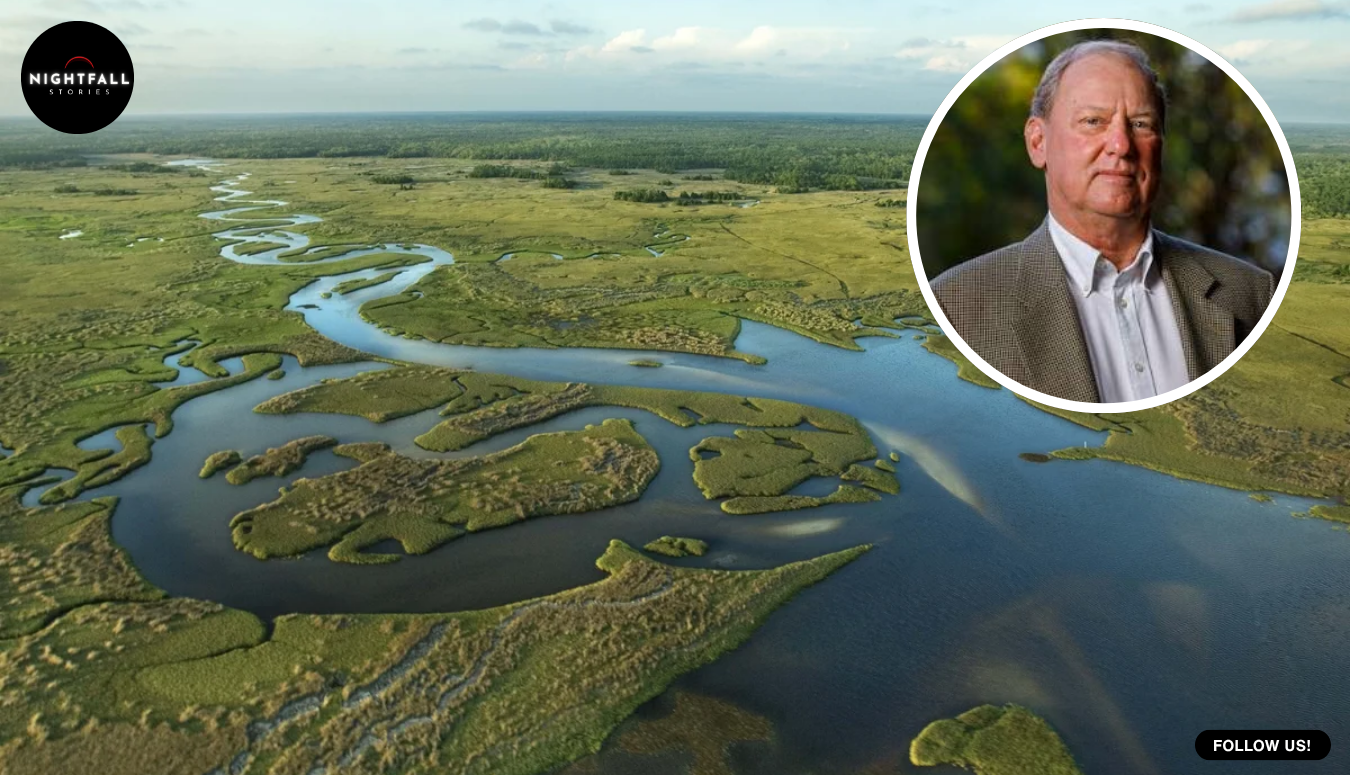
Thomas Van Lent walked into a Miami-Dade County courtroom in the summer of last year and surrendered to serve ten days in jail. The reason was not fraud, not violence, not money. It was data. Specifically, it was what a Florida judge had concluded he did with files belonging to his former employer, and with the contents of his own laptop, after he resigned from one of the most influential conservation organisations in the United States.
Roughly fourteen months after he walked out of that jail, his name went on a report arguing that the reservoir Florida’s governor has called the crown jewel of Everglades restoration is nowhere near large enough to do the job it was sold as doing. Not slightly undersized. Short by a factor of four or more.
That is the shape of the story, and it is worth slowing down on both halves of it, because each one is easy to get wrong.
Start with the thing being built, because it is genuinely enormous. In the flat sugar country south of Lake Okeechobee, in a landscape of straight canals and black soil that was swamp within living memory, the US Army Corps of Engineers and the South Florida Water Management District are digging a reservoir across about 10,500 acres. Roughly sixteen square miles of water. Around twenty-three feet deep at full capacity. It is designed to hold 240,000 acre-feet, which the agencies translate for the public as something over 78 billion gallons. Alongside it sits a 6,500-acre stormwater treatment area, an engineered marsh whose job is to strip phosphorus out of the water before it moves south. The combined price tag is given as about 3.9 billion dollars. Ground was broken on the reservoir component three years ago, and the state has since announced an agreement with the Department of the Army that pulls the completion date forward from 2034 to 2029.
The purpose of all that earthmoving is simple to state and very hard to achieve. For more than a century, the water that once spread slowly south out of Lake Okeechobee across the Everglades has been diked, pumped and redirected. When the lake rises, water gets discharged east and west down two rivers that were never meant to carry it, and the result has been the algae blooms that periodically shut down waterfronts on both coasts of the state. The reservoir is meant to catch that water instead, clean it, and send it south where it used to go. Officials describe the finished system as delivering something like 470 billion gallons of clean water a year to the Everglades and Florida Bay.
Van Lent’s report, written for Friends of the Everglades, does not dispute that the reservoir will help. It argues that the amount of storage in it is not remotely proportionate to the amount of water the system has to move. The figure in the report is about a million acre-feet of storage in the Everglades Agricultural Area, on top of what the current reservoir will hold. Not a deeper version of the same thing, either. What he describes is a wide, shallow sheet of water sitting on the landscape, something closer to a second and much smaller Lake Okeechobee than to a conventional engineered basin. Inside Climate News, which first reported the findings, put the alternative at something on the order of 77,000 acres at about thirteen feet deep.
The logic behind the shallowness matters. Deep water in a sub-tropical reservoir is water under pressure, water that has to be pumped in and pumped out, water that stratifies and goes anoxic and grows the wrong things. Shallow water spread across a wide footprint behaves more like the thing being restored. It also, and this is the part that makes the number politically radioactive, requires land. Friends of the Everglades is campaigning for the acquisition of at least 100,000 acres in the Everglades Agricultural Area, which is some of the most valuable farmland in the southern United States and is held in large part by the sugar industry. The organisation’s executive director, Eve Samples, has been making that case publicly. Paul Gray, an environmental scientist who has spent thirty-eight years studying Lake Okeechobee, is among the voices in the same reporting arguing that the current design is not sized to the problem.
To understand why 100,000 acres is a sentence that stops conversations in Florida, it helps to know what the Everglades Agricultural Area actually is. It is not ancient farmland. It was designated in 1948 by the Central and Southern Florida Project, the federal flood-control scheme that followed decades of drainage and that carved out an area originally set at 470,000 acres, something like a quarter of the pre-development Everglades, for agriculture. Today the area runs to roughly 700,000 acres, and by most accounts around 500,000 of those acres are controlled by sugar companies, principally US Sugar and Florida Crystals. Asking the state to buy 100,000 acres in that landscape is not a land transaction. It is a request that one of the most organised industries in the state give up a fifth of its ground, and everybody involved in the conversation understands that.
It also helps to understand why the water has to go anywhere at all. Lake Okeechobee is ringed by a dike, built and rebuilt over most of a century after hurricanes pushed lake water into the towns on its southern shore and killed thousands of people. The dike does what it was built to do, and the consequence is that the lake no longer overflows south into the marsh the way it did for millennia. When the lake rises past the level engineers are willing to tolerate, the water has to be released somewhere, and the somewhere is east and west through rivers that were never designed to carry it. That is the mechanism behind the algae events that periodically close waterfronts on both coasts. Every argument about the reservoir is ultimately an argument about how much of that water can be caught and sent south instead, and how fast.
So that is the engineering argument, and it can be assessed on its merits by anyone who wants to go and read it. What makes this more than a technical dispute between an agency and an advocacy group is who signed it.
Van Lent is a hydrologist. He holds a doctorate and he spent years as chief scientist of the Everglades Foundation, which is a separate organisation from Friends of the Everglades and the distinction is not cosmetic. The Everglades Foundation is a large, well funded, politically connected group founded in the 1990s. Friends of the Everglades is older and smaller, founded in 1969 by Marjory Stoneman Douglas, the writer whose book gave the Everglades the phrase river of grass. Confusing the two is the single easiest mistake to make in this story, and the two organisations are on opposite sides of Van Lent’s own history.
He left the Everglades Foundation in early 2022. On his way out he said publicly that he was going somewhere that put facts ahead of politics, a remark widely read as a criticism of his former employer’s willingness to accommodate the state’s preferred version of restoration progress. Within weeks the Everglades Foundation sued him. Its case was that he had taken trade secrets, meaning the foundation’s modelling work and data, when he went.
Here is where precision earns its keep, because this part of the story has been described loosely in a lot of places, in both directions.
The lawsuit itself was settled. In September 2022, a few months after it was filed, both sides reached an agreement and Van Lent signed a permanent injunction. That should have ended it. It did not, because the foundation then went back to court alleging that he had breached both the original temporary injunction and the settlement one. What followed was not a continuation of the trade secrets suit. It was a contempt proceeding, which is a different animal: the question in front of the judge was no longer whether Van Lent had stolen anything of commercial value, but whether he had disobeyed a court order.
In the spring of 2023, Judge Carlos Lopez found him guilty of indirect criminal contempt of court. The findings were specific. The judge concluded that Van Lent had downloaded foundation files and had erased tens of thousands of items of data from his laptop computer, and wrote that he had clearly intended to take the foundation’s materials with him for future use and had intentionally deprived the foundation of those same materials. Van Lent’s own account, given in testimony, was that he had copied material in order to keep an archival record of his own working life as a scientist. Character witnesses appeared for him, among them the Duke University ecologist Stuart Pimm, who described him as a scientist of extraordinary integrity.
The sanction was ten days in jail. That was the sentence handed down at the end of 2023, against a statutory maximum for the offence of six months or a 500 dollar fine. Separately, he was ordered to pay the Everglades Foundation about 177,700 dollars in legal fees and costs, and he filed for Chapter 7 bankruptcy. He appealed the contempt finding and lost; an appellate court upheld it in late 2024. He was ordered to surrender in the spring of last year, and he surrendered in the summer, serving the term in Miami-Dade County.
It is worth being plain about what that is and is not. It is not a conviction for theft, and no court found that he sold, published or commercially exploited anything. It is also not a technicality or a misunderstanding, and it is not accurate to describe him as having been jailed merely for having his own work on his own computer. A judge found, after a hearing with witnesses, that he had deliberately breached an order he had signed, and that he had destroyed data in the process. Both of those sentences are true at once, and the story only makes sense if you hold them together.
What happened next is the part that most people miss. He did not leave the field. He joined Friends of the Everglades, where the organisation’s own materials identify him as its senior scientist. He went back to doing the same arithmetic on the same watershed, for a group with a fraction of his former employer’s budget, having been through a lawsuit, a contempt finding, a bankruptcy and a jail term over the handling of exactly that kind of material.
There is no triumphant reading of that available. Bankruptcy is not a plot point and ten days in a county jail is not a badge. A man in his sixties with a doctorate and a long technical reputation spent four years of his life in litigation with the organisation he had done his best work for, and came out of it owing money he could not pay. The only thing that can honestly be said is that the work continued, and that the report now carries his name.
Which brings the two halves of the story into contact. The gap Van Lent’s report identifies is not a rounding error. The reservoir under construction holds 240,000 acre-feet. The figure in his report, for storage in the Everglades Agricultural Area in addition to that reservoir, is around a million acre-feet. Even allowing for every reasonable argument about how storage interacts with treatment capacity, conveyance south through the water conservation areas, and the timing of releases from the lake, a difference of that magnitude is not a disagreement about efficiency. It is a disagreement about whether the project as scoped can do the thing it is named for.
The agencies have their answers, and they are not frivolous ones. The reservoir is one component of a decades-long plan with dozens of moving parts, some of which are finished, some of which are decades out. Storage is not the only lever; the stormwater treatment area next door is doing work the reservoir cannot do, and water quality standards for what moves south are strict enough that simply holding more water would not by itself solve the problem. Nobody involved claims the reservoir finishes the restoration. The dispute is over whether the current design leaves the system structurally short, and that question turns on modelling assumptions rather than on anyone’s good faith.
It is also a question that will not be settled by the organisations arguing about it. It will be settled by water: by how many wet seasons arrive in a row, by how often the lake goes high and the discharges start again, and by whether the finished reservoir can absorb enough of that to change the pattern on either coast. Florida will find out in the 2030s whether the number in this report was alarmist or conservative.
The political problem with it is that the reservoir has been a success story for years before it has been a functioning piece of infrastructure. It has a groundbreaking ceremony on film, a cost acceleration to celebrate, a governor’s phrase attached to it and a line in multiple budget cycles. A report saying the crown jewel is undersized by several hundred thousand acre-feet is not a technical footnote in that context. It is an argument that the signature project is a down payment being described as a purchase.
And the most uncomfortable detail is the smallest one. The man making that argument is the man who was taken to court, found in contempt and jailed over how he handled Everglades data, and he is still working on the same numbers. Two hundred and forty thousand acre-feet is what is being built. A million is what his report says the Everglades needs. The distance between those two figures is the whole story, and it was published by someone who already knows exactly what it costs to hold on to Everglades data that somebody else would rather he did not have.