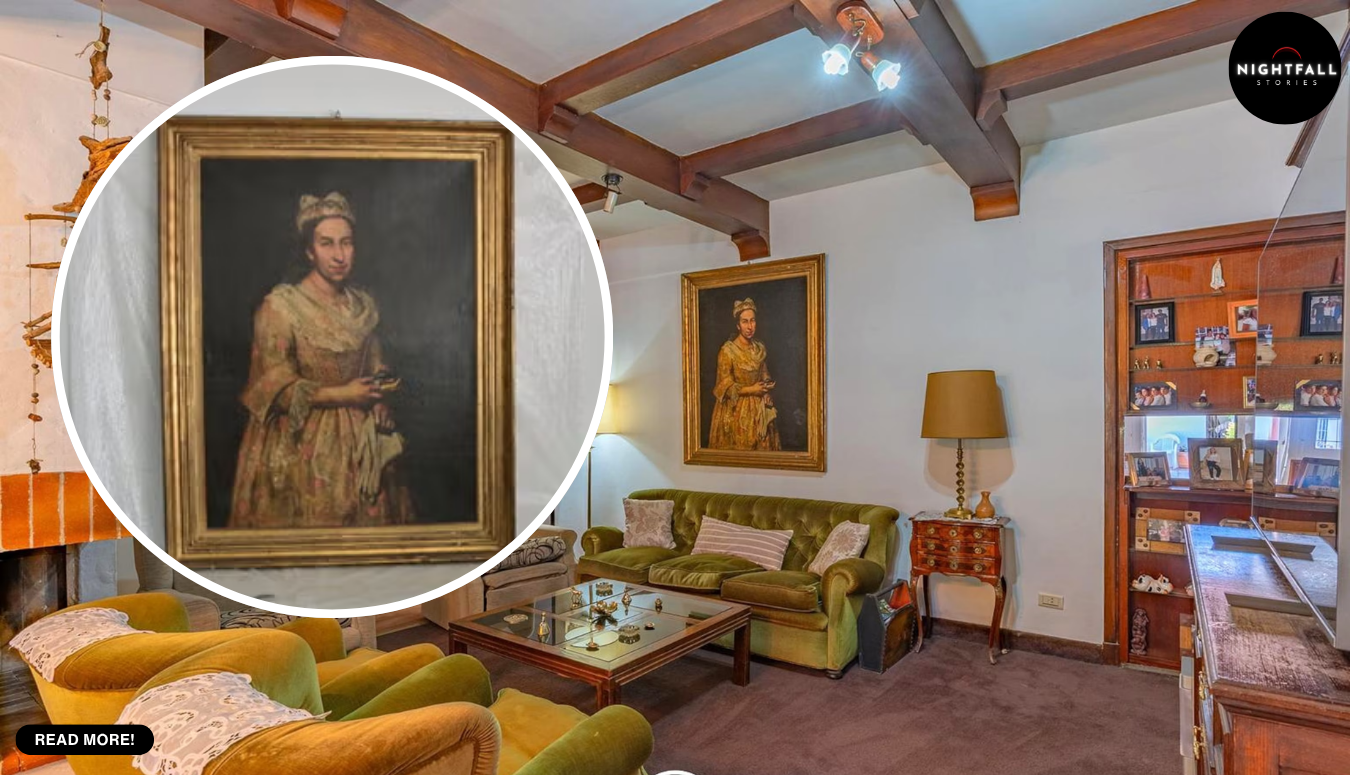
The photograph was doing the job every estate agent photograph does. Wide angle, good light, the furniture arranged to make a living room look like somewhere you would want to live. A green velvet sofa along the wall. And above the sofa, in a dark frame, the portrait of a woman in eighteenth century dress, hung at the height people hang pictures they have stopped noticing.
Two journalists in the Netherlands were looking at that photograph on an Argentine property website, and they recognised the painting.
They recognised it because they had been working for a long time on the man who used to own the house. They were going through everything they could find about his family, which is why they were reading property listings in a coastal city in Argentina in the first place, and the portrait on the wall above the sofa was on a list of works looted from a Jewish art dealer in Amsterdam after the German invasion. It had been missing for about eighty years. Anybody with an internet connection and a vague interest in buying a house by the sea could have scrolled past it.
The dealer was Jacques Goudstikker, who ran one of the most significant art businesses in Amsterdam before the war. When Germany invaded the Netherlands he fled with his wife and infant son, and he died in an accident during the escape. His gallery and its stock did not escape. The business was taken over and the inventory dispersed, and because Goudstikker had kept proper records of what he held, a great deal of that inventory remained identifiable decades later. That is the whole reason a picture on a property website could be matched to anything at all. Without the paperwork it would have been a nice old portrait above a sofa and nothing more.
The painting is called Portrait of a Lady. For a long time it was given to the Italian painter Giuseppe Ghislandi, and it is now attributed to Giacomo Antonio Melchiorre Ceruti, another Italian of the same broad period, which is the sort of reassignment that happens to Old Masters as scholarship shifts and which matters here mainly because it means the work appears in different records under different names. By one estimate it is worth somewhere around 288,000 dollars, converting a figure of 250,000 euros at the rate prevailing when the case was decided. That number is single sourced and it is also, honestly, not the interesting part of this story.
How it got to a living room in Mar del Plata is the next question, and the answer is one clean clause. The house had belonged to Friedrich Kadgien, a German who worked in the financial machinery of the Nazi regime and who prosecutors have described as a financial adviser to Hermann Goering. After the war he left Europe for South America and spent the rest of his life in Argentina, dying there in the late 1970s. The portrait stayed in the family. By the time the journalists spotted it, the house was in the name of his daughter, Patricia Kadgien, who lived there with her husband, Juan Carlos Cortegoso.
The journalists published what they had found. And then the part of the story that reads like fiction began.
Argentine prosecutors moved quickly. Police searched the house. The painting was not there. In the place on the wall where it had been hanging, there was now a tapestry. The property listing had been taken down. For a few days the single most identifiable object in the case had simply vanished from a house that investigators had photographs of it in.
It took more than one search before the portrait was produced and handed over. The prosecutor on the case put it bluntly in the charge he brought, which was that the couple had kept the painting concealed while fully aware that the criminal justice system was looking for it, and that it only came out after repeated police visits. They were charged with aggravated concealment. Both were put under travel bans and restrictions on their movement while the case proceeded. Other nineteenth century works taken from the house went into the investigation as well.
It is worth being precise about how long all of this took, because the speed of the first week has made the rest of it look faster than it was. The property photographs the journalists were looking at had been posted early in the year. Their story ran at the end of that summer. The searches, the missing painting, the tapestry and the eventual handover all happened within days of publication, which is the part everybody remembers. Then came a full year of ordinary legal process, with investigators valuing and authenticating the work, the National Academy of Fine Arts examining it and reporting that it had survived in good condition, lawyers in two hemispheres filing, and the question of who the court would recognise as the lawful heir being settled properly rather than assumed. The ruling came almost exactly a year after the story ran. Recognising the painting took a scroll through a property listing. Deciding what to do about it took twelve months.
So that was the position. A woman in her late fifties was facing a criminal prosecution over a painting that had hung in her family’s home her entire life, that her father had brought out of Europe, and that was now the subject of international news coverage and an Argentine federal investigation.
She gave it up.
Not grudgingly, and not after years of appeals, which is what usually happens in these cases and is why they usually take a decade. She and her husband signed an agreement in which they renounced, in the explicit wording of the court record, expressly and irrevocably, any right, action or claim over the work. All of it. Not a negotiated share, not a finder’s arrangement, not a loan with their name on the label. Every claim, surrendered.
What she got in exchange was not an acquittal. This is the part that most of the coverage has rounded off, and it should not be, because the difference between the two versions is the difference between a story that has ended and a story that has merely stopped.
The mechanism used is called suspension of trial on probation, a provision in Argentine law that allows a prosecution for certain offences to be put on hold rather than fought, if the accused accepts a set of conditions. A judge has to approve it. In this case the federal judge in Mar del Plata, Santiago Inchausti, did, and the conditions attached were a probationary period of two years, a set of behavioural rules to comply with over that period, a payment each to the support association of a children’s hospital in the city, reported at a few thousand dollars, and the irrevocable surrender of all claim to the painting.
For two years, then, the proceedings sit suspended rather than closed. If the conditions are kept, the case against them is extinguished at the end of it. If they are not kept, the prosecution can be revived and the trial they avoided can be put back on the calendar. There has been no conviction. There has also been no finding in their favour. Anyone writing that this couple were prosecuted over a looted painting, or that they were cleared of it, is writing something that is not true. What they did was decline to find out.
It is worth saying plainly what that decision was and was not. Patricia Kadgien is a private person and she is not her father. Whatever he did in Europe, she was not born when he did it. What is on the record about her is narrow and it is enough: she held a painting she had no right to, including for a period after she knew the authorities were looking for it, and when she was challenged she stopped holding it rather than contest it through the courts. She could have fought. People in her position routinely do, for years, and the strategy frequently works, because heirs die and funding runs out and jurisdictions disagree. She chose the other thing. That is the pivot of the whole case and it does not need to be dressed up as a moral awakening or run down as a calculation. It was a decision made by somebody facing a criminal charge, and it is the reason this story has an ending at all.
With the claim surrendered, the judge cleared the way for the painting to go to Marei von Saher, who the court recognised as the sole heir to the Goudstikker estate. She is the widow of Goudstikker’s only son, the infant carried out of the Netherlands in 1940, and she has been working to recover pieces of her father in law’s stock since the 1990s. That is more than thirty years of correspondence, archives, lawyers and national commissions, across multiple countries and multiple separate cases involving different paintings, most of which the public never hears about because most of them do not end.
The lawyers involved in this one have described what happened as close to unprecedented, and that claim is worth examining rather than simply repeating. Looted art does get restituted, fairly often now. What is unusual is the route. The overwhelming majority of recoveries happen through civil claims, negotiated settlements, museum ethics panels and national restitution committees, which are slow, expensive and only really work against institutions, because institutions have reputations and legal departments and an interest in resolving things. Getting a painting out of a private living room is a different problem entirely, because a private owner can simply say no, and frequently does, and the claimant’s only lever is a lawsuit in a foreign jurisdiction that may well be time barred.
Here the lever was a criminal charge. The state was not asking her to be fair. It was alleging an offence, with a prosecutor and a federal judge and the possibility of a trial attached, and it offered her a way out that required surrendering the object. That is a structurally different kind of pressure, and it is why the case is being read closely by people who do this work. It is not a template that transfers easily, because it needed a concealment charge to be available and provable, and that in turn needed the painting to have been moved and the listing to have been pulled after the journalists published. In a quiet way, the attempt to hide the picture is what made the recovery possible.
The painting itself has not gone anywhere. It is in official custody in Argentina, held at the Holocaust Museum in Buenos Aires while the paperwork catches up with the ruling. Ownership has been settled. Geography has not.
And this is where the case takes its last unexpected turn, which comes from the person with the strongest claim to simply take the thing home.
Von Saher asked that the painting stay in Argentina for a while. Her lawyers put it to the court as her own wish: that before it comes to the family, the portrait should remain in the country temporarily and be put on public display, so that people can see it and understand how a work like this travels from a looted gallery in Amsterdam to a wall in a seaside house on the other side of the world. Several Argentine museums have been discussed, including the one currently holding it.
Think about what that costs her. She has spent more than thirty years chasing this collection. She is in her eighties. She finally has a federal ruling in her hand recognising her as the heir and ordering the work released, and the most natural thing in the world, the thing nobody could criticise, would be to have it crated and flown out within the week. Instead she has asked for it to be hung somewhere in the country where it was hidden, with its history on a card beside it, and to wait.
Because a painting in a family’s hands is a painting restored to one family. A painting on a wall in Buenos Aires with an explanation next to it is an argument, aimed at everyone who has an old portrait hanging above a sofa in a house their grandparents left them and has never once wondered where it came from.
Eighty years in a living room, found in a photograph taken to sell the house, and now the last request of the person who got it back is that it stay a little longer in the country that kept it.