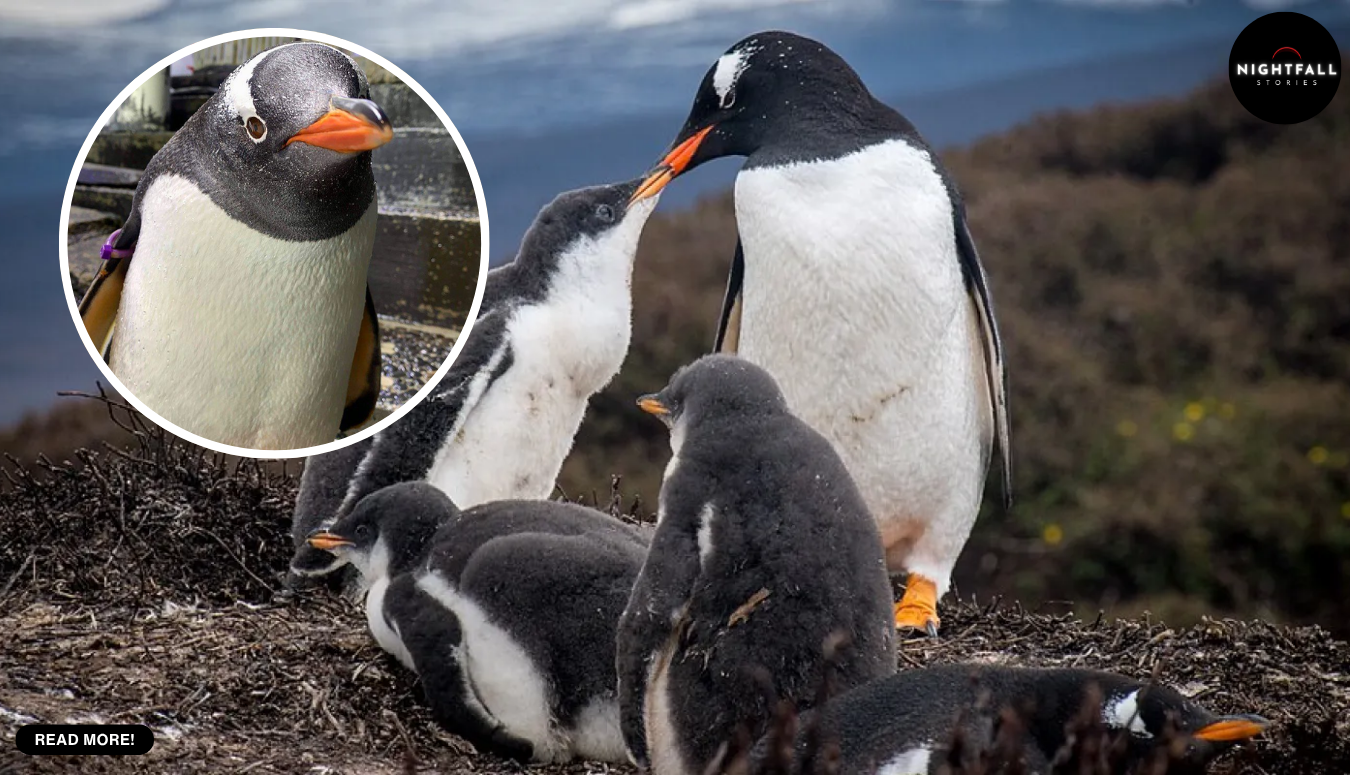
On a cluster of islands in the southern Indian Ocean, almost two thousand miles from the nearest permanently inhabited land, there are penguins that nobody had ever formally described. Not because they are rare, or shy, or hard to see. There are plenty of them and they stand around in the open. The reason is simpler and stranger. Everybody already thought they knew what they were.
A team of researchers argue otherwise, in a paper published in Communications Biology earlier this year, and the argument is a big one. The gentoo penguin, treated for as long as anyone can remember as a single widespread species, is not one species. On their evidence it is four. The birds on the Kerguelen Islands are one of them, and they are new to science. The authors propose the name Pygoscelis kerguelensis.
Before going further, it is worth being clear about what kind of story this is, because a species being named sounds like an event and it is not one. The paper appeared in the spring and the university announcement followed a few weeks later. Since then it has been doing what any serious taxonomic claim does, which is working its way slowly through the field while other specialists test it. Nothing has been settled by a press release. Penguin taxonomy in particular has a long history of proposed splits that were argued over publicly for years before anyone agreed. So read this as a case being made, and a strong one, rather than a decision that has been handed down.
What makes it worth your time anyway is not the new name. It is the consequence, and the consequence is uncomfortable.
Here is the work behind it. The team sequenced whole genomes from 64 individual birds across ten breeding colonies, covering very nearly the entire geographic range of the gentoo penguin. That is an unusual amount of coverage for a Southern Ocean animal, and it is the thing the claim rests on. What those genomes showed was four distinct groups, with no sign of ongoing gene flow between them. The populations have not been exchanging birds. They have, in effect, stopped being the same animal.
The timescale is the part that reframes the whole thing. The divergence is estimated to have happened in the last 300,000 to 500,000 years, which in evolutionary terms is recent and in human terms is unimaginably long. Half a million years of separation, and to our eyes they still look like the same penguin.
That is the real finding, and it is worth saying plainly. Human vision is a poor species detector. We are extremely good at telling human faces apart and surprisingly bad at telling animals apart, especially animals that are all the same shape for the same hydrodynamic reasons. A gentoo is a gentoo: black back, white front, orange bill, white patch over the eye. The differences between the four groups exist, and the researchers document them, but they are not the kind of difference that jumps out from a boat.
Critically, the team did not argue the case on DNA alone, and that matters enormously for whether the split survives. A split proposed purely on genomic distance is a weak claim, because genomes differ between any two populations that have been apart for a while, and the question is always whether the difference amounts to separate species or just to geography. So the researchers went further. They compared coloration. They compared vocalisations, which for penguins are essential, because the birds find their mates and their own chicks in a crowd of thousands largely by voice. They compared the timing of breeding, which is one of the most powerful isolating mechanisms there is: two populations that nest at different times of year cannot interbreed even if they meet. They compared diet and feeding behaviour. And they brought in climate modelling to look at the conditions each group occupies.
When genetics, appearance, voice, breeding calendar and ecology all line up on the same four way division, the case stops being a statistical artefact and starts looking like biology.
It helps to know why a claim like this is contentious at all, because the sticking point is not usually the data. It is the definition. Biologists have never fully agreed on what a species is. The version most people were taught at school, that two populations are separate species if they cannot produce fertile offspring together, breaks down constantly in the real world, where plenty of recognised species interbreed where their ranges meet. Other definitions draw the line at whether populations have independent evolutionary trajectories, or at whether they form distinct genetic clusters, or at whether they are diagnosably different in appearance.
Those definitions do not always give the same answer for the same animals, which is why taxonomy produces arguments that look, from the outside, like arguments about nothing. They are not. They are arguments about where to cut a continuum that nature did not cut for us. Populations separate gradually, and there is no moment at which a bell rings.
What the gentoo paper does is sidestep the problem by piling up independent lines of evidence that happen to agree. If the genomes said four and nothing else did, the critics would have an easy job. When the genomes, the voices, the breeding calendar and the feeding ecology all say four, the disagreement has to be about interpretation rather than about whether the populations are really distinct. That is a much narrower fight, and narrower fights get resolved faster.
The four, as the authors set them out, are Pygoscelis papua in the north, Pygoscelis taeniata in the east, Pygoscelis ellsworthi in the south, and Pygoscelis kerguelensis in the southeast. Three of those names were already in use, but at subspecies rank, which is a lower level of recognition. That distinction gets flattened in a lot of coverage, so it is worth keeping straight. The claim is not that three species were already recognised and a fourth was found. The claim is that three populations previously filed as varieties of one species deserve to be ranked as species in their own right, and that a fourth, on Kerguelen and probably nearby Heard Island, had not even been recognised as a variety.
Kerguelen explains itself once you look at where it is. It is a French sub-Antarctic territory, a scatter of volcanic islands in the furthest reach of the southern Indian Ocean, with a small rotating scientific station and no permanent population. Getting there takes a ship and a serious reason. Which means that while gentoos on the Antarctic Peninsula and the Falklands and South Georgia have been watched, counted and photographed by generations of researchers and tourists, the Kerguelen birds were simply assumed to be the same as everyone else’s. Not studied and dismissed. Just assumed.
The researchers on the paper come from institutions in at least ten countries. Daly Noll, affiliated with the University of Chile and Universidad de Los Lagos in Chile, is the first author. Juliana Vianna of Universidad Andres Bello in Santiago is the last, which in this field is the senior author position. Elie Poulin at the University of Chile and Rauri Bowie, a professor and curator at the Museum of Vertebrate Zoology at the University of California, Berkeley, are among the co-authors, along with colleagues in Australia, Spain, South Africa, the United Kingdom, France, Argentina, Monaco, Brazil, the United States and Venezuela. Twenty two names in all.
That author list is not bureaucratic padding and it is the only reasonable way to tell the human part of this story. There was no single moment of discovery. What there was, over years, was the assembling of blood or tissue samples from ten penguin colonies spread across thousands of miles of some of the roughest water on the planet. Each one of those samples represents somebody on a beach in the wind, with permits, with a boat waiting, handling a wild bird carefully and briefly and then letting it go. Some of those colonies can only be reached in a short weather window once a year. The expedition work is the achievement, and the sequencing was the comparatively easy part.
Now the uncomfortable consequence, which is where this stops being a taxonomy story.
Conservation status is assigned per species. That sounds like an administrative detail and it is actually the whole machinery. When an organisation assesses extinction risk, it assesses a species, and it looks at the total population, the total range and the overall trend. A bird that is abundant somewhere and declining somewhere else can come out looking stable, because the numbers are added together before anyone looks at them.
Gentoo penguins have long been a reassuring entry on that list. Hundreds of thousands of breeding pairs, a wide range, no alarm bells. A species you do not have to worry about.
Split that entry four ways and the reassurance evaporates. Each of the four is, by definition, rarer than the one was. Each has a smaller range. Each faces its own local pressures: changes in sea ice and sea temperature, shifts in the krill and fish they feed on, fisheries competition, disturbance at colonies. And the authors argue that three of the four are already in trouble from climate change in the sub-Antarctic, which is warming fast.
Be careful about how far that goes. Formal threat assessment has not been redrawn, and it cannot be until the four way split is accepted by the taxonomic authorities that conservation listings follow. There is no new official designation for any of these birds. What the researchers are saying is that the biology has moved and the paperwork has not, and that until it does, the paperwork is describing an animal that does not exist.
That is a problem with teeth in it, because protection follows the paperwork in extremely concrete ways. Protected areas are drawn around species. Fishing quotas and exclusion zones around breeding colonies are justified by reference to species level status. Funding goes to things that are listed as being at risk. A population that is genuinely in difficulty but filed under a secure species is almost invisible to all of those mechanisms. It does not appear as a problem until the decline is large enough to drag the whole combined figure down, and by then the local population may be past saving.
The sub-Antarctic makes this harder than it needs to be. The region is divided among numerous governments, with Chile, South Africa, France, Australia, New Zealand and the Netherlands all holding territory or jurisdiction in different parts of it, each with its own legislation, its own listing process and its own timetable. A split accepted in one country’s framework may wait years for recognition in another’s. The penguins, naturally, do not read legislation.
It is worth adding what the next few years actually look like for a proposal like this. Names do not take effect because a paper says so in any practical sense. They take effect when the committees and checklists that the rest of the world uses adopt them, and those bodies move deliberately, reviewing proposals and sometimes rejecting them. Field guides follow the checklists. Government listings follow the field guides and the checklists. Each step adds time.
So there is a lag built into the whole system, and the lag is not a scandal. It is the price of not rewriting the rulebook every time a paper appears. The cost of that caution, though, lands on the animals with the least margin. If one of these four populations is in genuine decline, the years spent confirming that it is a species are years during which nothing is formally protecting it as one.
There is a wider point underneath all of this, and it has nothing to do with penguins specifically. If a large, conspicuous, intensely studied, famously photogenic bird can turn out to be four species, the obvious question is what else is hiding in plain sight. Gentoos are about the best observed wild animals in the Southern Ocean. They nest in the open, in daylight, on accessible beaches. They have been on documentaries for sixty years. If this group was concealing three additional species, the number of overlooked species in less charismatic groups, in less accessible seas, is likely to be large.
Cryptic species, which is the term for exactly this situation, have been turning up steadily since cheap genome sequencing arrived. Frogs, bats, fish, insects. Usually it is a story about a laboratory finding something unexpected. The gentoo case is more interesting because it reverses the usual order of concern. Normally, finding new species sounds like good news, an addition to the total. Here it is a subtraction, because what has been added is four smaller problems in place of one comfortable non problem.
The honest state of play is this. A substantial international team, using whole genomes from across almost the entire range of the animal, backed up with appearance, voice, breeding timing and feeding behaviour, argue that one penguin is four and that one of the four has never been named. Other seabird specialists will now test that, and some will disagree, and the version that settles may not be exactly four. That process is normal and it takes years.
But the part that should stay with you does not depend on how the argument resolves. Somewhere in the far southern Indian Ocean, on islands most people will never see, there is a population of penguins that has been going about its business for several hundred thousand years without anyone noticing it was its own thing. Nobody missed it through carelessness. It was missed because it looked familiar, and looking familiar was enough.
And the conservation file that is meant to be protecting those birds was written for a species that, if the researchers are right, is not the one standing on the beach.