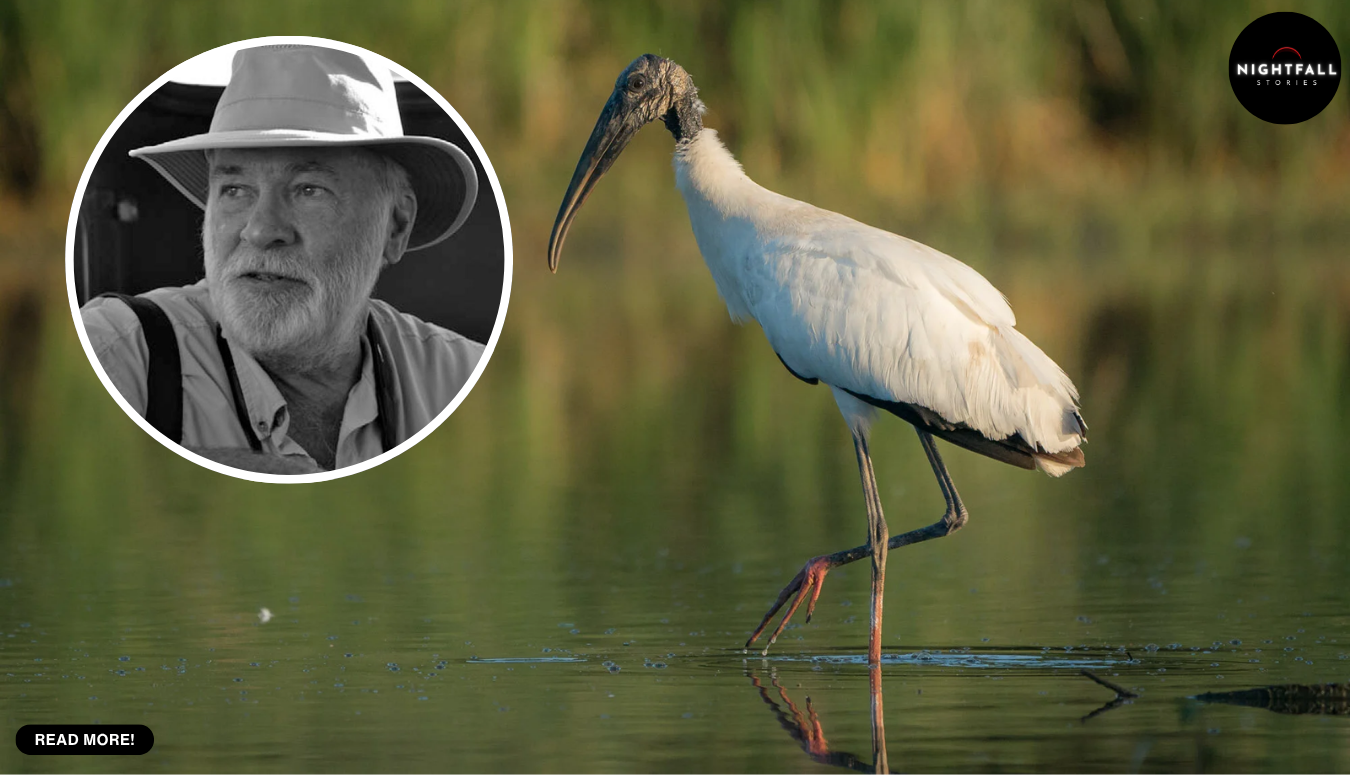
The letter arrived at the US Fish and Wildlife Service in the early 1980s, and its message was not complicated. John Ogden, a wading bird biologist with the Audubon Society, had looked at the numbers and concluded that wood storks in the United States were on a path to extinction by the end of the twentieth century. He was not guessing. The American breeding population had collapsed by more than 75 per cent since the 1930s, and by the late 1970s it was down to somewhere around 4,000 to 5,000 nesting pairs.
In 1984 the southeastern US population of the wood stork was listed as endangered. Earlier this year, forty-two years later, the Service removed it from the federal list of endangered and threatened wildlife, and the removal took legal effect in March.
Here is the part the announcement did not dwell on. The recovery did not run on legislation, or on enforcement, or on anybody being prosecuted. It ran, to a startling degree, on a handful of people spending decades doing manual, unglamorous things to water and trees. One of them spent years building fake trees out of wood, rebar and fencing and standing them up in a pond in Georgia, because the real trees had gone.
To understand why, you have to understand how a wood stork eats, because the bird’s feeding method is the entire story and everything else is a consequence of it.
Most wading birds hunt by sight. They look into the water, aim and strike. A wood stork does not. It wades with its long heavy bill held open underwater, sweeping and probing, and when something living touches the inside of that bill, the bill snaps shut. The reaction is among the fastest known in vertebrates. It is a brilliant adaptation to murky, vegetated southern wetlands where you cannot see a fish anyway.
It also comes with a condition attached that is almost cruel in its specificity. Hunting by touch only works if there are enough fish per square metre of water for your bill to keep hitting them. In a healthy natural wetland that happens seasonally: the water spreads out in the wet season and fish breed and disperse, then the water slowly draws down and the fish are squeezed into shrinking pools at concentrations high enough for a stork to feed a nest full of chicks. The stork does not need water. It needs water that is going away at the right speed, at the right time of year, for long enough.
Drain a wetland, ditch it, dike it, pump it or reroute it, and you do not simply make it smaller. You break the timing. Water that drops too fast, or that never gets high enough to spread fish in the first place, or that is held artificially steady, all produce the same outcome: a landscape that looks wet and is useless to a bird that fishes by feel. That is what a century of drainage across the Everglades and the wider southeastern coastal plain did. Nobody shot the wood stork out. The plumbing was changed.
Which is why one of the most useful contributions anyone made to this bird’s recovery was not in the field at all. Shawn Clem, research director at the Corkscrew Swamp Sanctuary in Florida, went back through decades of records reaching into the 1960s and matched the water against the birds. The pattern that came out of the data was that the storks were not simply declining; in particular years they were choosing not to nest at all, and those were the years the water levels dropped suddenly. That is a precise and testable mechanism rather than a general lament about habitat loss, and a precise mechanism is something a land manager can actually act on.
The man at the centre of the recovery itself is Billy Brooks, a fish and wildlife biologist at the Service’s Florida Ecological Services Office, and the Service’s own wood stork recovery lead. He is the thread that runs the whole length of this story, because he is the one who received Ogden’s warning. Ogden himself, who died in 2012, does not get to see how it turned out. Brooks has described him simply as a biologist who got things done.
Brooks’s own documented contribution is the fake trees, and they are worth describing properly because they are an admission as much as a solution.
Wood storks nest colonially in trees standing in water, which is the point: water under the nest keeps raccoons and other climbing predators away from eggs and chicks. At Woody Pond on the Harris Neck National Wildlife Refuge in Georgia, the trees the birds needed were largely gone, and planting cypress is not a short term plan. Cypress takes decades.
So in the early 1990s, Brooks and colleagues built artificial nesting structures out of wood, rebar and fencing and installed them in the pond. They started with six. Within a few years there were about fifty. The birds used them. By 2002, fledging success at Woody Pond was reported at around 20 per cent higher than at other rookeries, and in 2012 biologists counted a record 484 nests there. The storks kept using the artificial platforms until the cypress that had been planted alongside them was finally big enough to hold a nest, at which point the scaffolding had served its purpose.
That is a forty-year plan executed by people who would not be around for all of it, which is a sentence you can say about almost nothing else in modern conservation.
The same stubborn, physical quality shows up everywhere in this file. Kimberly Hayes, the refuge manager at Harris Neck, has run the annual nest count there with volunteers and overseen the raising of levees, the installation of pumps and the building of nesting platforms, which is to say she manages the water by hand on behalf of a bird that needs the water to behave. Jim Stevenson, a retired state park biologist, has spent years pulling invasive trees out of wetlands near Tallahassee and clearing choking floating vegetation off the water, sometimes with mechanical harvesters, to keep nesting sites usable.
And at the Washo Reserve in South Carolina, Colette DeGarady of the Nature Conservancy planted 275 cypress saplings inside the hollow stumps of dead cypress. The logic is lovely and entirely practical: a sapling planted at ground level in a flooded site drowns, but a sapling planted inside a standing dead stump starts life a foot or two higher, above the water, with a ready made collar protecting it. It is gardening, at the scale of a swamp, on a timetable measured in human generations.
The legal arc also came in three steps rather than one, which is worth knowing because it shows the decision was not sprung on anybody. At listing in 1984 the population was reportedly falling by about 5 per cent a year. In 2014, with the numbers climbing, the bird was reclassified from endangered to threatened, a downgrade of urgency rather than a release, and the announcement was made at Harris Neck National Wildlife Refuge, the same pond where the artificial nesting platforms had gone in. Brooks was there for it, described in the Interior Department’s own account of the day as the Service’s recovery coordinator for the wood stork. Full delisting was then formally proposed a few years ago and spent a long stretch in public comment before the final rule.
The numbers at the other end of those four decades are real. The Service puts the current southeastern population at roughly 10,000 to 14,000 nesting pairs across about 100 colony sites, more than twice the pairs and more than three times the colonies of 1984. The published rule is more precise: the five-year average reached 11,224 nesting pairs, and the recovery target of 10,000 had been cleared since 2016. The colonies were distributed across four states, with the largest share in Florida and substantial numbers in Georgia, South Carolina and a handful in North Carolina.
South Carolina on its own is the clearest illustration of the shape of the change. The first successful wood stork nesting in the state was documented in 1981, three years before the bird was listed. Early monitoring found eleven nests. By 2023 the state count was approaching 4,000.
Then there is the figure that should make anyone pause before calling this finished. As of last year, 82 per cent of South Carolina’s wood stork colonies were on private land. Eighteen per cent were on public land.
Think about what that means now that the listing is gone. For four decades, a colony on private property came with federal consequences attached: the Endangered Species Act constrained what could be done to it. That constraint has now been lifted from the great majority of the colonies in at least one state. What holds those nesting trees up from here is not law. It is landowners who want the birds there, and the relationships that state and federal biologists have built with them over years of showing up.
The Service has been careful not to describe this as a finish line, and the structure of the decision says so. A ten-year post-delisting monitoring plan is attached. It tracks not only the population but physical and environmental changes at colony sites, specifically including changes in the regulatory protections those sites rely on. You do not write a ten-year watch into a decision you are certain about.
The published rule is also franker about the mixed scorecard than the press release was. Of the three recovery criteria, the first, the five-year average of 10,000 nesting pairs, was met and had been for years. The third, which required a minimum of 2,500 pairs nesting in the southern breeding region, was met in each of the preceding six years. The second, which set a target of 1.5 surviving chicks per nest, was achieved in every region except the South Breeding Region. The Service’s position is that the essential intent of that goal has been achieved. That is a judgement call, stated as one, and it is where the argument lives.
It is also worth saying plainly what delisting is and is not. It is not a statement that a species is safe forever, and it is not a prediction. It is a legal finding that the specific threats which justified federal listing no longer put the population in danger of extinction across its range, measured against criteria written down in advance. The Act was built to be exited. A list that nothing ever leaves is a list that is not doing its job, and genuinely few species have left it on these grounds rather than by going extinct. That is the honest frame for this: the paperwork worked the way the paperwork was designed to work.
What the paperwork cannot do is hold the conditions still. The recovery criteria measured storks. They did not, and could not, measure whether the wetlands would still be managed the same way in 2040, or who would own them, or whether the water would keep arriving and leaving on a schedule a bird can breed against.
Not everyone accepts it. Will Harlan, southeast director at the Center for Biological Diversity, has argued that this is close to the worst possible moment to remove protections, on the grounds that recent court decisions and regulatory changes have narrowed federal protection for wetlands in general. His case is not really about stork numbers. It is about the water again, and about whether the conditions that allowed the recovery are still guaranteed to exist. Given that the bird’s entire biology is a bet on how wetlands behave, that is a serious objection rather than a reflex.
There is one more thing the file makes clear, and it cuts against the way these stories are usually told. Almost none of the decisive work was done by anybody famous, and almost none of it was done quickly. A data analysis that took reading through sixty years of water records. Six fake trees that became fifty. Two hundred and seventy-five saplings planted one at a time inside dead stumps. A nest count run every year with volunteers. Levees raised, pumps installed, weeds hauled out by hand. None of it photographs well and none of it makes a headline on its own, and together it is the reason the number went from roughly 4,000 pairs to more than 10,000.
So what actually happened here, stripped of the celebration and the complaint?
A bird that fishes with its eyes closed was pushed to the edge by what people did to water. A biologist wrote a letter saying it would be gone by the end of the century. The letter helped produce a listing, the listing produced a recovery plan, and the recovery plan produced forty years of people hauling rebar into ponds, planting trees inside dead stumps, pulling weeds out of swamps, counting nests, and reading old water records until a pattern came out. The population more than doubled. The law let go.
And on the great majority of the land where these birds now nest, there is no longer any legal obligation to keep a single tree standing in a single pond. There is a ten-year monitoring window instead, which is not a victory lap. It is a test, and the thing being tested is not the stork.