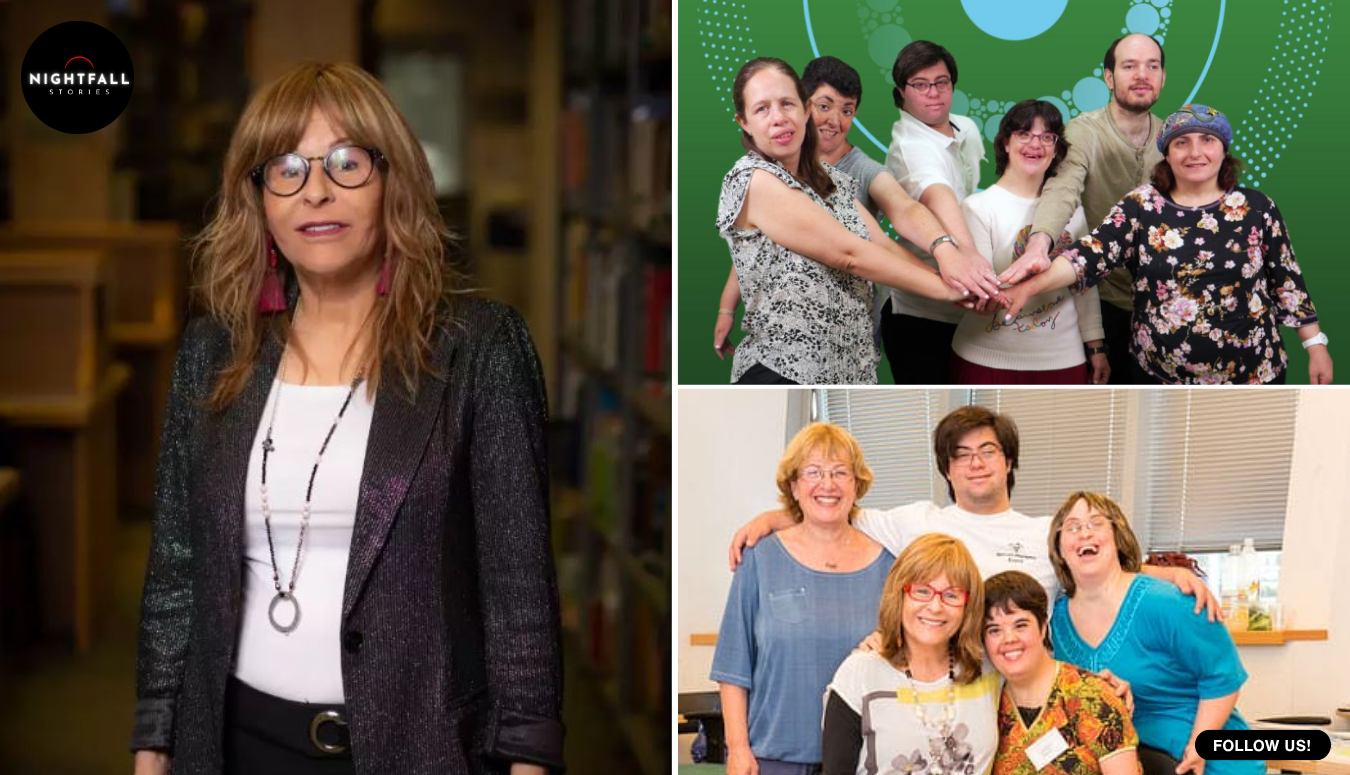
Ruti Bar-Or was 46 when she collected a bachelor’s degree in social sciences. She is a poet and keeps a diary, she has Down syndrome, and for most of her life the standard professional literature said the thing she had just done was not possible. Not difficult. Not unlikely. Not possible, because the cognitive development of people like her was supposed to have finished somewhere around the end of adolescence, and what came after that was supposed to be a long flat line and then a decline starting in the mid thirties.
She was one of six. Tomer Gad-Barak, 35, who has mild cerebral palsy. Hofit Gilad, 41, a mother who turned out to have a head for statistics. Henia Greengarten, 42, who has Kabuki syndrome and volunteers in preschools. Oded Naftali, 34, a military veteran with Down syndrome. Lior Shmualevitz, 35, who has Williams syndrome. All six were registered as regular students at Bar-Ilan University in Israel, all six sat the courses, and after roughly ten years of study all six were awarded a multidisciplinary BA in social sciences through the university’s Faculty of Education.
The researcher who built the road they walked down is Professor Hefziba Lifshitz, and earlier this year the President of Israel put a medal around her neck for it. That part is easy to report. The harder and more interesting part is what she actually proved, because the temptation with a story like this is to turn it into a single heroic act of overturning, and that is not what happened. What happened was slower, more argumentative, and more useful.
Start with the assumption, because the assumption is the story. If you trained as a special educator or a clinical psychologist in most of the second half of the twentieth century, you were taught a developmental trajectory for intellectual disability that had three parts. Restricted cognitive growth up to roughly the age of 20. Then stability. Then accelerated decline from the mid thirties or forties onward, with signs of dementia appearing in people’s thirties and forties. That was not folklore. It came out of research literature going back to the 1960s, and Lifshitz’s own papers cite it directly as the position she was arguing against.
Think about what a trajectory like that does once it is inside a system. If development is over at 20, then everything after 20 is maintenance. You do not design a curriculum for a 35 year old, because there is nothing left to teach that will take. You design occupation, supervision, pleasant activity, safety. Money follows the model. Staffing follows the model. Expectations follow the model, and expectations are the part that gets into people’s heads and stays there. An adult with an intellectual disability who wanted to study something new was, under that framework, asking for a kindness rather than an education.
Lifshitz’s counter-proposal has a name. She published it in 2015, under the surname Lifshitz-Vahav, as Compensation Age Theory, in the journal Education and Training in Autism and Developmental Disabilities. The core claim is deliberately modest in its wording and large in its consequences. It is that chronological age, not mental age, is the variable that matters for adult cognitive performance in this population, and that all human beings, including people with intellectual disability and including older ones, remain capable of change given the right environmental conditions and systematic intervention. Her formulation is that adulthood involves processes of development, growth and neural sprouting rather than stagnation or decline. Her clinical estimate, drawn from her own data, is that measured intelligence in this population tends to peak somewhere around 40 to 45, which is to say two decades after the textbooks had it finishing.
The evidence behind that arrived in pieces over a long stretch, and it is worth walking through the pieces, because the quality of each one is different and an honest account says so.
The largest single study came in 2024 in Scientific Reports, with Lifshitz as lead author alongside Roi Yozevitch of Ariel University and Shlomit Shnitzer-Meirovich of Levinsky College of Education. It compared 340 people with intellectual disability, 79 of them with Down syndrome and 261 with intellectual disability of non-specific origin, across an IQ range of 43 to 75. The sample split into an adolescent group aged 16 to 21 and an adult group aged 22 to 45, and the researchers put both through standard measures of acquired knowledge and of problem solving: vocabulary, similarities, block design, Raven’s matrices.
The adults outperformed the adolescents on three of the four measures. That is the headline result, and it runs in exactly the opposite direction to the trajectory the field had taught. A second finding surprised the researchers more. Participants with Down syndrome, long characterised in the literature as having relatively weak non-verbal reasoning, did better than the non-specific group on block design and on Raven’s matrices, and a network analysis of how the two kinds of intelligence related to each other showed a more coherent, more integrated pattern in the Down syndrome group than in the comparison group, whose pattern was diffuse.
Now the honesty. That study is cross-sectional. It compared different people of different ages at one moment, rather than following the same people as they aged, and the authors say plainly in their own limitations section that this design cannot establish causation and that cohort effects between the age groups are a live possibility. The adults in that sample grew up in a different service system from the adolescents, and some of the gap could be the system rather than the ageing. The Down syndrome subgroup, at 79 people, is small. The IQ range covers mild and moderate disability only. None of that is a reporter’s objection. It is the paper’s own.
Which is why the intervention studies matter more, and they are smaller. In 2018, in PLOS ONE, Lifshitz and colleagues including Jay Verkuilen of the City University of New York compared two groups of adults who had come through different versions of university study: 10 who had been fully included in regular courses and 21 who had taken adapted enrichment courses. The fully included group, aged 26 to 51, scored a mean general IQ of 68.7 against 56.6 for the adapted group, and a mean verbal IQ of 72.9 against 59.7. That is a gap, not a change, and selection could easily explain some of it, since the stronger students were the ones who went into full inclusion in the first place.
In 2023, in the European Journal of Special Needs Education, the team tested the same question with a before and after design. Twelve adults with mild intellectual disability who went through four and a half years of the university programme were compared with twelve who did not. The programme group’s scores rose. Lifshitz’s account of it is that among the students pursuing a BA, the second IQ measurement crossed the 70 to 75 threshold that the definition of intellectual disability itself sits on, landing at 80 and in some cases higher. One report of the programme’s third stage put the increase as high as 15 points, with verbal scores reaching the nineties.
That finding deserves to be read carefully rather than enthusiastically. Twelve and twelve is a very small study, nobody was randomly assigned, and an IQ score crossing a diagnostic cutoff is not the same as a diagnosis being withdrawn or a life being transformed. What it does mean is that the number which the system treated as a fixed property of a person moved, measurably, in adults in their thirties and forties, after education. The flat line was not flat.
The study that pushed hardest against the old model came last year, in Research in Developmental Disabilities, and it went after the group that the deficit framework had written off most completely. Lifshitz, with Shira Posner and Shnitzer-Meirovich, ran an introduction to sociology course, built around an e-book and a mediational teaching strategy, for nine adults with severe intellectual disability and extensive support needs, aged 27 to 58, against ten controls. The students gained academic knowledge, which you might expect from a course. More unexpectedly, the gains showed what the researchers call near transfer onto basic cognitive measures, while the control group stayed flat or slipped. Nine people. The authors say so, and say generalisation should be cautious.
So the fair summary is this. A specific, consequential, widely taught claim about when development ends has been contradicted by a consistent body of work, most of it from one research group, much of it on small samples, with designs that establish that change is possible rather than that it is universal. That is a real result. It is not a cure, nobody involved has claimed it is, and the field’s acceptance is best measured by the fact that a mainstream academic publisher, Springer, brought out her full monograph on it in 2020, under the title Growth and Development in Adulthood among Persons with Intellectual Disability, with a chapter devoted to cognitive rehabilitation for older people with intellectual disability and Alzheimer’s disease.
That chapter is the sign of a researcher arguing in good faith, because the decline literature did not evaporate. It is strong and it is specific. A large American cohort study published in JAMA Network Open in 2024, drawing on claims data covering 132,720 adults with Down syndrome, found that 23.3 percent had ever received an Alzheimer dementia diagnosis, with a mean age at first diagnosis of 54.5 years. Among those who were 55 to 64 when they entered the study, the probability of an Alzheimer diagnosis over the following eight years was 63 percent. Early onset dementia in Down syndrome is not an old prejudice that better research dissolved. It is a documented medical reality with a genetic mechanism behind it.
Both things are true at once, and holding both is the whole intellectual achievement. Development can continue into the forties and the risk of a steep decline can arrive in the fifties. What the old trajectory got wrong was not the existence of decline. It was the dates, and the assumption that the two decades in between were dead ground.
Which brings us to the second step, the one that is much harder than publishing. In 2012 Lifshitz started a programme at Bar-Ilan called Otzmot, which translates roughly as strengths or powers, and is presented in English as the Empowerment project. It did not begin as a gesture. It began as the obvious operational consequence of her own data: if adults keep developing, enrol them.
By her own account, that drew scepticism from parts of the academy. It is not difficult to see why. A university is a machine for sorting people by measured ability, and the proposal was to run students through it whose measured ability put them outside the entry criteria by definition.
The programme is built in three stages, and the design is the interesting part. The first stage puts students into academic courses adapted for them at the university’s school of education: introduction to psychology, introduction to sociology, self-advocacy, library and computer skills. The teaching is largely done by master’s students in the intellectual disability programme, who are trained in curriculum adaptation first, which means the adaptation is a taught professional skill rather than improvisation. The second stage puts Otzmot students into BA research seminars alongside typical students, working on research together. The third stage registers the strongest students as regular undergraduates working toward a degree.
Note what is adapted and what is not. The route in is adapted, the materials are adapted, the pacing and the mediation are adapted. The subject matter is not watered into something else, and the degree at the end is a real degree from a real faculty, not a certificate of attendance. That distinction is the difference between a programme and a courtesy.
It now runs at a scale that is no longer experimental. Around 120 adults are enrolled across the full range of disability severity, from mild and moderate through to severe with extensive support needs, under director Dr Shoshana Nissim. Lifshitz also heads the Machado Center for Research and Advancement of Variability and the Baker Center at Bar-Ilan, where the research and the teaching feed each other, which is why the intervention studies exist at all: the students are not case studies, they are enrolled adults whose results are measured the way any educational outcome is measured.
The six graduates collected their degrees in 2024, at a ceremony the country’s first lady attended. Lifshitz has said she is aware of only three other people anywhere in the world who hold a BA having met comparable criteria, which is a statement about how closed the door has been rather than about how rare the people are.
Earlier this year the Israeli Presidential Medal of Honor went to eleven people, and she was one of them. The award is the state’s highest civilian decoration, established in 2012 and revived by President Isaac Herzog after a long gap, and it is given on the recommendation of an advisory committee chaired by the retired Supreme Court justice Professor Yoram Danziger, which considers nominations against published criteria for an exceptional contribution to the country or to humanity. There is no public vote, no entry form and no fee, which is a lower bar to clear in a story than it sounds, and a lot of awards do not clear it. The others honoured alongside her were Yona Elian-Keshet, Hossam Haick, Mooli Lahad, Yossi Leshem, Abie Moses, Ziva Mekonen, Moshe Nissim, Rabbi Haim Sabato, Yehuda Eder and Uriel Reichman. Herzog told the recipients that each of them was a beacon in their field.
The medal is the recorded ending, but it is not the point, and Lifshitz would be an odd person to turn into the moral of her own research. The point is that a number in a textbook was wrong, and that being wrong about it had a cost nobody was counting. For decades, adults who could have been learning something were handed activities instead, on the authority of a developmental ceiling that had been measured badly and then repeated confidently. Six people with a social sciences degree each are not proof that everyone should have one, and nobody serious is arguing that. They are proof that the ceiling was never where the field had drawn it, and that the only way anyone was ever going to find out was by teaching the people on the other side of it and seeing what happened.
What happened is that they learned. The rest was paperwork.