At roughly twenty-six minutes past six in the evening, a dashcam in traffic on the North-South Expressway in the Malaysian state of Perak recorded something most drivers will never see and would not know what to do with. An express bus, running south out of Kedah towards Kuala Lumpur, was coming down the long descent near the Menora Tunnel and it was no longer being driven. It was simply moving. It struck a guardrail. It came close to several smaller cars. And ahead of it, in the right-hand lane, a loaded lorry slid sideways into its path rather than away from it.
That was deliberate. The lorry driver, Wong Tuck Meng, forty, had worked out what was behind him and had decided that the back of his own vehicle was going to be the brake. The bus hit his rear. Both vehicles slowed together. He kept the pair of them against the barrier until they stopped. There were twenty-one people on the bus.
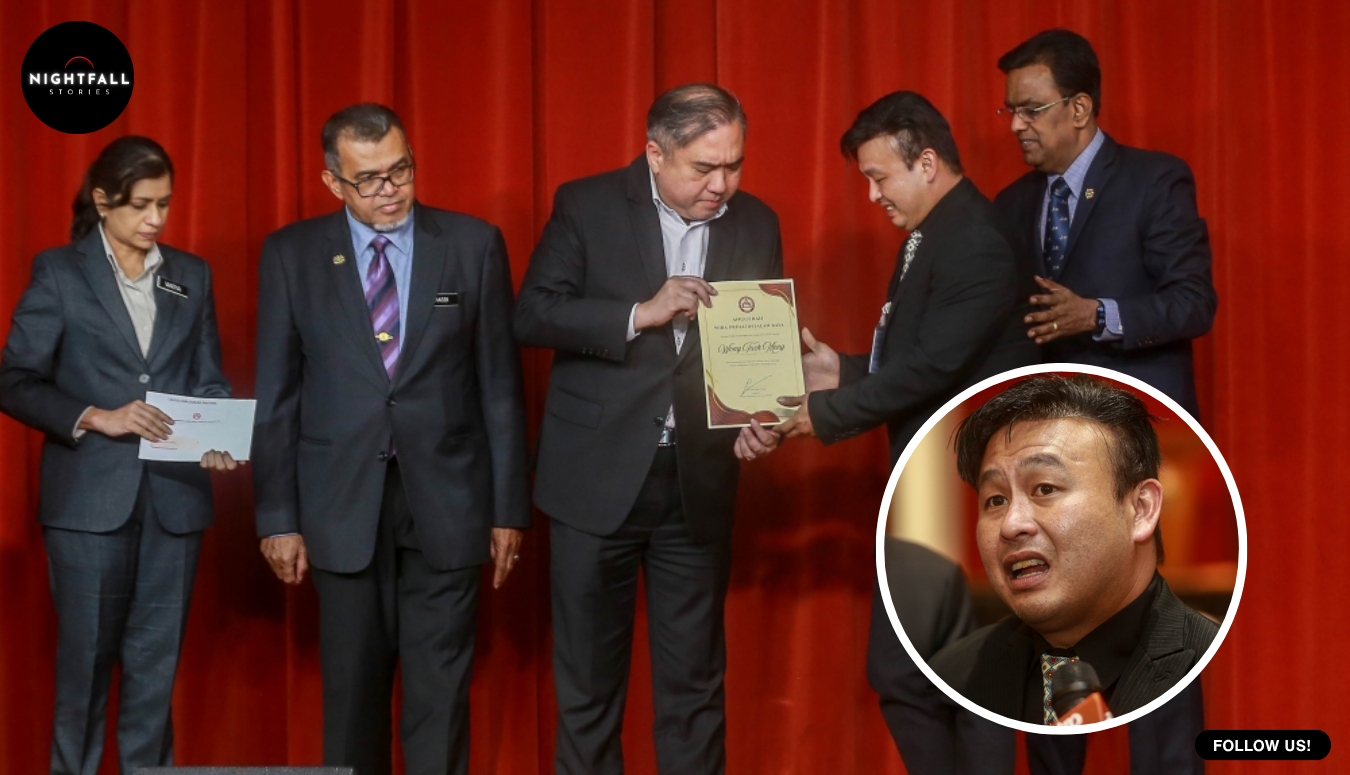
Eight days later he was standing inside the national Parliament building in Kuala Lumpur, being handed a certificate and the equivalent of about 2,150 US dollars.
The clean version of this story, the one that travelled, is a man who sacrificed his truck to save a bus. That version is true as far as it goes, and it is also the least interesting thing about it, because it skips the part that actually took nerve. Wong did not stop a bus. Nobody stops a bus. What he did was choose where and how it would come to rest, and he made that choice in the handful of seconds available to him while sitting inside one of the two objects involved.
Start with what a runaway vehicle on a gradient is. A fully loaded express coach is a very large amount of mass moving at highway speed, and on a downhill run gravity is adding to that every second rather than taking from it. The only question left is what absorbs the energy. If nothing does, the vehicle keeps accelerating until the road geometry decides for it, which on a mountain descent usually means a curve it cannot hold. A guardrail is not there to stop a coach. It is there to keep one from leaving the carriageway. The barrier buys you a direction, not a halt.
What a lorry in front offers is something a barrier cannot: it offers mass moving in the same direction. Contact between two vehicles travelling the same way is an enormously gentler event than contact between a moving vehicle and anything fixed, because the closing speed is only the difference between them rather than the full speed of the faster one. The lorry then has its own brakes and its own traction to spend, and because it is in front, every bit of braking it does is braking the thing behind it too. That is the whole mechanism. It is crude and it works and it is also the reason runaway lanes on steep highways are filled with gravel rather than walls.
Understanding it afterwards, in writing, is easy. Working it out in the mirror is not.
The place itself is worth a moment, because the geography is not incidental. The Menora Tunnel is a pair of eight-hundred-metre bores driven under the Keledang Range near Jelapang, two lanes in each direction, open since the late nineteen eighties. It is the point where the main expressway up the western side of the peninsula stops going around the hills and goes through them, and either side of it the road climbs and falls hard. Every express coach running between the northern states and the capital uses this stretch, which means that on any given evening there are dozens of heavy vehicles on a long gradient with a tunnel mouth at one end of it. Drivers who work the route know exactly which section they are on without looking. That is the stretch where this bus stopped being a bus and became a weight.
Wong’s own account of the moment, as he gave it to reporters at Parliament, is unglamorous in a way that reads as honest. He said he had a little distance to work with because the bus was still some way back, so he used it to sound his horn and give the cars in front of him a chance to move out. That is the detail that tells you he was thinking about the whole road and not only about himself. His first action in a situation he had no training for was to clear the space downstream, because he already knew he was about to become an obstruction.
He also said, more or less, that you only really think about one thing in that situation, which is that a crash with people dying in it has to be avoided if there is any way to avoid it. He did not frame it as courage. He framed it as the available option.
There is a second driver in this story and he is usually left out of it. The man at the wheel of the bus, named in one Malaysian daily as Ahmad Yasin Ab Malek, gave his own version, and it is the version that completes the picture. He said he tried to hold himself together once he realised he had lost control, moved across into the right-hand lane, and judged that the lorry ahead of him was the safest thing available to him. That matters enormously. This was not a passive object hitting a volunteer. Two professional drivers, strangers, in different vehicles, with no radio between them, arrived independently at the same plan and executed it in traffic. One steered towards the lorry. The other steered towards the bus.
That is the part worth sitting with. Road rescue is usually told as one hero and a crowd of victims. This one needed two people to be right at the same time, and nobody had time to agree anything.
Now the honest limits, because this story has been circulated with more certainty than the record supports, and the gaps are not small ones.
Nobody has published what went wrong with the bus. The Malaysian reports describe a technical failure and a loss of control on a descent, and that is as far as the sourcing goes. Whether that was a brake problem, and if so whether it was wear, overheating on the gradient, a mechanical fault, a maintenance failure or something else entirely, is not established in anything that has been made public. The operator has not been named in the coverage. No investigation finding has been released. Anyone telling you the brakes failed because of one specific cause is filling in a blank.
More importantly, and this is the detail that keeps getting invented: it is not on the record whether anyone was hurt. When the footage first circulated, the clearest contemporaneous write-up said plainly that it remained unclear whether anyone had been injured or what had caused the bus to lose control. The later award coverage says the passengers were spared a far worse outcome and that lives were saved. It does not say that nobody was hurt, and neither does the wire copy, and neither does any of the papers. Twenty-one people were inside a large vehicle that hit a guardrail and then hit a lorry. The responsible thing to say is that no deaths have been reported from this incident and no injury figure has been published either way. The cheerful line that everyone walked away is not something anyone has actually reported.
There is also a cost side to this that nobody has published, and it is worth naming because it is the part that makes the decision a real one rather than a free gesture. A lorry is not a prop. For a man who drives goods for a living, that vehicle is the income, and letting a coach run into the back of it is a decision to damage the thing he is paid with. Depending on how the load was secured, it is also a decision to accept whatever the impact did to the cargo. None of the reporting says what happened to his lorry, what it cost to repair, who paid, how long he was off the road, or whether the award money came anywhere near covering it. Ten thousand ringgit is a serious sum in that trade and it is also not a lot of bodywork. He will have known the general shape of that arithmetic as he moved across, and he moved across anyway.
What is on the record, in detail, is what happened eight days afterwards.
On the twenty-third of June, Wong was brought to the Parliament building and presented with two things from the Road Safety Council of Malaysia: a special certificate of appreciation, and a road safety hero award. With them came ten thousand ringgit, about 2,150 dollars, paid out of the council’s fund. The transport minister, Anthony Loke, said in substance that a tragedy had been avoided and many lives saved because one driver acted quickly even though doing so could have cost him his own. A letter of appreciation went into the parliamentary record.
There is a wrinkle here that should be reported rather than smoothed over, because two Malaysian outlets do not agree on who handed over what. The national news agency, along with three separate newspaper groups that sent their own reporters, has the transport minister making the presentation, with the deputy speaker of the lower house, Ramli Mohd Nor, conveying Parliament’s own appreciation separately. One major Malay-language daily instead describes the deputy speaker as the one who presented the award. Both officials were plainly there and both plainly took part. Which hand passed the certificate is the sort of detail that gets garbled in a scrum of photographers, and the balance of the reporting favours the minister presenting, but it has not been settled by any primary document, so the fair version is that both men took part in honouring him and the accounts differ on the choreography.
The same caution applies to his name, which is a small thing that matters a great deal if you are the person it belongs to. Five of the Malaysian outlets covering this, including the national wire and three papers working independently, spell it Wong Tuck Meng. One spells it Wong Tuck Ming. I could not retrieve a published citation from the Road Safety Council or the transport ministry that would settle it from the awarding side, which is where it should be settled. Tuck Meng is the spelling carried by the clear majority and by the wire, and it is the one used here, but it is a weight of usage rather than an official confirmation, and it is worth saying so out loud.
It is also worth being honest about how many eyes have actually been on this. The story looks heavily covered, and in a sense it is: it appeared across a dozen sites in two languages within a day. But most of that is the same wire copy under different mastheads, and two of the titles that carried it belong to the same group. Stripped down, the real base is the national news agency plus a handful of papers that put their own reporters and photographers in the room at Parliament. That is enough to stand on. It is not the twelve independent accounts the search results suggest, and the difference matters when the thing you are checking is a detail only one of them has.
One more thing is absent and its absence is the reason the clip travelled. Nobody knows who filmed it. The footage that put Wong on the national record came from a dashcam in following traffic, and the person behind that camera has never been identified in any of the coverage. They happened to be on that stretch of road at that moment, pointed the right way, and their recording is the only reason a lorry driver’s decision became a public act rather than a private one and an insurance claim. He got a certificate in Parliament. They got nothing, because nobody knows who to give it to.
The backdrop to all of this is less comfortable. Almost exactly a year before, in the same state, a chartered bus carrying university students home after a holiday lost control on a dark downhill curve, hit a guardrail and came to rest near a ravine. Fifteen students died. More than thirty people were injured. The operator’s licence and permits were pulled, the driver was charged, and there was a long national argument about who is accountable when a coach full of people goes off a hill. That is the context in which a country gives a lorry driver money and a certificate for a descent that did not end that way. The Road Safety Council exists partly because these roads keep producing this exact geometry: a long gradient, a heavy vehicle, a barrier and a curve.
Which is why the award is a slightly odd object, and interesting for it. It is not a jury prize with published judges and a methodology. It is a statutory council and a government ministry deciding, quickly, that a particular act deserved public money and the floor of Parliament. Somebody other than Wong decided it, there was no application and no nomination fee and no popularity vote, and the whole thing went on the parliamentary record with a date attached. Eight days from the deed to the certificate is fast for any government anywhere. Somebody in that system watched the clip, found the man, and pushed it through.
What strikes me, reading all of it, is how little room there was. Wong did not have a minute. He had the length of a mirror glance to understand the problem, decide that the solution was his own vehicle, sound his horn for the cars ahead, and position himself. Whatever he feels about it now, at the time it was a small number of seconds and a choice between being somewhere else and being the thing that stopped it.
He chose to be the thing that stopped it. And then, eight days later, a man who drives goods for a living stood on a floor built for politicians while the transport minister explained to the country what he had done, which is not where that Monday evening on the expressway looked like it was going.