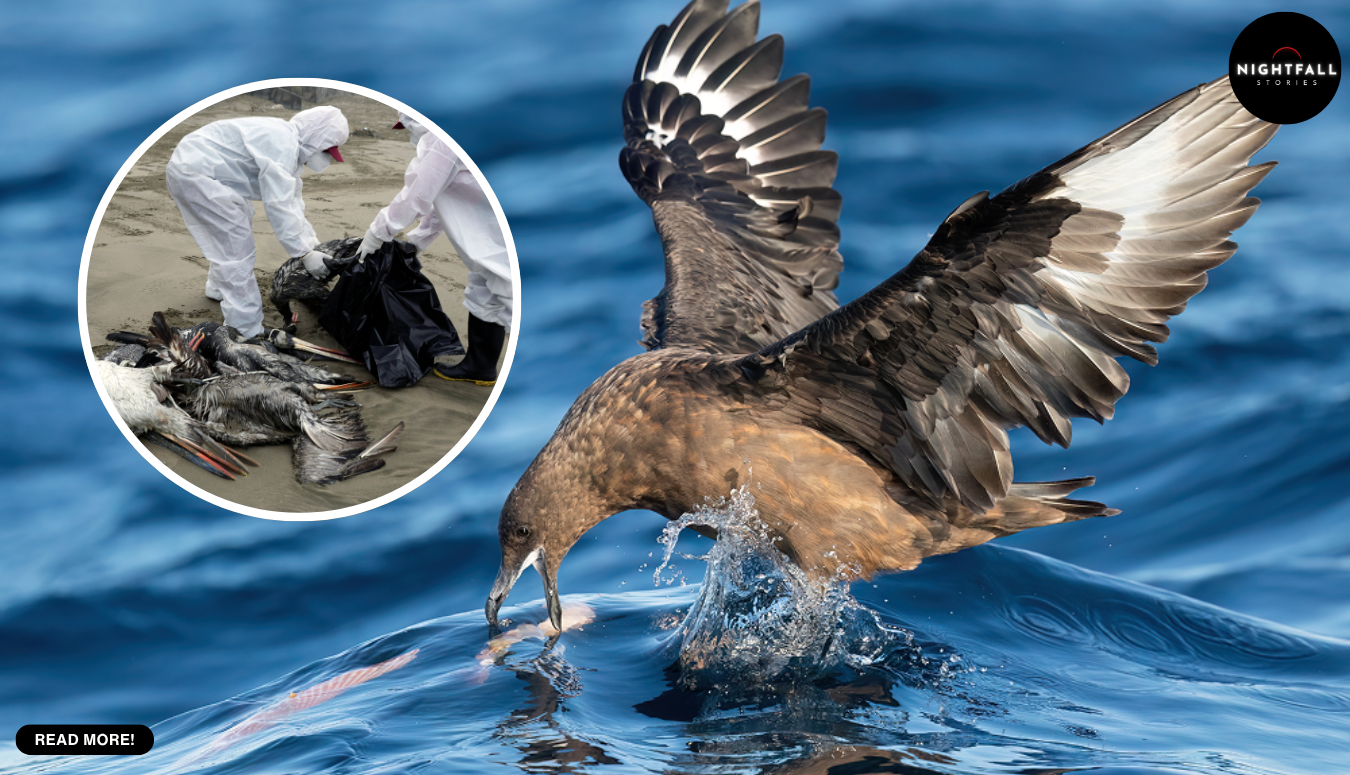
The bird was a brown skua, and it was dead on a beach at the eastern end of a national park in southwestern Australia, a few hundred kilometres along the coast from the nearest city of any size. Someone found it, someone sent samples away, and a laboratory confirmed what a lot of people had spent four years quietly dreading. The official notification went out the following day, and it is a short, dry document that says one very large thing: highly pathogenic avian influenza H5N1, clade 2.3.4.4b, in a wild bird in Australia, for the first time.
That is the confirmed fact, and it is worth keeping it separate from everything that has been said around it, because plenty has.
For roughly four years the H5N1 panzootic had been working its way through the world’s wild birds with a thoroughness nothing quite like it had managed before. It moved through Europe, through Africa, through North and South America. It reached the Antarctic Peninsula. It killed birds in numbers that stopped being countable and started being estimated. Hundreds of millions of poultry have been culled or died worldwide since this thing started moving. More than 600 wild bird species and around 100 mammal species have been affected. Seabird colonies in the North Atlantic lost large shares of their breeding birds in a single season. In South America it ran down the Pacific coast and killed pelicans, other seabirds and sea lions in very large numbers, and then it reached the Antarctic, which is where the southern route into Australia began. And through all of it Australia held, the one inhabited continent where this particular virus had never been detected in a wild bird. Australian biosecurity officials were asked about it constantly, and the honest answer was always the same. Not yet.
There is an important footnote to the “last continent” framing that got lost in a lot of the coverage, and it deserves to be said plainly, because it changes how you read the mainland detection. Australia’s remote sub-Antarctic territory had already been hit. On Heard Island, a glaciated speck in the Southern Ocean thousands of kilometres from anywhere, H5N1 arrived around the middle of the previous year, most likely carried in by wildlife moving from the French-administered Crozet Islands roughly 1,800 kilometres away. Australian Antarctic Program scientists surveyed the damage, and the numbers are hard to hold in your head. Among southern elephant seal pups, average mortality across the island ran at about 76 per cent, and in some areas it reached 97 per cent. Out of a total pup production of around 17,000, roughly 13,000 died. Six vertebrate species tested positive, including king penguins, gentoo penguins and Antarctic fur seals. Working out the scale of it took drones, because Heard Island’s coastline is not something a small team can walk, and counting bodies from the air was the only way to turn an obvious catastrophe into a number anyone could publish. Surveys the following summer found several hundred dead adult king penguins, though that was a small proportion of a very large colony.
So the virus was not knocking on Australia’s door. It was already inside the outermost room. What fell in June was the mainland.
The skua matters as much as the location does. Brown skuas are big, powerful, scavenging seabirds that make their living partly by eating things that are already dead, and they move between the sub-Antarctic islands and the southern coasts of Australia and New Zealand. Epidemiologists had drawn that exact route on a map years earlier as the most likely way in. Scavengers eat infected carcasses, scavengers travel long distances, scavengers do not respect quarantine zones. The bird that brought it was the bird everyone said would bring it, which is a strange thing to be right about.
The detection site was Cape Le Grand National Park, near the coastal town of Esperance in Western Australia, about 700 kilometres southeast of Perth. A southern giant petrel at the same site was also suspected. Samples went to the national high-containment animal laboratory for confirmation, and the international notification followed immediately, which the World Organisation for Animal Health went out of its way to note approvingly. Australia has a long record of reporting fast even when reporting fast is inconvenient, and it reported this within a day.
Then came the part nobody can control.
Here is what has been confirmed since, because this is where it is easy to slide from fact into fear. Within about ten weeks of that first skua, Australian authorities had logged more than 350 confirmed detection events. The virus has turned up in six states and territories. More than twenty species of bird have tested positive, and the list reads like a survey of the southern Australian coastline: greater crested terns, silver gulls, Pacific gulls, black-faced cormorants, little penguins, Australasian gannets, several petrel and shearwater species, white-fronted terns. It also reached birds nobody associates with the sea at all, including Australian magpies, ravens, a peregrine falcon and a southern boobook owl.
It has crossed into mammals too, which is the part that gets virologists’ attention. Confirmed mammal cases include long-nosed fur seals and an Australian sea lion on Kangaroo Island, a common dolphin in South Australian waters, and a red fox in Adelaide. Every one of those is consistent with what H5N1 has done elsewhere in the world over the past four years, and none of them is evidence of the virus adapting to spread between mammals.
The first mass die-off came in early August, off the coast south of Adelaide. Aerial surveillance spotted dead greater crested terns at Cape Jaffa, and the count came in at 49 dead birds with another 35 visibly sick. That was small enough to describe precisely, which is exactly why it is worth recording, because two weeks later it stopped being that kind of number. Three separate mass mortality events were confirmed across South Australian islands, on Troubridge Island off the Yorke Peninsula and on the North and South Page islands near Kangaroo Island, and the combined toll passed a thousand greater crested terns. On King Island, off Tasmania, 28 little penguins and three terns were found dead in the same week.
The state premier in South Australia called it a significant escalation and said the loss of more than a thousand birds was deeply concerning. The federal agriculture minister was blunter about what comes next, telling people to expect more spread and larger numbers of wildlife affected. The environment minister put it in the flattest possible terms: you cannot stop wild birds flying and you cannot stop wild animals moving, and that means more events like this one.
Two things have not happened, and both belong in any honest account.
Australia’s commercial poultry industry has not recorded a single H5N1 infection. Farms have been locking down since the June detection, and so far the virus has stayed in wildlife. This is a genuinely important distinction and it is one people keep getting wrong, because Australia has had high pathogenicity bird flu in poultry before. Those were H7 viruses, a different subtype entirely, and they behaved differently. The most recent H7 outbreaks were contained and eradicated, and Australia was formally declared free of high pathogenicity avian influenza in poultry the year before the skua turned up. Blending the two together produces a story that is not true. The H7 outbreaks were a poultry emergency that was closed out. This is a wildlife event, so far.
And no human case has been recorded in Australia. The Australian Centre for Disease Control’s assessment is that most bird flu viruses do not spread easily from animals to people and that the risk to Australians is very low. That is not reassurance for its own sake, it is what the global numbers look like. Across roughly ten months spanning the arrival in Australia, twelve human H5N1 infections were reported anywhere in the world, in Bangladesh, Cambodia and India, and three of those people died. No person-to-person transmission was identified in any of them. Every case involved close contact with infected animals or contaminated environments. The public health advice in Australia is correspondingly simple and mostly about wildlife rather than people: do not touch sick or dead birds, keep your distance, keep pets away, and report what you find to the emergency animal disease line.
What is genuinely at stake here is not human health. It is a set of animals that exist in very small numbers in very few places.
That is why the most remarkable part of this story is not the virus at all. It is what Australia did with four years of warning.
On Phillip Island, off the Victorian coast, there is a little penguin colony famous enough that tourists come at dusk to watch the birds walk up the beach. Wildlife staff there have spent months catching those penguins one at a time, giving each one an injection, and then catching the same bird again three or four weeks later for a booster. The target is up to 5,000 penguins on Phillip Island and up to 800 more at the St Kilda colony in Melbourne. It is one of the largest wildlife vaccination programmes of its kind ever attempted anywhere, and it was possible only because the same organisation had already run the trials, years earlier, that showed little penguins mount a decent immune response to the vaccine without long-term ill effects. Somebody did that unglamorous preparatory work when the virus was still on another continent.
It is worth understanding how unusual this is. Vaccinating wild animals against a disease is something conservation biology almost never does, and for good reasons. You have to catch every individual, which for most species is impossible. You have to catch most of them twice. Handling stresses the animal and can itself cause deaths. The vaccine has to be tested on that particular species, because what is safe in a chicken is not automatically safe in a seabird. And you have to be confident that the population is small enough and concentrated enough for the effort to actually change the outcome, rather than being a gesture that makes everyone feel better while the virus goes around it. Penguin colonies that come ashore in the same place every night, and a critically endangered parrot that spends part of its life in an aviary, happen to be two of the rare cases where the arithmetic works.
At Cleland Wildlife Park in South Australia, around a hundred birds were vaccinated. And in Tasmania, where H5 spread across the state and had produced 54 confirmed cases by the start of September, keepers began vaccinating the orange-bellied parrot.
That bird deserves a paragraph of its own. The orange-bellied parrot is one of the rarest parrots on Earth. It breeds in one remote corner of southwest Tasmania and migrates across open water to the mainland, and the entire wild population is estimated at fewer than a hundred individuals. There is a captive breeding facility near Hobart holding several hundred more, and those captive birds are the reason the species still exists at all. Roughly 350 of them are being vaccinated, two shots each, over a programme running into the following year, before the birds are released at Melaleuca in the far southwest. The Tasmanian environment minister did not soften it: the virus threatens the species’ existence.
Beyond the parrot, conservation bodies have flagged which Australian species are most exposed, and the logic is uncomfortable but straightforward. The birds at greatest risk are the ones that nest in enormous dense colonies in a handful of locations, because that is a perfect setting for a respiratory virus. Christmas Island frigatebirds. Abbott’s booby. Gould’s petrel. Australian pelicans. Black swans. Species where a single bad season at a single breeding site could take out a meaningful share of the world population.
The other projected worry, and it is a projection rather than an observation, is ducks. If H5N1 establishes itself in Australia’s waterfowl, the virus stops being a coastal problem and starts moving inland along wetlands and river systems into the interior, where almost nobody is watching and almost nothing can be surveyed. That has not been confirmed. It is the scenario that keeps the modelling teams busy.
Ask the people actually doing this work how it is going and the answers are exhausted rather than dramatic. One veterinary pathologist working through the South Australian cases described the situation as pretty overwhelming. Wildlife vets have been telling rescuers and volunteers that biosecurity, the boring business of gloves and disinfectant and not carrying the virus home on your boots, is by far the most important thing anyone can do.
So did the drills work? Partly, and the honest answer is the useful one. Nothing was ever going to stop a scavenging seabird flying across the Southern Ocean and dying on a beach. Australia did not prevent the arrival, and no country has. What four years of preparation bought was a laboratory that could confirm the virus in days, a notification that went out within twenty four hours, a surveillance system that caught the first mass mortality from a helicopter, a public reporting line people actually use, and a vaccine programme that was ready to run on the day it was needed instead of being designed from scratch in a crisis.
It also bought something less tangible. Nobody had to argue about whether this was real.
Out on the islands the terns are still dying, and the counts are still coming in, and the season ahead will decide how much of this becomes permanent. But the picture worth holding onto is a smaller one. It is a wildlife officer on a windy beach in the dark, holding a little penguin that weighs about as much as a bag of sugar, while a colleague finds the right spot with a needle. Then letting it go. Then picking up the next one. Four thousand nine hundred and ninety nine to go.
They are not going to save every bird. They knew that before they started. They are doing it anyway.