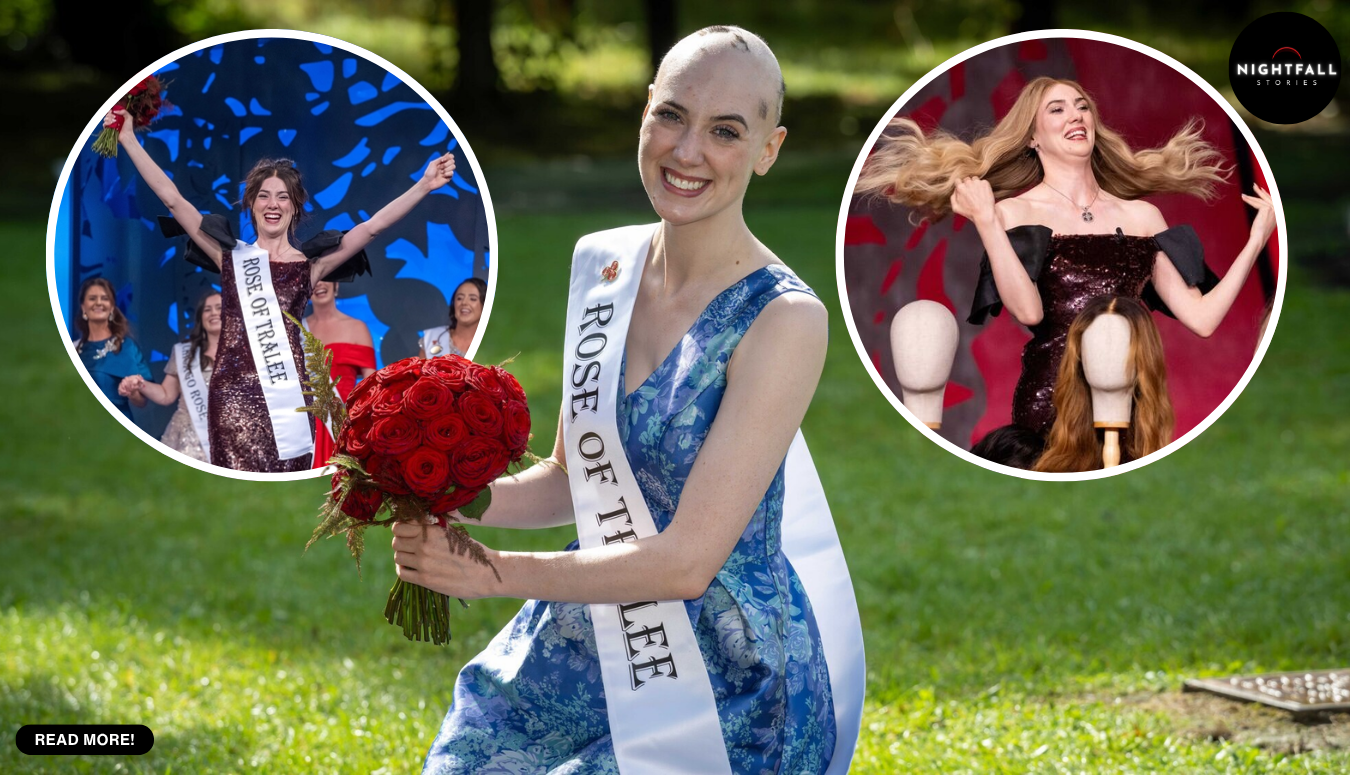
The trolley was the giveaway. Every other woman on that stage had a party piece, a song or a dance or a recitation, and Caoilfhinn Ni Choiligh came out with a wheeled rail of wigs, like a props cart. She went along them. Then she reached up, took off the dark one she had walked on in, and put a blonde one on instead, and explained that this was the point, that she can change her hair whenever she likes and that a wig is an accessory you can have styled before you ever put it on.
Then she took that one off too, and finished the rest of her interview bare headed, in front of a live audience in a sports arena in Kerry and a national television audience watching the biggest broadcast night in the Irish calendar.
The following night, out of thirty two women, the judges picked her. She is the 2026 Rose of Tralee.
What makes this worth more than a clip is what she did next, which was go back to the course she had already enrolled on. Caoilfhinn Ni Choiligh works in retail in Mullingar, in the Irish midlands, and she is training to be a wig maker. Not a wig seller. A maker. Of all the things that could have followed a moment like that, the one she chose was a hand trade.
First, though, the thing that almost every piece of international coverage gets wrong about the event itself, because it changes how you read her twelve minutes on that stage.
The Rose of Tralee is not a beauty pageant. That is not a defensive line from the festival’s own press material, it is how the thing is actually built. There is no swimsuit round. There never has been. Appearance is not scored. The published criteria are personality and suitability to act as an ambassador for the year, and the festival talks about aspirations, ambitions, intellect, social responsibility and Irish heritage. In practice each Rose gets an interview on stage with the host, a few minutes of conversation about who she is and what she cares about, and a party piece if she wants one.
It started in 1959, got up by a handful of local business people in Tralee, in County Kerry, to pull visitors into the town. It was open only to women from Tralee at first, then to the county, and from 1967 to any woman of Irish birth or Irish descent anywhere in the world, which is why the lineup every year includes Roses from Chicago, New York, Sydney, Dubai and London alongside the thirty two counties. There is an upper age limit of twenty nine. Since late 2021 married women and transgender women have been eligible. Unmarried mothers were excluded until 2008, which is the kind of detail that tells you more about the institution’s history than any brochure.
And here is the irony sitting at the centre of it. The festival is named after a nineteenth century ballad about a woman called Mary, and the entire burden of that song is that she was lovely to look at. The event named after it has spent decades insisting, correctly, that it is not judging anyone on their looks. Ireland has never quite stopped arguing about whether that works. The lovely girls jibe has followed it around for thirty years. Every August there are the memes and the eye rolls and somebody writing that it has had its day.
Which is the context that a trolley of wigs was wheeled into.
Caoilfhinn Ni Choiligh is from Mullingar in County Westmeath. She has had alopecia areata since she was fifteen, which she has talked about openly and at length in her own words, and which is the only basis on which it appears here. She has described what the start of it felt like in a way that nobody else writing about her has improved on: that when you lose your hair there is a bit of grief in it, because you are losing a small piece of yourself.
Fifteen is a specific cruelty of an age for that to happen, for reasons that need no elaboration to anyone who was ever fifteen.
She is twenty five in most of the reporting and twenty six in some of it, and both are probably right, because she said in the summer that she had turned twenty five the previous August, which puts her birthday within days of the festival itself. Earlier this year she passed the ten year mark, and she has said that was the thing that moved her. Ten years in, she worked out that she had accumulated practical knowledge that would be useful to somebody else, and that sitting on it was a waste.
So she started putting herself out there, which is her phrase, not an interviewer’s. She co founded a support group called The Hair Loss Haven with her friend Saoirse. It runs meetups and events for people losing their hair, from any cause, and the work it does is the unglamorous specific sort: when do you get your first wig, what do you do about the in between stage, how do you handle the day you tell people. A clinic can tell you what is happening to your scalp. It cannot tell you what to say to your manager. She gets a steady traffic of messages from strangers asking exactly those questions.
She has form on this kind of thing. Before any of it she had worked with Comhairle na nOg, Ireland’s network of local youth councils, and with the Irish Second Level Students’ Union, which are both organisations where the entire job is getting young people’s own views into rooms that would otherwise decide without them.
She was chosen as the Westmeath Rose on a June evening at a hotel in Athlone, out of a field of twenty women. Then came the Rose Tour, which is a genuinely odd piece of Irish tradition in which the whole group travels the country together for a fortnight before the festival, and then Tralee.
The clothes detail is worth a line, because it is the opposite of the image people have of this event. The gown she wore on the night she was crowned was rented, from a shop in her own town called The Dress Collective.
About the stage itself. She has been candid that she thought hard about whether to do the wig segment at all, and that the hesitation was not stage fright. It was the risk of being flattened into one fact about herself, of becoming the alopecia Rose and nothing else for a year. She decided to do it anyway, on the grounds that it genuinely has shaped who she is and that pretending otherwise would be its own kind of lie. She has since said that taking the wig off on the opening night was the highlight of the whole thing, and the part of it she is proudest of.
There is a strong temptation, in a story like this, to park the whole thing on the word brave and go home. It is worth resisting, partly because it is lazy and partly because she herself keeps steering away from it. Her line after she won was not about courage. It was that you can be a Rose whatever your imperfections and whatever your background. Her line to younger girls was that they should never let anybody dull their confidence. And the line she gave afterwards about the crying, hers and the audience’s, was that emotion is powerful and is not something we should be apologising for, which is a more interesting sentence than any of the headlines written around it.
Now the part that nobody expected, and the reason this is a story with an ending rather than a clip with a caption.
Wig making is a real trade and a dying one. A machine made wig is sewn: wefts of hair stitched in rows onto a cap, fast and cheap and recognisably a wig from across a room. A hand made one is knotted. Someone sits with a tiny hook and a base of lace or fine mesh and ties hair into it a few strands at a time, controlling the direction each one lies in, thinning the density at the front so the hairline looks like it grew there, building a parting that reads as scalp. It is close, slow, repetitive work and the difference between a good one and a bad one is almost entirely in the hands of the person who made it. The people who can do it properly are not numerous and they are not young.
That is the thing Caoilfhinn Ni Choiligh is studying for, while working in retail to pay for it. Her route into it was not a careers fair. It was eight or nine years of being a customer, of wearing the things daily, of knowing from the inside which seams itch and which partings fool nobody and what it costs in confidence when a wig is slightly wrong.
The money is the quiet scandal underneath all of this, and it is worth stating plainly because it is the part that shapes everyone else’s experience of hair loss and not just hers. In Ireland there is a state grant towards a hairpiece, wig or hair replacement, introduced in 2022 under the Department of Social Protection’s Treatment Benefit Scheme. It names alopecia areata specifically among the conditions it covers, along with hair loss from cancer treatment, scarring alopecias and hair loss after surgery, trauma or burns. You can claim it once in a calendar year. The ceiling is five hundred euro, which is roughly five hundred and eighty dollars.
That is a real improvement on nothing, and nothing is what existed before 2022. It is also a long way short of what a good hand made human hair wig costs, which is why the second hand market, the online guesswork and the long silent misery of wearing something that does not quite sit right are all still thriving. Somebody has to actually make the things, and make them well, and know what they are for.
So the arc of it is this. A fifteen year old loses her hair. She spends a decade learning, by necessity, everything there is to know about an object most people never think about. At twenty five she decides the knowledge is worth something to other people, starts a support group, and then goes on the most watched television programme in her country, takes the object off in front of about half a million people, and talks about it. Then she wins, which was not the plan, and now she has a year of public engagements and a car and a travel voucher worth around twenty nine thousand dollars, and she is still going to her wig making classes.
The prize list has one accidentally perfect item in it, by the way. Among the travel voucher and the loan of an electric car and the free hotel room in Tralee, the new Rose of Tralee receives a year of hair styling services from the local further education college. Nobody designing that package was thinking about a winner with alopecia. She can presumably put it to use, given that she owns more hair than most people in the arena.
The year ahead is a job, not a tiara. A Rose does school visits and charity work and openings and interviews, somewhere upwards of a hundred engagements, in Ireland and abroad. She has said she does not want the whole twelve months to be about her hair, and she is right to want that, because she is also a person who has worked on youth representation for years and who is halfway through qualifying in a skilled trade.
But she knows exactly what the hair bought her. Her own reckoning of the stage moment was not that she had been inspiring. It was that she had a platform for a few minutes, that she wanted to say her piece about something that matters to her, and that if one person watching who was in the middle of losing their hair saw a woman take a wig off and keep talking, that was the whole point and she had got it done.
The wig she pulled off on that stage is now the thing she is learning to build. Strand by strand, with a hook, badly at first, the way everybody learns a trade. It is not a metaphor. It is a course, with assessments, and she has to pass it.