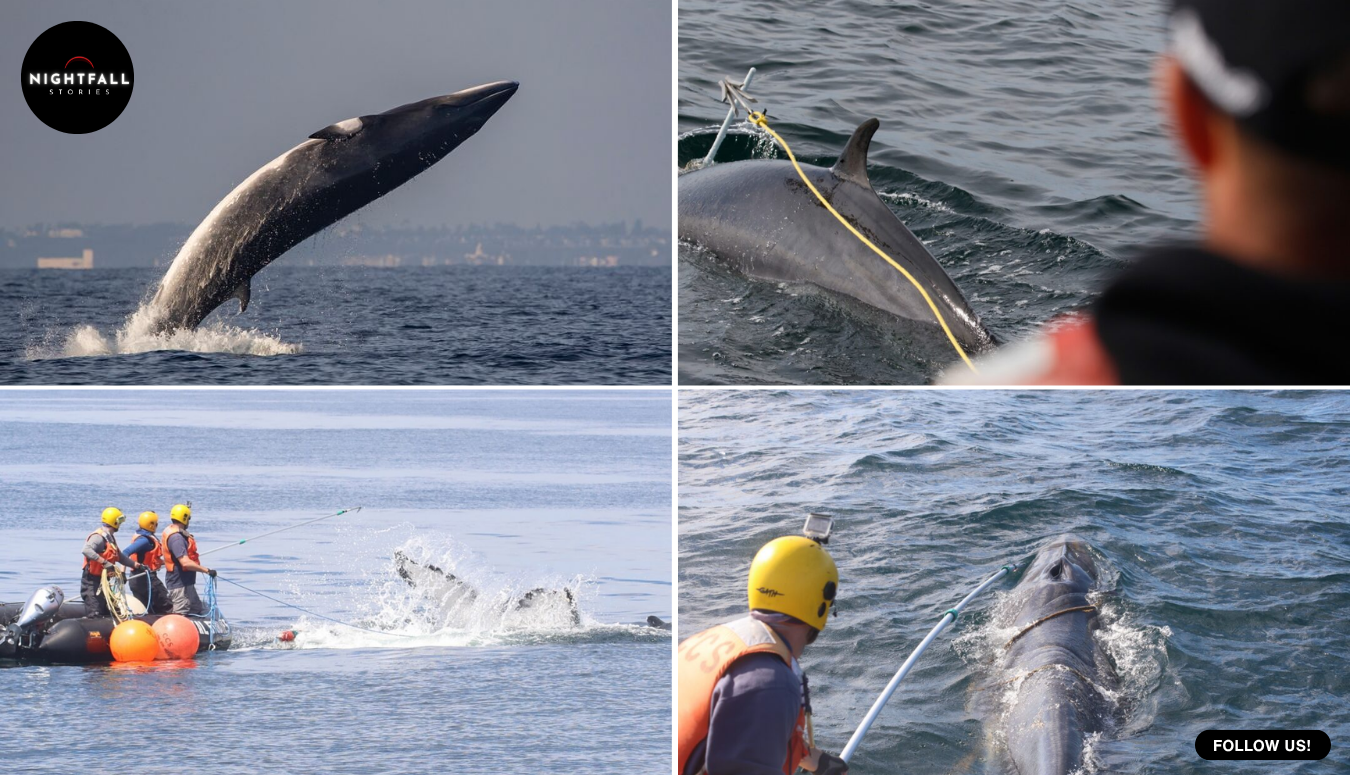
The whale was eighteen feet long, which for a minke is close to full grown, and the rope had found the worst possible position on it. A buoy line from fishing gear had gone in through the animal’s mouth, wrapped around its head and trailed back along its body to a point just forward of the tail. It could still swim. It could still breathe. What it almost certainly could not do was feed.
Getting that rope off took a crew from the Center for Coastal Studies in Provincetown about an hour and a half of searching and then roughly two hours of work, during which they brought their boat up alongside the animal somewhere close to fifty times. Not once. Not three times in a dramatic final push. About fifty approaches on a free-swimming whale in open water in Cape Cod Bay, each one a chance to catch a line with a grapple, almost all of them failures.
That number is the whole story, and it is worth sitting with before anything else, because it is the opposite of how whale rescues are usually told. There was no moment of understanding between species. The animal was not cooperating. It was doing what an eighteen-foot wild animal does when a boat comes at it, which is leave, and the people on the boat had to come back and do it again.
The call came in on a Saturday morning a few weeks ago. A whale watching vessel out of Hyannis had seen a minke towing a buoy, which is the classic signature of an animal dragging gear. A charter fishing boat reported a second sighting about two miles further east but could not stay with it. Both reports went to the entanglement hotline run by the Center’s Marine Animal Entanglement Response team, and that is where the first piece of luck in this story sits, because an entangled minke whale that has been seen once is usually not seen again.
Scott Landry directs that team, and his assessment of relocating the animal at all was that it was very lucky. Minke whales are the smallest of the baleen whales in these waters and by far the hardest to work with. A North Atlantic right whale is enormous, slow and relatively predictable. A humpback is big enough to be followed and often surfaces on something like a rhythm. A minke is compact, fast, erratic and spends very little time at the surface. It can be gone in a direction nobody expected in the time it takes to coil a line. Everything that makes a minke a difficult animal to study makes it a difficult animal to save, and it is precisely why fifty approaches were needed rather than five.
The team went out on their boat, the Ibis, with support from the Coast Guard out of Station Provincetown. Aboard were two trainees from France, part of an international exchange that moves disentanglement technique between countries: Willy Dabin from the Pelagis Observatory and the French national research agency CNRS, and Livier Schweyer from the Iroise Marine Natural Park. Whatever else those two took home, they got to watch the least glamorous and most instructive version of the job.
Before that, though, there was the search, and ninety minutes of it is a long time on the water. Two reports two miles apart do not give you a position, they give you a direction and a guess. A minke surfaces briefly and low, shows very little of itself and leaves almost no footprint on the water. The thing the crew were actually looking for was not a whale at all. It was a buoy moving the wrong way, against the set of the tide, because that is what an animal towing gear looks like from a distance.
It also matters that the rope was where it was. Gear wrapped around a fluke or a flipper is damaging and can be lethal over months, but an animal with its tail fouled can still eat. Gear through the mouth and around the head is the configuration responders least want to see, because a baleen whale feeds by taking in water and straining it, and rope running through that apparatus interferes with the one thing the animal has to do several times a day to stay alive. An entangled whale that cannot feed is on a clock, and nobody can read the clock from outside. That is why these responses happen on the day the report comes in, in whatever weather there is, rather than on the day conditions would be pleasant.
The problem in front of them was not cutting the rope. Cutting rope is easy. The problem was holding on to a whale.
This is where the technique gets genuinely strange, because the method the Center uses to control an entangled whale was borrowed, deliberately and explicitly, from the whaling trade. Nineteenth century whalers used an approach called kegging. Having harpooned an animal, they would attach large floats, kegs, to the line, so that the whale had to drag the buoyancy with it. The drag tired it out and the floats kept it at or near the surface where the boats could stay with it. The crews that now spend their lives undoing damage to whales use the same physics for the opposite purpose. Attach buoyancy to the gear the animal is already carrying, and the whale slows, surfaces and becomes something a small boat can work beside without being dragged under.
Before you can keg anything, though, you have to get a line on the whale, and that is the part Landry described as incredibly difficult on this particular animal. The tool for it is a grapple, thrown or set to catch the trailing gear. On a fast minke surfacing briefly and unpredictably, you get a second or two of chance per approach. That is what the fifty approaches bought: not fifty attempts at a rescue, but fifty attempts at a single preliminary step.
Once they had the line, the cutting tool was a knife on the end of a pole with a hooked blade, shaped so that it can be pushed past rope and then pulled back to slice from the inside out, cutting the line rather than the animal. Working alongside the whale from the small boat, the crew got that hook onto the rope at the head and cut it.
What happened next took seconds. The whale opened its mouth and released all of the remaining gear. Then it swam off, free of the rope.
That is the documented outcome, and it is important to state it precisely. The record says the whale was freed of the entangling gear and swam away. The record does not say the whale survived. Nobody followed it. Minke whales are not individually catalogued and tracked the way North Atlantic right whales are, and no re-sighting or assessment of its longer-term condition has been reported. Landry called it a nearly miraculous disentanglement, which is a statement about the operation, not a prognosis for the animal. An animal that has been unable to feed properly for an unknown period carries consequences that do not resolve the moment the rope comes off. The honest end point here is that the gear is off and the whale went away under its own power, and that is where the evidence stops.
There is one more element in Landry’s account that changes how you read the whole thing, and it is uncomfortable. His reading of the configuration was that the whale had very likely been anchored in the fishing gear originally, held in place, and that some well-intentioned mariner had cut the rope at some point, probably believing that was help. By his assessment it made things worse for the whale and harder for the responders.
It is worth understanding why, because the instinct behind that cut is one almost anyone would have. A whale held fast in gear is a whale in obvious distress, and cutting the rope that holds it looks like the obvious kindness. But an anchored whale is a whale you can find, a whale that is still in one place when trained responders arrive, and a whale whose gear is under tension in a known direction. Cut the anchor and you have converted a stationary problem into a mobile one. The animal is now a fast-moving target somewhere in a large bay, still wearing most of the rope, and the chances of anyone ever seeing it again drop sharply. The first sighting is usually the only sighting.
That is the reason the entanglement response network is structured the way it is, and the reason the authorities are so insistent that the public report rather than intervene. Responders in this network train for a long time before they are authorised under a federal permit to approach an entangled whale closely, let alone cut gear off one, and the network is tiered by species and difficulty, with the most restricted level covering work on North Atlantic right whales. The federal fisheries agency’s own guidance on this is about as blunt as official guidance gets. People, including trained and authorised responders, have died attempting to rescue entangled whales.
Hold that next to the picture of a small boat coming alongside an eighteen-foot animal fifty times. This is not a feel-good activity. It is dangerous, repetitive, technical work done close to a large frightened animal that can injure or kill a person without any intention of doing so, in a boat, on the open water, for hours.
And it is work with a genuine lineage. The Center’s disentanglement programme is the oldest in the United States, and it began with a single humpback on Thanksgiving Day in 1984. The whale had been tangled in gill netting for months. Charles Mayo, known as Stormy, and David Mattila took a crew out, including Mayo’s father, and improvised: a grapple anchor tied to large plastic floats, buoyancy added to the gear the animal was already carrying, which is kegging in everything but name. Four hours later the whale was free. It was seen the following spring on Stellwagen Bank, breaching and swimming, which is about as good an outcome as that kind of story gets.
Mayo had named that whale Ibis, after a mark on it that reminded him of an Egyptian hieroglyph. The boat the team works from in Cape Cod Bay today carries the same name.
In the four decades between those two animals, a piece of improvisation became a profession. The grapple, the kegging floats, the hooked knife on a pole, the decision rules about when to approach and when to stand off, the training ladder, the permits, the hotline, the exchange programmes that put two French responders on an American boat for a season: all of it grew out of people working out, case by case, how to get rope off an animal that cannot be asked to hold still.
The reason it had to become a profession is the scale of the underlying problem, and this is where the story stops being about one whale. Entanglement in fixed fishing gear is one of the central threats to large whales in the North Atlantic. The mechanics are grim and simple. Rope interferes with swimming, feeding and breathing. Gear that stays on an animal for months can cause infection, starvation, loss of a flipper or a fluke, blood loss, strangulation or drowning. For the North Atlantic right whale, a species down to a few hundred animals, entanglement is one of the main reasons the population has been in sustained trouble.
The argument about what to do runs through gear design: breaking strengths in rope, vertical line reductions, seasonal closures, and on-demand or so-called ropeless systems that keep line out of the water column until a trap is retrieved. Those debates are real and they are not resolved, and it is worth being careful about how they are framed, because the people on the other side of them are working fishermen whose livelihoods depend on the answer, not villains. Nobody sets a trap in order to entangle a whale. The gear is doing what gear does.
In this particular case, nothing in the record establishes which fishery the rope came from, and it would be unfair and unfounded to guess. The rope was a buoy line. That is as far as the documentation goes.
What the record does establish is a sequence. Two vessels reported an animal towing a buoy. A team went out and spent about ninety minutes finding it again, which by their own account was the lucky part. They then spent roughly two hours approaching a fast, unpredictable whale close to fifty times to catch a trailing line with a grapple. They got the line, held the animal alongside, cut the rope at the head with a hooked blade, and within seconds the whale opened its mouth, dropped the rest of the gear and left.
No one on that boat called it heroic. Landry’s own description of the hardest part, catching the line, was that it was incredibly difficult, and his description of the outcome was that it was nearly miraculous, which in context reads less like triumph and more like a man acknowledging how often this does not work. For every minke relocated after a first sighting, there are others that are seen once with a buoy behind them and never seen again. Those animals do not appear in the reporting, because nothing happened to them that anyone could write down.
That is the real weight of the fifty approaches. Not that a whale was saved, which is more than the record supports, but that a crew kept coming back to a moving animal in open water, failing, turning the boat, and coming back, until one approach out of about fifty landed.