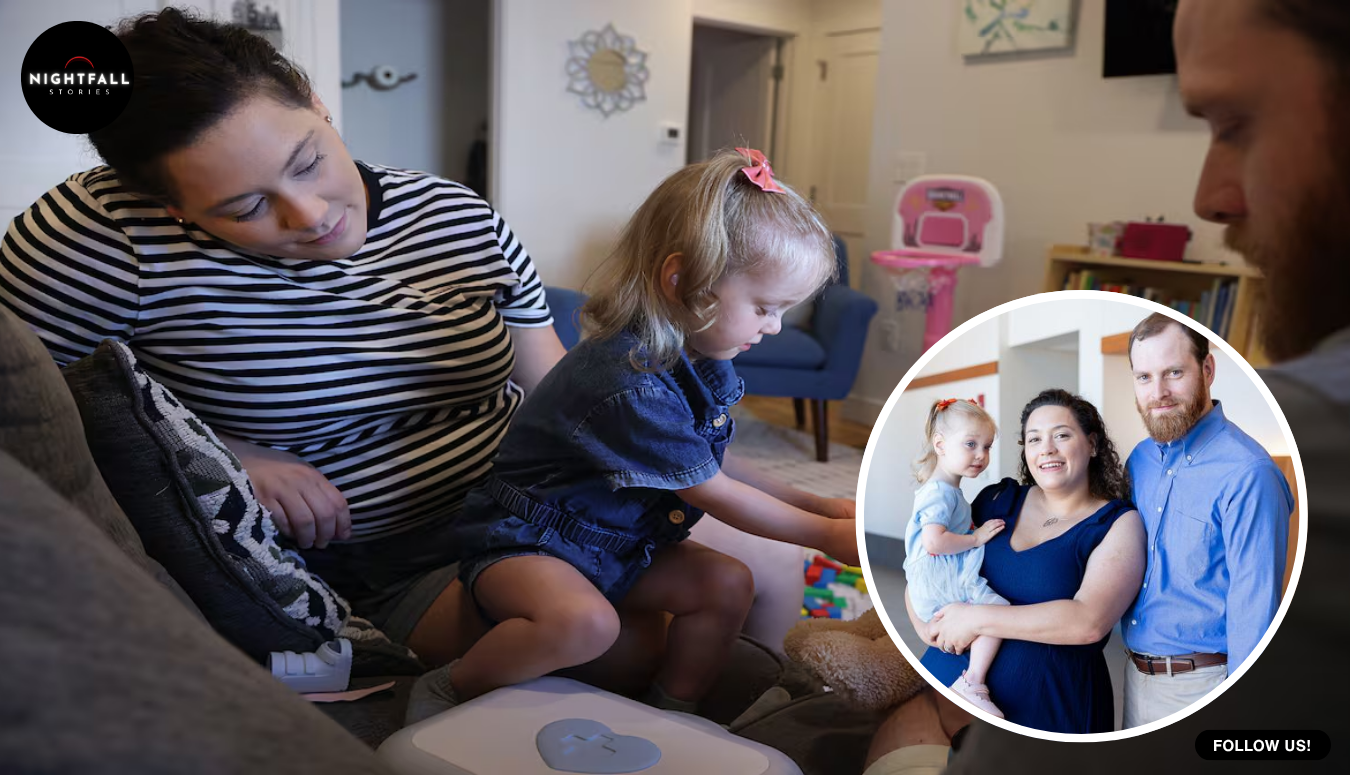
The email went out in the middle of September two years ago, from a neonatal nurse in Massachusetts to a state caseworker she had never met. It asked a question that nurses are generally advised to think very hard about before they ask it. There was a baby in the special care nursery at Beverly Hospital, a few weeks old, fed through a tube because she could not yet manage a bottle, and the nurse who had been with her three nights a week from seven in the evening until seven in the morning wanted to know whether she could foster her.
Her name is Nora Lussier. She was twenty eight at the time and four years into the job. The answer came back fast, and it was yes, which is the part most people do not expect. Just over two weeks later the baby came home with her. Just under two years after that, on the girl’s second birthday, Lussier and her husband Martin signed the papers that made Pamela legally their daughter, in a room with about twenty five people in it, including several of the nurses who had taken turns holding her on the night shift.
That is the whole shape of it, and it is the kind of story that usually gets told in forty seconds and a soft piano cue. The more interesting version is the one that takes the professional question seriously, because a nurse adopting her own patient is not a small decision made in a quiet moment. It is a process with background checks in it, a statute behind it, a court report, a minimum residence period, and a professional code that has something quite specific to say about getting too close to the people in your care. All of that happened. None of it is sentimental. Most of it is the reason the ending held.
Start with what the work actually was. A special care nursery is not a ward where babies lie quietly getting bigger. Anna McNicholas, the nurse manager of the unit, has described the particular case plainly: babies who were exposed to substances before birth tend to stay longer, and the nurses hold them more, because holding is part of the treatment rather than a kindness added on top. That is a named clinician describing her own unit’s practice, and it is worth repeating exactly at that level and no further. Pamela needed a feeding tube when she arrived. She needed specialist care that eventually involved an evaluation at Boston Children’s Hospital. Beyond that, nobody outside her medical team is in a position to say what her chart contained, and this piece is not going to guess.
What a tube feed involves is less dramatic than it sounds and more laborious than people imagine. A measured volume, checked and rechecked. A line that has to be in the right place every single time, confirmed before anything goes down it. A baby who may be unsettled, whose cues you learn by repetition, in a room where the lights are kept low and the monitors do the talking. Then you write it down, and four hours later you do it again, and at seven in the morning you hand over to someone else and go home. Multiply that by three nights a week across most of a baby’s first three months and you have something that is not quite parenting and not quite nursing either, which is precisely the territory the professional codes are built to patrol.
The current Code of Ethics for Nurses published by the American Nurses Association devotes a whole provision to it. The language is about protecting the patient and reducing the power imbalance that sits inside any care relationship, and it asks nurses to watch themselves for the risk of becoming either under involved or over involved with the people they look after. It does not say that what Lussier did is forbidden. What it says, in effect, is that a nurse must not settle a question like this privately, inside her own head, on a night shift. She has to examine her own conduct, work out whether she is still inside her professional role, and take it through the proper channels.
An email to the child’s state caseworker is a proper channel. It is, arguably, the only one that matters, and that is the structural fact the short version of this story leaves out. A hospital does not place children. In Massachusetts, where a child is in the care of the Department of Children and Families, the department decides where that child lives, and the department’s own written placement policy is unusually welcoming to exactly this situation. It describes itself as a kin first agency. Its definition of kin is deliberately broad: biological relatives, adoptive relatives, and what the policy calls fictive kin, meaning another individual to whom the child or the parents ascribe the role of family on the basis of cultural and affectional ties, as well as people the department itself identifies as suitable caregivers for a particular child.
That is the door Lussier walked through. The caseworker’s answer, by the family’s account, was an emphatic yes, and the route offered was fictive kinship, which lets someone with a close existing connection to a specific child be approved as that child’s foster parent rather than as a general purpose foster home. The policy calls this child specific licensing. It exists because the alternative, for a medically fragile three month old, is a stranger.
It is not a shortcut in the sense of being easy. The licensing policy requires criminal and child welfare history checks on every member of the household aged fifteen and over, including criminal offender records, sexual offender records, the department’s own case history, and a fingerprint based check against the national crime database. Certain convictions disqualify an applicant for five years and certain convictions disqualify them for life, automatically, with no discretion. The home has to meet basic housing standards, which are spelled out down to the square footage of a child’s sleeping space and the requirement for working smoke detectors and carbon monoxide detectors on every level. There is an assessment of the caregivers themselves, built around a framework that looks at resilience, social connections, knowledge of child development and access to practical support. Foster parents have to complete twenty hours of training a year, and the initial training covers trauma, behaviour, permanency planning and the adoption process itself.
What kinship status changes is mostly the clock. For an unrelated foster family the department’s assessment has to be completed within sixty working days. For a kinship family it is forty five working days, with a short extension possible, and in urgent cases the policy contemplates same day placement with the licensing finished behind it. In Lussier’s case there was a home visit, there was paperwork, and Pamela came home in early October, roughly three months old, after the stretch of hospital care that had begun at birth.
There was also a reason the clock mattered. The family that had originally been lined up to foster her was not able to take her, because of the level of medical need involved. That is a quiet sentence with a lot inside it. Finding a foster placement for a newborn is hard. Finding one for a newborn who still needs a feeding tube and specialist follow up is considerably harder, and the pool of people who are both willing and competent to do it is small. A neonatal nurse who had already been doing that exact care, by hand, for weeks, is an unusually strong answer to a difficult problem, which is presumably why the answer came back as fast as it did.
Martin Lussier is the part of this that gets skipped, and he should not be. He works in marketing. He had not been on the night shift. He had not held the baby, learned her cues, or watched her chart improve. He married Nora a little over three years ago, and fostering a medically fragile infant was the sort of thing the two of them had filed under someday. Then someday arrived as a question from his wife about a specific child with a specific set of needs, on a timeline measured in weeks. He said yes to a child he had no professional relationship with at all, which is in some ways the harder yes. His own account of how he knew it was right is simple and not especially poetic: once she was home and laughing, he stopped wondering.
Fostering, though, is not adoption, and the gap between the two is where most of the two years went. In Massachusetts an adoption decree is a matter for the Probate and Family Court, and the statute is not casual about it. Ordinarily adoption requires the written consent of both lawful parents, executed no earlier than the fourth day after the child’s birth, witnessed and notarised, and final from the moment it is signed. Where that consent cannot be obtained, the court may dispense with it, but only on an application from someone with custody of the child or from the department or a licensed agency, and only where allowing the petition is in the child’s best interests.
The statute then makes the court do actual work. It has to weigh the ability, capacity, fitness and readiness of the existing parents and of the prospective adoptive parents, with the child’s health and safety treated as paramount though not as the only consideration. It lists fourteen specific factors for the fitness assessment. One of those factors is whether the child has formed a strong bond with a substitute caregiver. It is a small clause in a long piece of legislation, and in this case it is close to the heart of the matter: the law anticipates that a child may attach to the person who has been doing the caring, and it instructs the court to count that.
Nor can the paperwork outrun the reality. Before any decree, the department has to carry out an inquiry and file a written report with the court, normally within thirty days of being notified of the petition, covering the child’s background, whether the child is suitable for adoption, and whether the petitioners and their home are suitable for raising a child. And no decree can be made until the child has lived in the petitioner’s home for at least six months, unless a judge waives that for good cause and records the reason for doing so. Pamela had lived there for about twenty one months by the time the case was finalised. There was nothing to waive.
For scale, the Boston Globe reported that the department had custody of nearly seven thousand children in 2024 and that eight hundred and seventy one adoptions were completed that year. Most of those children are not adopted by the nurse who fed them. The point of the comparison is not that this family beat the system. It is that the system has a narrow, specific provision for a person already bonded to a particular child, and this is what it looks like when that provision is used properly rather than bent.
The unit did not stay out of it. Lussier’s colleagues, by the nurse manager’s description, were taken with Pamela from the start, and once she was going home with one of their own they behaved like what they had effectively become, which the family calls her nurse aunties. They threw Lussier a baby shower, because she had gone from no children to an infant with medical needs in a little over two weeks and did not own any of the equipment. They babysat. McNicholas has made the obvious professional observation about that arrangement, which is that a rota of neonatal nurses available to mind a medically fragile toddler is about as good as it gets. About twenty five people were there when the adoption was finalised, family and friends and nurses from the nursery together, on the child’s second birthday.
Pamela is two now and does not have a feeding tube. She has developmental delays connected to her exposure before birth, which is as far as the reporting goes and as far as this account will go, and she is receiving early intervention speech and occupational therapy and, by her mother’s description, catching up quickly. She is described as sweet and happy. That is the whole medical picture that anyone outside her care team is entitled to offer.
Her birth parents were not able to be involved. That is the only thing the reporting says about them, and it is the only thing worth saying. No one in that situation is a villain in somebody else’s feel good story, and the details of how a family comes apart are not public property. They are not the subject here. What happened to the baby is.
The thing about a neonatal unit is that the entire discipline points one way. You learn a child completely, down to the volume and the timing and the particular way she settles, and then you hand her over and she leaves and you do not find out how the rest of it goes. The ability to do that without breaking is part of the professional skill, and it is why a code of ethics bothers to warn people about over involvement in the first place.
Once, in that unit, somebody did not hand the child over. What makes the story worth more than forty seconds is that she did not simply decide to keep her. She wrote to the caseworker. She submitted to the fingerprints and the records checks and the home study and the square footage and the annual training hours. She fostered for close to two years while a court worked through a statute with fourteen factors in it and a department filed a report on whether her house was a fit place to raise a child. All of that machinery exists to stop people taking children they have become attached to. In this one instance it was pointed at the question properly, from both ends, and it agreed.
The nurses who fed Pamela through a tube on the night shift still see her. They are not visitors. They are the aunts.