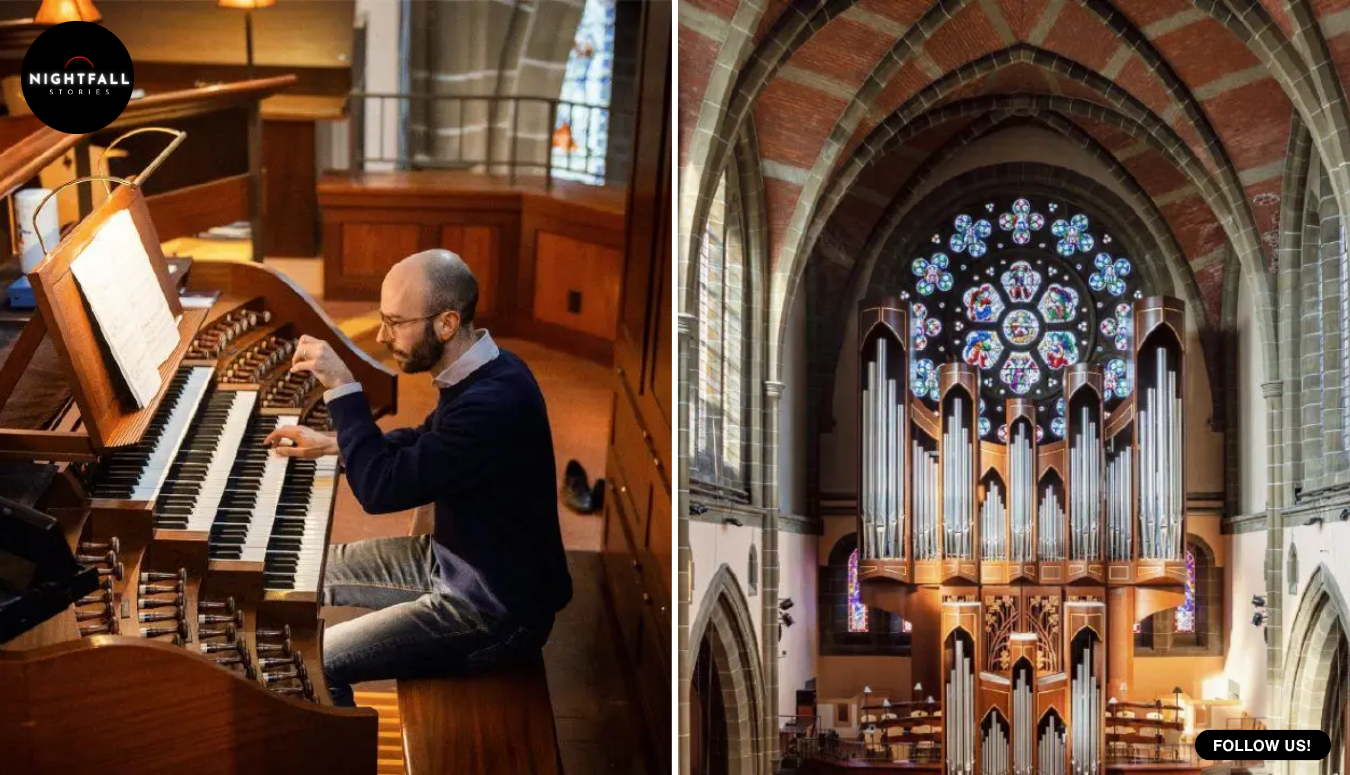
For eleven weeks this summer, the largest mechanical pipe organ in Canada west of the Rocky Mountains was not an instrument at all. It was components. Four thousand pipes, or something close to four thousand three hundred depending on whose count you accept, came out of a free standing mahogany case built around a rose window and were laid out, cleaned one at a time, and put back. Twenty tons of wood, leather, tin and lead, sitting on a reinforced steel frame wedged between two bell towers to keep it still in an earthquake, was opened up and gone through by hand.
The crew who did it worked for a company in Montreal called Juget-Sinclair. The organ they were taking apart was built by a man called Hellmuth Wolff, in a workshop in Laval, Quebec. And the reason this is a story rather than a maintenance invoice is that the people who dismantled the instrument had learned the trade inside Wolff’s own shop, from Wolff, and came back to his work two decades later to undo and redo it. Wolff himself died in Montreal in 2013. He never saw the overhaul, and he never had to watch anybody else’s hands inside his masterpiece.
That is the headline fact, and it holds up. Stephen Sinclair, who became an associate of the Montreal firm in 1998, worked in Hellmuth Wolff’s workshop from 1989 until 1998, with spells in France and England along the way. Denis Juget, who founded the firm in 1994 after training as a cabinetmaker and apprenticing in organ building in France before moving to Montreal, also came out of Wolff’s orbit. The Victoria reporting describes Juget-Sinclair plainly as a company made up of Wolff’s former associates, and the firm’s own account of itself confirms the apprenticeships. These were his people.
The instrument sits in Christ Church Cathedral in Victoria, British Columbia, on Canada’s Pacific coast. It is Wolff’s Opus 47, out of roughly fifty instruments he designed, built and installed across North America between 1968 and 2008, which means it arrived near the end of a working life and is widely treated as one of the best things he ever made. Mark McDonald, the cathedral’s organist and assistant director of music, puts his finger on why: Wolff, he says, was really a musician at heart, and it shows in the way the thing sings rather than merely sounds.
Wolff’s own route to that workshop is worth a paragraph, because it explains the instrument. He was born in Zurich in 1937. He apprenticed with Metzler and Soehne in Dietikon, worked at Rieger in Austria, then crossed the Atlantic to work with Charles Fisk in Massachusetts before emigrating to Canada in 1963. He spent time as a designer at Casavant Freres in Quebec, worked briefly with Karl Wilhelm, and in 1968 opened his own shop in Laval. He became a Canadian citizen in 1970. He was one of a small number of builders in North America who turned back towards historical practice at exactly the moment the industry was going the other way, which is to say he built tracker organs, where the keys are connected to the pipe valves by a physical linkage of wooden rods rather than by electricity. Press a key on an instrument like that and you are pulling open a valve with your finger. You feel it. That is the whole point, and it is also why such an instrument wears like a machine rather than like a piece of furniture.
The Victoria organ took six years to come together and cost about 2.2 million Canadian dollars to build, somewhere around 1.8 million US dollars at the exchange rates of the day. More than a quarter million of that went on steel alone, because the engineering problem in a seismic zone is not the music, it is stopping twenty tons of case from moving. Installation began in 2004 and the instrument was inaugurated in the autumn of 2005, with a dedication recital given by the English organist John Scott. The case is mahogany, free standing, deliberately shaped around the rose window in the west wall so that the window still reads as a window. The console is detached from the case with enough room between the two for two rows of singers, which is a small design decision that tells you the builder was thinking about choirs and not about photographs.
The thing it replaced had been in constant use for well over a century. McDonald’s description of its final decades is the kind of line that sticks: held together, he says, with duct tape and prayers. A former music director, Michael Gormley, started arguing in the 1980s that the cathedral needed something spectacular instead, and spent years pushing the fundraising that eventually produced the Wolff.
It helps to know what is actually being counted, because the counting is where this story gets slippery. A rank is a single row of pipes, one pipe for every note, all built to the same recipe so they share a family voice. A stop is the control the player pulls to bring a rank, or sometimes several ranks at once, into play. So ranks are hardware and stops are closer to choices, and the moment a builder lets one rank be played from two different keyboards, or borrows a bass rank to serve two purposes, the arithmetic stops being arithmetic and becomes a matter of convention.
It is also worth knowing how small the shop was. By 1990 Wolff’s firm had completed thirty three instruments in twenty two years, with James Louder joining as an associate in 1986, which is the output of a handful of people working slowly rather than a factory. Opus 47 was not assembled by a workforce. It was made by a few pairs of hands over six years, and almost everybody who ever touched the inside of it knew everybody else who had. That is why sending Wolff’s former apprentices back to it is not a sentimental coincidence. In a trade that small, there was hardly anyone else to send.
Here is where the numbers go sideways, and rather than quietly split the difference it is more honest to lay the disagreement out. The cathedral’s own description of its instrument says sixty seven stops and four thousand pipes across four manuals and pedal. The standing Quebec organ catalogue that documents the province’s builders lists the same instrument as sixty one stops, eighty six ranks and approximately four thousand three hundred pipes. A third reference gives sixty one stops and eighty five ranks. Local reporting over the summer used both sets at different times, sixty one stops and eighty five ranks in the spring, sixty seven stops in the autumn. Nobody is lying. Stop counts move depending on whether you count borrowed and duplexed registers, couplers and transmissions, and rank and pipe counts move with them. But the spread is real, and the only defensible way to write it is to say that the cathedral calls it sixty seven stops and four thousand pipes, that the catalogue calls it sixty one stops, eighty six ranks and about four thousand three hundred pipes, and that both figures describe the same object.
What is not in dispute is the workload. In its first twenty one years the instrument was used for more than twenty thousand hours. The cathedral breaks that down as roughly four thousand services, three thousand rehearsals and two hundred concerts, and it is the primary teaching instrument for the University of Victoria’s organ programme and the Victoria Organ Studio on top of all that. Which means students. Which means scales, and the same passage ninety times, and the mechanical action taking every one of those repetitions through a linkage of wood.
Twenty thousand hours does specific, unromantic things to an organ. Leather dries and hardens and stops sealing, so wind leaks where it should not and pipes speak when they are not asked to. Felt and cloth bushings compress, so the action develops slack and the touch goes vague. Wooden trackers move with two decades of humidity swings and the regulation drifts out, so the keys no longer all feel the same under the hand. Pipe mouths fill with dust and the voicing dulls, a few cents and a shade of brightness at a time, slowly enough that nobody in the congregation ever notices a bad day. Electrical contacts on the stop action corrode. None of it is dramatic. All of it is cumulative, and the sum of it is that the instrument gradually stops being the instrument that was delivered.
There is something quietly surprising in that for anyone who assumes an organ restoration must involve a nineteenth century relic. This machine was twenty one years old. It had already worn out once. That is not a sign of poor building, it is a measure of how hard a working cathedral instrument is actually driven, and it is a far more interesting fact than the usual heritage rescue story.
The cathedral decided to deal with it rather than let the drift continue. The target was 150,000 dollars, raised by public donation, and by the time the crew arrived in the middle of June about 120,000 of it was in, leaving the committee chasing the last thirty thousand while the work was already underway. Thomas Chase, who chaired the fundraising, described the instrument as the voice of the cathedral, something that can fill the building with thunder and can also whisper, and the campaign leaned on exactly that: not a building fund, not a roof, but the sound of the place.
Then the organ went silent, and stayed silent through the entire summer, in a building whose liturgy is organised around it. McDonald’s own formulation is that the organ gives voice to the liturgy. Take it out in the middle of June and give it back in September and you have taken out the thing the congregation sings against for a whole season.
The work itself was straightforward in description and brutal in scale. Every pipe cleaned and regulated. Mechanical components taken apart, refurbished and reset. Electrical components gone through. A hard deadline at the start of September, because the first booking back was not a quiet Sunday but a concert by the Choir of Merton College, Oxford, on the seventh. There is no version of that date where the instrument is nearly ready.
It was ready. The organ returned to public service on 7 September, under an Oxford choir, which is about as exposed a re entry as an instrument can be given. Donald Hunt, the cathedral’s director of music, said afterwards that it came back sounding as beautiful as ever, which from a director of music is less a quote than a verdict.
What happens next is scheduled rather than finished, and it is worth being precise about that. The formal rededication falls on 4 October, at Evensong, and a British composer, David Bednall, has written a new piece for the occasion which is due to receive its world premiere at that service. The weekend around it is built out: Mark McDonald playing a lunchtime recital with the Calgary trumpeter Adam Zinatelli, and Alex Ross of Juget-Sinclair giving a public talk about what the crew actually did, which is an unusually good idea, because the work is invisible once the case is closed. The internationally known organist Jan Liebermann is booked for a concert the same weekend. At the end of October the organist David Briggs is due to accompany the 1925 silent Phantom of the Opera on the restored instrument, which is the single best demonstration of range anyone could have programmed: the same machine that carries an Evensong has to produce a horror film for ninety minutes without a break.
So the rededication and the premiere are still ahead as this is written. The ending that has actually happened is the one in September, and it is the better ending anyway, because it is the one where the instrument had to work.
There is a detail in the Bednall commission that rewards a second look. Commissioning a new piece is what you do when an organ is new. Doing it for a rededication means the cathedral is treating a twenty one year old instrument as something with a future rather than something being tidied up, and asking a living composer to write for this particular box of pipes, in this particular stone room, with this particular reverberation.
And the shape of the whole thing is unusual enough to say out loud. Most restoration stories are about strangers rescuing an object from its own history. This one is about continuity. A man trains two young builders in a workshop in Quebec. They leave and start their own firm. He builds, late in his career, the instrument most people consider his finest, and ships it across the continent to a cathedral on the Pacific. He dies. Twenty one years of use grind the thing out of tune with itself. And the people who come west with the tools are the people he taught, doing to his work exactly what he taught them to do, in a building where nobody in the pews will ever be able to point at a single thing they changed.
That is the test they were working to, in fact. A restoration of this kind succeeds when it leaves no trace. If a parishioner sits down in October and thinks the organ sounds different, somebody got it wrong. If they sit down and think it sounds the way it always did, better than they remembered, and cannot say why, then eleven weeks and 150,000 dollars did precisely what they were supposed to do. The congregation paid for an absence of change, and got it.
The instrument is booked solid through the autumn. Lunchtime recitals, a Danish organist in September, the rededication, the silent film at the end of the month. Hellmuth Wolff’s Opus 47 is back to doing the four thousand services and three thousand rehearsals and twenty thousand hours again, which is the only form of immortality a working machine gets, and the only one its builder would have asked for.