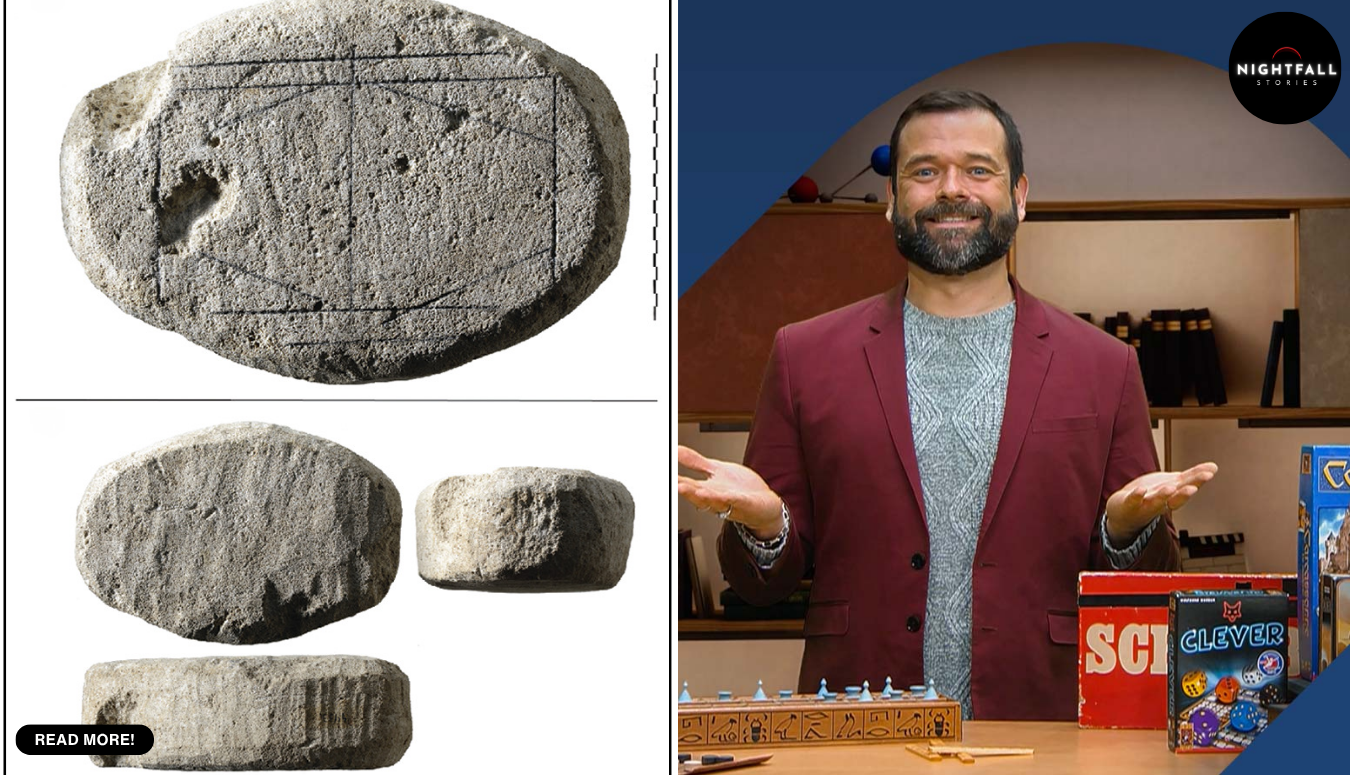
The object is small enough to carry in one hand. It measures 212 by 145 by 71 millimetres, weighs 3.38 kilograms, and is made of white Jurassic limestone quarried at Norroy in what is now northeastern France, which means somebody paid to move it a long way. On its top surface, cut with something harder than the stone, there is a rectangle, four diagonal lines, and one straight line running across. It was dug out of the Dutch town of Heerlen more than a century ago, catalogued as object 04433, and then it sat in a museum collection for decades while nobody worked out what it was.
In 2020 an archaeologist named Walter Crist asked to look at it. Crist studies ancient board games, which is a real specialism and a small one, and he has spent years learning to read incised grids the way other people read handwriting. He knows the three-in-a-row grids the Romans scratched into paving stones. He knows the merels boards, the race boards, the alignment games. He looked at the pattern on object 04433 and did not recognise it. It matched no game that anyone currently knows how to play.
That is where most stories like this one stop. A grid of lines on a stone is one of the most frustrating objects in archaeology, because a grid of lines is exactly what you get from a dozen different human activities that have nothing to do with each other. It could be a tally. It could be a mason setting out a cut. It could be a geometric doodle made by somebody waiting for something. It could be a game. The history of games is thin for precisely this reason: play leaves behind almost nothing that is unambiguously play, and so the record we have starts much later than the behaviour did.
There was also a problem with the object’s paperwork, and it is worth being honest about it, because it limits what anyone can claim. Object 04433 was excavated in Heerlen in the late nineteenth or early twentieth century, at a time when recording standards were not what they are now, and the provenance documentation that survives is minimal. Nobody can point to the exact layer it came out of or the exact year it was lifted. That is why the dating is given as a range of centuries rather than a date, and why the study leans so heavily on the stone itself rather than on its context. When the context is gone, the object has to testify on its own behalf.
So Crist and a team drawn from Dutch, Belgian and Australian institutions did something unusual. Instead of arguing about what the lines looked like, they asked the stone what had been done to it.
Under a microscope, the surface of the limestone is mostly rough, the way a broken piece of Norroy limestone is rough. In places, though, the individual grains have been levelled and smoothed flat, which is what happens when something harder is dragged repeatedly across them. Those smoothed patches are not scattered randomly. One continuous smoothed zone runs alongside one of the diagonal incised lines, its inner edge parallel to the line and sitting between 16 and 18 millimetres away from it, which is roughly the width of a hand pushing a small object along a track. The underside and the vertical edges of the stone, by contrast, show no abrasion at all. Something had been moved back and forth along that one diagonal, many times, for a long time.
The team also did the thing that separates careful use-wear work from wishful use-wear work, which is to set up controls. They photographed the microtopography of a naturally broken, unworked piece of Norroy limestone, so they had a baseline for what this specific stone looks like when nothing has happened to it. They also photographed the deliberately flattened surface of another Norroy limestone object from the same museum, an inscription, so they had a baseline for what the stone looks like when a craftsman has worked it on purpose. The smoothed patches on the game board do not match either baseline. They are not raw rock and they are not tool-dressed. They are what you get from prolonged, gentle, repeated contact.
To capture this properly, Luk van Goor at the Restaura restoration workshop in Heerlen built a digital model of the stone using photogrammetry combined with a photometric stereo technique, which lets you turn surface topography into measurable depth rather than just a picture of shadows. The resulting depth map showed the surface generally lowered around the incised lines, and showed something more useful still. Some of the lines were a fraction of a millimetre deeper than others. Not decoratively deeper. Worn deeper. The board had favourite routes.
That is the physical half of the work, and it is the half that usually gets skipped in the coverage. It is also the half that does the real evidential lifting, because it establishes that objects were slid along these lines rather than the lines simply being cut and admired.
The second half is where the computers come in, and it needs describing carefully, because most of the headlines about this study have described it wrongly.
The team could not simply read the rules off the stone. To begin with, they could not even agree on the board. The incised lines support six different plausible geometries, depending on which lines you treat as part of the playing surface and which you treat as errors, and treating some lines as errors is not special pleading, because other excavated game boards do carry visible mistakes where somebody misjudged a cut. So they carried all six forward.
Haretavl is worth a word, because the choice of starting point was not arbitrary. It belongs to the broad family of Northern European hunt games, the same family as the various tafl games, in which the two sides are deliberately unequal: one player has many pieces and a blocking or capturing goal, the other has few and is trying to survive or escape. These games were still being played in living memory in parts of Europe, and their rules are recorded, which is the only reason a simulation seeded with them is anything other than guesswork. The team was not inventing candidate rules out of nothing. It was asking whether any rule set from a documented regional tradition would, if played on this board, produce this pattern of wear.
Then they used Ludii, a general game system developed at Maastricht University that can encode and play an enormous range of historical board games under formally specified rules. They assembled 130 possible configurations of board and rule set. Of those, 112 were variations on haretavl, a family of Northern European games in which one side has more pieces and the other has fewer, and the many pieces try to pin the few. Artificial agents using alpha-beta search then played each configuration, 1,000 rounds per combination, with one second of thinking time per move.
Crucially, they were not asking the software to guess the rules. They were asking a narrower and much better question: if people had played this particular rule set on this particular board, thousands of times, which lines would have taken the most traffic? Each simulated game logged which lines its pieces travelled along. The team then compared those traffic patterns against the wear on the real stone, and specifically against that one smoothed diagonal.
Nine configurations produced a match. All nine were blocking games. The single most likely candidate is straightforward enough to teach a child in about a minute. One player begins with four pieces along one vertical side of the main rectangle. The other begins with two pieces on the opposite side. The player with four pieces is trying to manoeuvre the player with two into a position where they cannot legally move at all. Then the players swap roles, and whoever trapped the other in fewer turns wins. You need the board, six counters of two colours, and somebody to play against. Coins work.
Dennis Soemers, one of the computer scientists on the team, has been notably careful in public about what this does and does not establish, and his caution deserves to be repeated rather than buried. A system like this will always be able to find some rule set that fits some pattern of lines. Finding rules that are consistent with the wear is not the same as proving those were the rules. Nobody can be sure that the people in Roman Heerlen played the game precisely this way. What the study offers is a plausible reconstruction, constrained by physical evidence, and published openly so that other people can attack it. That is a genuine result. It is not a solved code, and the decode-style headlines that followed the paper oversell it.
What is left once you strip the overclaiming out is still significant, and it is significant for a reason that has nothing to do with computers. Blocking games of the haretavl type have been documented in Northern Europe from the medieval period onward. There was no accepted evidence for them earlier. Object 04433 has been dated to roughly 1,500 to 1,700 years ago, and if the reconstruction holds even approximately, the genre was being played in this part of Europe centuries before the record allowed. Veronique Dasen, a specialist in ancient play who was not part of the team, has called the approach groundbreaking and pointed out that the same method could be turned on the many other carved stones and tiles sitting in collections around the world whose meaning nobody has been able to establish.
It is worth putting the object back in its town, because the town explains the stone. Heerlen sits on what was once Coriovallum, a Roman settlement on the empire’s northern edge where two major roads crossed. Coriovallum is best known for its bath complex, and the physical fabric of that complex tells you something about the place. The foundations of its portico are rough blocks of local Kunrader limestone from a nearby quarry, and resting on top of them is a pillar base of imported Norroy limestone, the same stone the game board is made from. Ordinary local material doing the heavy work, expensive imported material where it would be seen.
Games themselves were entirely ordinary across the Roman world, which is part of why the gap in the record is so odd. Roman soldiers and townspeople played rota, a three-in-a-row game whose circular grid turns up scratched into paving and steps all over the empire. They played alignment games of the sort that later become gomoku. They played race games with dice, and they gambled on them, and they complained about the gambling. What was missing from that picture was any solid evidence of the blocking game, the cold, quiet, dice-free kind where nothing depends on luck and the whole contest is about closing off your opponent’s options. That absence is what object 04433 pushes against.
The museum collection from the same site also holds glass gaming pieces, a small handful of them, smooth and rounded and exactly the sort of thing that would slide along a shallow incised line and, over a long enough period, polish the grains of a limestone surface flat.
So the picture is not a mystery so much as an ordinary afternoon. Somebody in a road town on a cold frontier got hold of a rounded lump of good imported limestone, shaped its underside and sides deliberately so it would sit flat, scratched a grid into the top, and then played on it. Repeatedly. Enough that one line took visibly more traffic than the others, which is the most human detail in the entire study, because it means they had a preferred opening. People in garrison towns have always had time to fill, and filling it is not the sort of thing anybody writes down.
That is also the answer to the question the paper actually sets out to ask, which is not how do you decode a Roman game but how do you recognise play in the archaeological record at all. The answer the team arrives at is that you look for the traces of repetition. Play is defined by doing the same thing over and over for no external reward, and repetition is the one thing that leaves a physical signature. A tally is cut once. A mason’s setting-out line is used once. A game is played until the stone goes smooth.
Object 04433 is still object 04433. The museum that holds it, Het Romeins Museum in Heerlen, is closed while it is rebuilt, and is not expected to reopen until 2028, so for the moment the stone itself is not something you can go and stand in front of. But the work that was done on it has left, and this is the part that makes the story finish rather than trail off.
The rule set is published, in an open access paper, alongside the wear data and the depth maps and the reasoning. The game has been given a name, Ludus Coriovalli, the game of Coriovallum, which is a modern invention because nobody knows what its players called it. And all nine surviving rule variants have been implemented in Ludii, which means the game is not a description in a journal. It is playable. You can pick a variant and sit down to it, four pieces against two, and try to pin your opponent in a corner of a rectangle that somebody scratched into a piece of French limestone in a frontier town seventeen centuries ago.
Nobody can promise you are playing it correctly. What can be said is that you are moving pieces along lines that were worn down by somebody else’s hands doing the same thing, and that the stone kept the record of their moves long after everything else about them was lost.