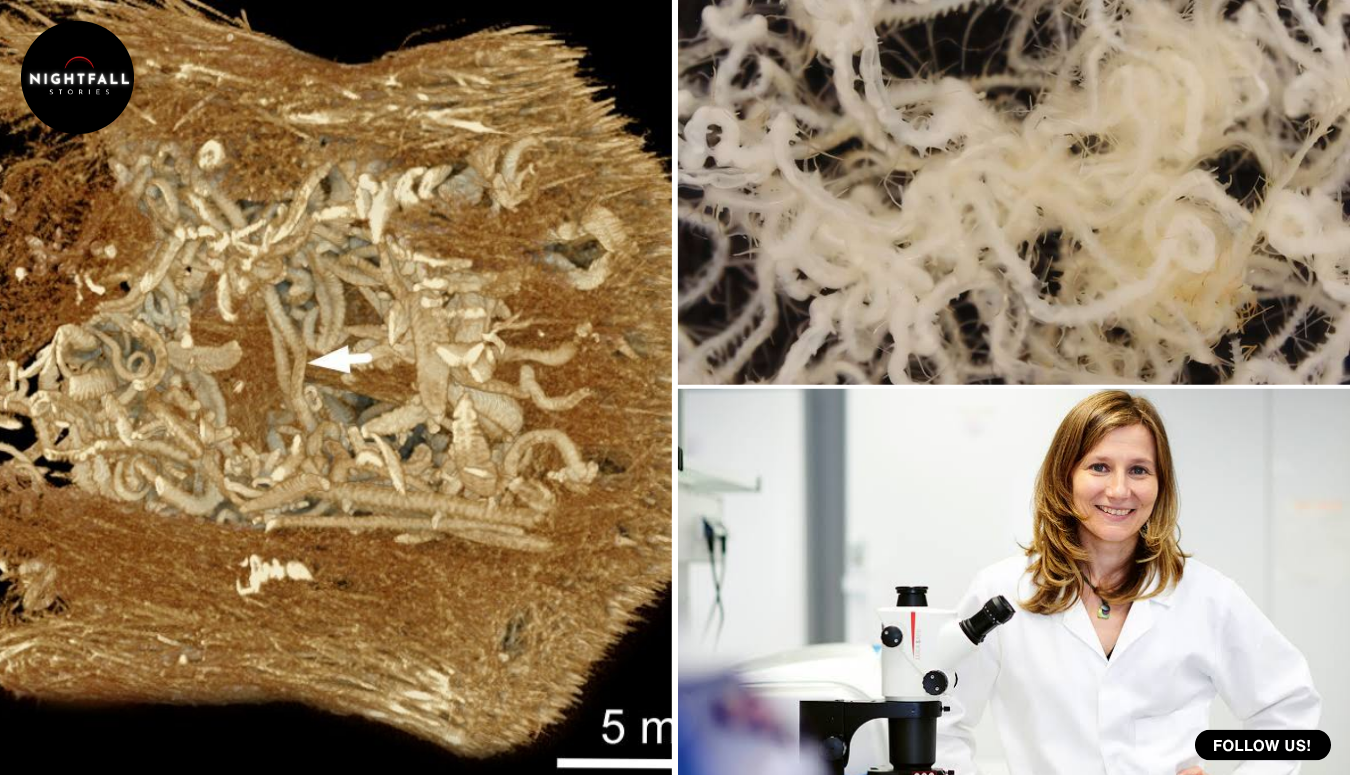
Among the more than twenty thousand species of annelid worms that science has described, exactly three were known to branch. Not segment, which all of them do, but branch: one head at the front, and behind it a body that forks, and forks again, into a tree of dozens or hundreds of separate rear ends, all of them threaded through the internal plumbing of a living sponge. Three species, out of twenty thousand. A team led by Professor Maria Teresa Aguado at the University of Göttingen has now taken that number to thirteen, adding ten new species and erecting a new genus called Cladosyllis alongside the existing Ramisyllis. Some of the material they worked from was collected in 1914 and has been sitting in spirit in Frankfurt ever since.
The species count is the headline, and it is not the interesting part. The interesting part is what having thirteen of them instead of three lets you finally ask. With three data points you cannot tell whether an extraordinary body plan is a repeated trick that evolution keeps rediscovering, or a single accident that happened once and then diversified. With thirteen, and with DNA from all of them, you can. The answer, the team reports, is that it happened once. Every branching worm known descends from a single common ancestor in which the branching began. The strangest architecture in the animal kingdom was invented exactly one time.
It helps to understand how weird the animal actually is, because the description sounds like a mistake in the transcription.
Take a sponge. A sponge is not a solid object; it is a filter, and its body is riddled with canals through which it pumps seawater to feed. Now put a worm inside those canals. The worm’s head sits at one point in the sponge. From there its body runs into a canal, and where the canal divides, the worm divides with it, growing a second body that continues down the branch. That happens again at the next junction, and the next, until a single animal has filled a large part of the sponge’s internal network with its own branching self. The result is one worm with one mouth and, in a big specimen, hundreds of tails. Its gut is continuous through the whole tree. If you dissolved the sponge away you would be left with something that looks like a root system and is a single individual.
For most of the time this was known, nobody could examine it properly, which is a large part of why the group stayed at three species. The worm is inside another animal. You cannot see it without destroying the sponge, and if the sponge is a museum specimen collected a century ago, destroying it is not an option worth discussing. The practical effect was that branching worms were studied from fragments: bits of worm teased out, drawn, described, and compared to other bits of worm. Which is a bad way to do taxonomy on an animal whose defining character is the shape of a structure you have just broken.
The nineteenth century got there first anyway. Syllis ramosa was described from the deep sea in the eighteen hundreds, and it was such an odd report that it hung around the literature for a long time as a curiosity rather than a starting point. A second branching species turned up in 2006, when Christopher Glasby found worms living inside sponges in Darwin Harbour in northern Australia; that animal was formally described in 2012 as Ramisyllis multicaudata, and the genus Ramisyllis was created for it. A third, from Japanese waters, followed a decade later. Aguado was involved in that work, and by then she had been on this group for years. Three species, three widely separated parts of the ocean, and no way to say whether they were relatives or coincidences.
What changed the problem was a scanner. Micro computed tomography does to a sponge roughly what a medical CT scanner does to a person: it takes X-ray images from hundreds of angles and reconstructs the interior in three dimensions. Point it at a sponge with a worm inside, and because worm tissue and sponge tissue absorb X-rays slightly differently, you can pull the worm out of the reconstruction as a complete object and look at the whole branching tree, junction by junction, without touching the specimen. A jar of preserved sponge that was scientifically opaque in 1914, and in 1960, and in 1990, becomes readable.
That is the part of this story worth being precise about, because there is a lazy version of it in circulation. The lazy version is that specimens sat forgotten in a drawer until somebody finally bothered to look. That is not what happened, and it is unfair to several generations of curators. The specimens were not forgotten. They were catalogued, maintained, topped up with preservative, and available to anyone who asked, at the Senckenberg Research Institute and Natural History Museum in Frankfurt, where Dr Ekin Tilic is among the study’s authors. What they were not was legible. The question the team wanted to ask, about the internal geometry of a branching body and the relationships between animals that share it, could not be asked of those jars with the tools that existed when the jars were filled. The collection was not neglected. It was waiting for instruments that had not been built yet.
The second instrument was genetic. The team sequenced DNA from both newly collected material and museum specimens, which is harder than it sounds, because old preservatives chop DNA into short fragments and the oldest material tends to yield the least. Getting usable sequence out of historic wet collections is a specialist craft, and it is the reason a jar from 1914 can contribute to a phylogeny at all. With sequence from across the whole set, the team could build a tree of how these animals are related to each other rather than a list of how they look.
There is a craft problem hiding underneath all of this, and it is the reason the group resisted sorting for so long. To tell two worm species apart, a taxonomist normally works from a short list of reliable characters: the shape of the head appendages, the arrangement of the bristles, the form of the hooks at the tips of the limbs, the proportions of the first few segments. Those characters work because they are stable within a species and different between species. Branching sabotages that. A branching worm’s most striking feature is the one thing you cannot use, because how much a given individual has branched depends on how old it is and on the geometry of the particular sponge it grew up inside. A small worm in a small sponge and a large worm in a large sponge can be the same species and look nothing alike. Worse, the branch points themselves are anatomically unusual, so a fragment that includes one can look like a different animal from a fragment that does not.
So the team had to do it the hard way: find characters that were not about branching at all, and check them against genetics rather than assuming they were sound. That is why the micro CT mattered beyond simply seeing inside a sponge. It let them examine the same structures across many specimens in identical orientation, at a resolution that made small consistent differences visible, and then ask whether those differences tracked the DNA. Where they did, they had a character. Where they did not, they had an artefact of growth. Aguado is the scientific curator of the Biodiversity Museum at Göttingen, and she has spent a large part of her working life on this one small group of animals, which is the sort of investment that makes a thirteen-way revision possible at all. Nobody arrives at this from a standing start.
Thirteen distinct forms came out of it, from three known before. The release describes ten of them as newly discovered species. They come from the Indo-Pacific, from the Red Sea, and from New Zealand, and they span an enormous range of depth: some in shallow-water sponges a diver could reach, others inside deep-sea glass sponges more than a thousand metres down. Glass sponges are a different kind of host altogether, built on a skeleton of silica, and the worms living in them appear to be specialists rather than opportunists. The pattern the team describes is of host preference sorting by region and by depth, which is to say these are not one adaptable worm turning up everywhere. They are a radiation.
And that radiation resolves into two lineages. One is Ramisyllis, the genus that already existed. The other is Cladosyllis, newly erected, which is what taxonomists do when the animals in front of them are clearly related to a named group but clearly not members of it. The name is not a flourish; it is a load-bearing statement that a group of these species shares an ancestor with each other more recently than any of them does with Ramisyllis, and that lumping them together would hide a real division.
The division shows up in the body. The two lineages do not branch in the same way. They both end up with a tree, but they build it differently, which is the kind of detail that would be easy to skip past and is actually the most informative thing in the paper. Because if branching had been invented twice independently, you would expect two different mechanisms, and you would explain the difference by saying they are not the same trick at all. The genetics rules that out. The two lineages are descendants of one branching ancestor. So the difference in how they branch is not evidence of separate origins; it is evidence that once an animal has the underlying capacity to fork, the developmental details are free to drift. The ancestor supplied the ability. The lineages then went their own ways about how to exercise it.
That is a real evolutionary finding and it is worth stating in plain terms. A body plan this extreme has been produced once in the history of a phylum containing tens of thousands of species. It did not arise repeatedly under similar pressures, which is what you would guess if living inside a sponge’s canals simply favoured branching. It arose once, in one lineage, and everything that has it inherited it. That makes branching a historical accident rather than a repeated solution, and it makes the animals that have it a single strange family rather than a category.
There are also things this work does not settle, and Aguado’s group has been open about them for years. Nobody knows what a branching worm eats, or how. One mouth at the front of a body with hundreds of tails is an obvious problem: the head cannot plausibly move around enough to gather food for the whole tree. Examination of the gut has found very little sponge material in it, which weakens the simplest hypothesis, that the worm is quietly eating its host from inside. One alternative under discussion is that the animal absorbs dissolved organic carbon straight through its skin, which some other marine invertebrates do, in which case the enormous branched surface area inside a sponge’s water canals starts to look less like a puzzle and more like the point. That remains unresolved.
The relationship with the sponge is also unresolved in a more basic way. If the worm is not eating the sponge, is it harming it at all? Is it paying for its accommodation somehow? Nobody has demonstrated either. What is known is that reproduction happens at the ends: some branches develop into stolons, detachable segments packed with eggs or sperm, which break away to spawn. So the tree is not merely a body. It is also a way of producing a great many reproductive units at once from a great many separate tips, from inside a shelter that a predator would have to demolish a sponge to reach.
The funding argument in all this is unglamorous and it is the honest lesson. Nobody builds a career, or gets a headline, out of maintaining spirit collections. Topping up alcohol in jars, keeping catalogue numbers legible, holding humidity steady in a basement for a hundred years: it is the least fashionable work in science and it has almost no visible output. What it produced here is ten species, a new genus and an answer to an evolutionary question, entirely from material that was already inside the building before any of the people who used it were born. The 1914 collector could not have imagined micro CT or DNA sequencing. The jar was filled anyway, and kept anyway, and it turned out to contain an argument.
Aguado has made the point directly, and it is worth relaying in her framing rather than sharpening it into a slogan: this work would have been impossible without access to museum specimens, and collections of this kind are not stores of old samples but resources that keep producing new results. That is a claim a curator has to make repeatedly and usually cannot prove. Here it is proved.
The count now stands at thirteen. Ten new species, published; a new genus, named; and the branching body plan traced to a single origin. Nothing in it awaits further analysis. The remaining questions are about how the animals live, not about who they are, and the next time somebody wants to ask one of those, the jars will still be in Frankfurt.