There were four of them, and they worked until roughly one in the morning.
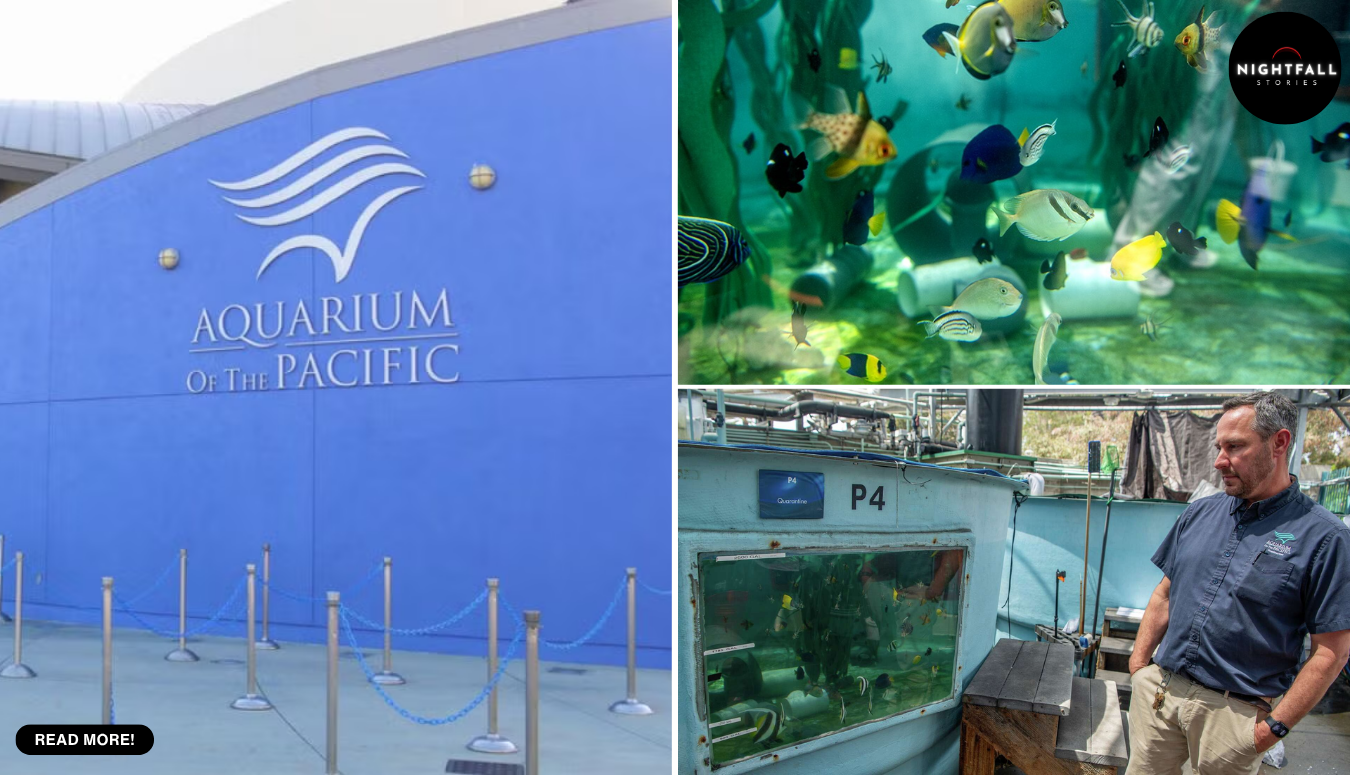
That is the detail that stays with you once you know the rest of it. Wildlife officials in Southern California stopped a box truck carrying somewhere around two thousand live animals, a mix of reptiles, fish and invertebrates packed for transport. That number belongs to the seizure, not to any one building. Of the animals in that haul, close to five hundred marine creatures were sent on to the Aquarium of the Pacific in Long Beach, arriving in bags and boxes of water on a single day in the middle of last year. Four staff members met them.
You cannot simply open a bag and pour a fish into a tank. That is the whole practical heart of this story, and it is the part almost nobody outside the profession has any reason to know.
Nate Jaros, the aquarium’s Vice President of Animal Care, has described what happened next in fairly unglamorous terms. Every bag had to be tested before anything in it was moved. The water an animal travels in stops being water and starts being a chemistry problem within hours. Oxygen falls. The animal keeps breathing and keeps producing waste, and ammonia climbs. As ammonia climbs, the pH of the water tends to drift, and the particular cruelty of the situation is that a low pH partly protects the animal from the ammonia. Raise the pH suddenly, by tipping that bag into a clean, well buffered tank, and the ammonia that was chemically parked becomes chemically active. An animal that survived the truck can die in the tank.
So the staff tested for pH, for dissolved oxygen, for ammonia, bag by bag. Then they acclimated slowly, letting clean system water in a little at a time, letting temperature and salinity close the gap over a period rather than in a moment. Jaros has called it a very careful process and a very stressful one, which is about as plain a description as the work allows. There is no dramatic version of it. It is hours of small adjustments made by tired people who know that the cost of hurrying is not abstract.
Stress is the other thing they were fighting, and it is less visible than water chemistry. Animals collected from reefs, bagged, boxed, moved, and then confiscated have been under pressure for a long stretch before anyone at an accredited facility sees them. Most reef fish carry some parasite load in normal life without much consequence. Jaros has pointed out the problem with that: bring an animal into a stressful environment and those loads can start to increase. The animal’s own defences drop at exactly the moment the parasites find their opening. This is why the first stop was not an exhibit but quarantine.
Alyssa Tillman, the aquarium’s Assistant Curator of Fish and Invertebrates, has explained the logic of that plainly enough. Everything arriving is watched closely in quarantine areas where staff can give immediate care and where any disease that came in with the shipment cannot spread into a collection of thousands of other animals. That is the standard for any arrival, planned or not. An emergency does not lower it. In a sense an emergency raises it, because nobody knows where these animals came from, what they were exposed to, or what they were kept alongside.
The list of what came through the door reads like a tour of the home aquarium trade. Brownbanded bamboo sharks, a species considered near threatened. Banggai cardinalfish, which are endangered and which have been collected heavily from a very small natural range. Ocellaris clownfish, the ones almost everyone can picture. Yellow longnose butterflyfish, domino damselfish, lemonpeel angelfish, powder blue tang, juvenile emperor angelfish. Alongside the fish came the harder part of the inventory: hundreds of corals, plus clams, shrimp, prawns and snails.
The corals were their own problem. Jaros has been candid that identification was close to impossible in the moment. There are thousands of coral species, many of them difficult to tell apart even with time and a reference collection, and some of them look nothing like the photographs once they have been out of a reef and inside a box. You cannot care for an animal properly without knowing roughly what it is, because light requirements, flow, feeding and temperature all change with species. The team had to make reasonable working judgements and correct them later.
The Banggai cardinalfish are worth pausing on, because they explain why a box of small fish can matter out of proportion to its size. They are a striking animal, silver and black with long trailing fins, and they come from a very small natural range in the tropical Pacific. Being desirable and geographically concentrated is a bad combination for a species. Decades of collection for the ornamental trade pushed the wild population down hard enough that the species is now classified as endangered, even though it breeds readily in captivity and captive bred stock is widely available. That is the uncomfortable arithmetic behind a shipment like this one. There was no biological need to take these fish from a reef at all.
About a quarter of the animals from that first arrival did not survive. Some were already gone when the boxes were opened. Others died within days. That is the honest figure and it deserves to be stated rather than buried, because it is the real measure of what a truck journey does. The people who took them in did not lose those animals. They inherited them already lost, and found out which ones over the following week. Nobody in that building had any control over the part of the journey that killed them.
What makes this more than a difficult night at one aquarium is the thing that made the phone call possible in the first place, and it did not exist a few years ago.
Until fairly recently, a wildlife officer who intercepted a shipment of living animals had a genuine institutional problem on their hands. Seized property is usually held. Seized property that breathes cannot be held in an evidence locker. Officers ended up making urgent calls to whichever zoo or aquarium they happened to know, hoping someone had space, water systems and staff free on a weekday afternoon. It worked when it worked and failed quietly when it did not.
In 2023 the United States Fish and Wildlife Service and the Association of Zoos and Aquariums set up a Wildlife Confiscations Network to replace that improvisation with something closer to a system. The idea is unglamorous and effective. A network of accredited facilities agrees in advance to take confiscated animals, with a known route, known contacts and a vetting committee that decides which organisations are equipped for which species. The Southern California branch of it is the reason a box truck stopped on a highway turned into a set of quarantine tanks the same day rather than a set of decisions nobody was ready to make. The Aquarium of the Pacific was a founding member of that regional network and sits on its vetting committee.
That structure was tested again a few weeks after the first haul. Near the end of July, a second operation brought roughly three hundred more marine animals, this time after a short stay at a federal wildlife centre in Torrance before they were transferred down to Long Beach. So the aquarium’s real intake across the two events was about five hundred and then about three hundred. Not two thousand. The larger figure describes what officers found in the truck, most of which went to other facilities suited to reptiles and to species an aquarium is not the right home for.
None of this is occasional. The aquarium has taken part in more than thirty confiscation events since late 2024, and says it has now helped more than three thousand three hundred trafficked animals since joining the network. That number is the quiet headline. It means the summer’s two seizures were unusual in size but not in kind.
Then comes the part that is a genuinely hard choice rather than a technical one, and it is the reason people in this field talk about confiscation with a certain flatness.
These animals almost never go home. Returning a confiscated reef fish to the ocean sounds like the obvious good ending and is usually the wrong call. Nobody knows which reef it came from, and releasing an animal into the wrong population can move disease and genetics into places they were not. The animals have often been held in conditions that leave them unfit to compete. For corals and invertebrates the identification problem alone can make release impossible. So the realistic options are placement in an accredited facility with appropriate space and expertise, or a place in an exhibit in Long Beach, and someone has to make that judgement for each of hundreds of animals while they are still in quarantine.
Quarantine is not a quick holding pen either. Depending on the species and what turns up in testing, an animal may sit behind the scenes for weeks while staff watch for parasites, treat what they find, and confirm the animal is feeding normally before it goes anywhere. Feeding is the tell. A fish that will not eat is a fish still in trouble, whatever the water readings say. Multiply that by several hundred animals across dozens of species with different diets, and the labour involved starts to become clear. This is not a rescue in the sense of one dramatic intervention. It is a long, dull, attentive process carried out by people with day jobs already attached to a working public aquarium.
Placement was expected to happen inside about two weeks for most of the survivors, moving out to other accredited institutions or into the aquarium’s own displays. That is fast, and it has to be, because holding capacity behind the scenes is finite and the next call is not scheduled.
It is worth being clear about why a truck like that is worth running at all, without turning it into a lecture. Marine ornamental animals are small, light, and worth a great deal relative to their weight. A single specimen of a sought after species can be worth hundreds of dollars by the time it reaches a home tank, and a coral fragment can be worth more. Much of the supply chain is legal and documented. The illegal share moves through the same channels, with paperwork that does not match the contents, protected species mixed in among unprotected ones, and volumes that make individual animals almost disposable. Losing a quarter of a shipment is a cost of doing business for a trafficker. It is a week of work for the people who end up with the survivors.
One thing this story does not include, and it should be said rather than implied: there is no public record reachable of charges, a prosecution, or any named defendant in either seizure. Whether anyone faces a case is simply not on the record. The animals are the documented part.
What the aquarium did get is money. Grant funding routed through the Association of Zoos and Aquariums, drawn from federal pandemic era recovery funds, has gone towards renovations, upgrades and new holding systems intended specifically to expand how much confiscated wildlife the building can absorb at once. More tanks behind the scenes is not a thrilling sentence. It is, in practice, the difference between four people working until one in the morning and four people working until four in the morning, and it is the difference between saying yes to a call and saying not this time.
The aquarium’s president and chief executive, Jeff Flocken, has framed the whole business in terms of extinction rather than crime, arguing that trafficking damages ecosystems and pushes species towards disappearing, and that answering these calls is something the institution intends to keep doing. That is a mission statement and it reads like one. The version of it that actually happened was less lofty and more convincing: bags on a floor, a water test kit, a coral nobody could name, and a decision about pH made at midnight that determined whether a fish that had already survived a truck would also survive the rescue.
Most of the survivors are now somewhere with a name and a record, spread across accredited facilities or in tanks in Long Beach where visitors will walk past them without knowing any of this. The quarantine systems behind those walls have been emptied, cleaned and refilled. That is the ending, and it is the right one, because the point of building a network was never any single truck. It was to make sure that the next time officers open a roller door and find two thousand living things stacked inside, the question is which facility takes which animals, and not whether anyone can be found who will pick up the phone.