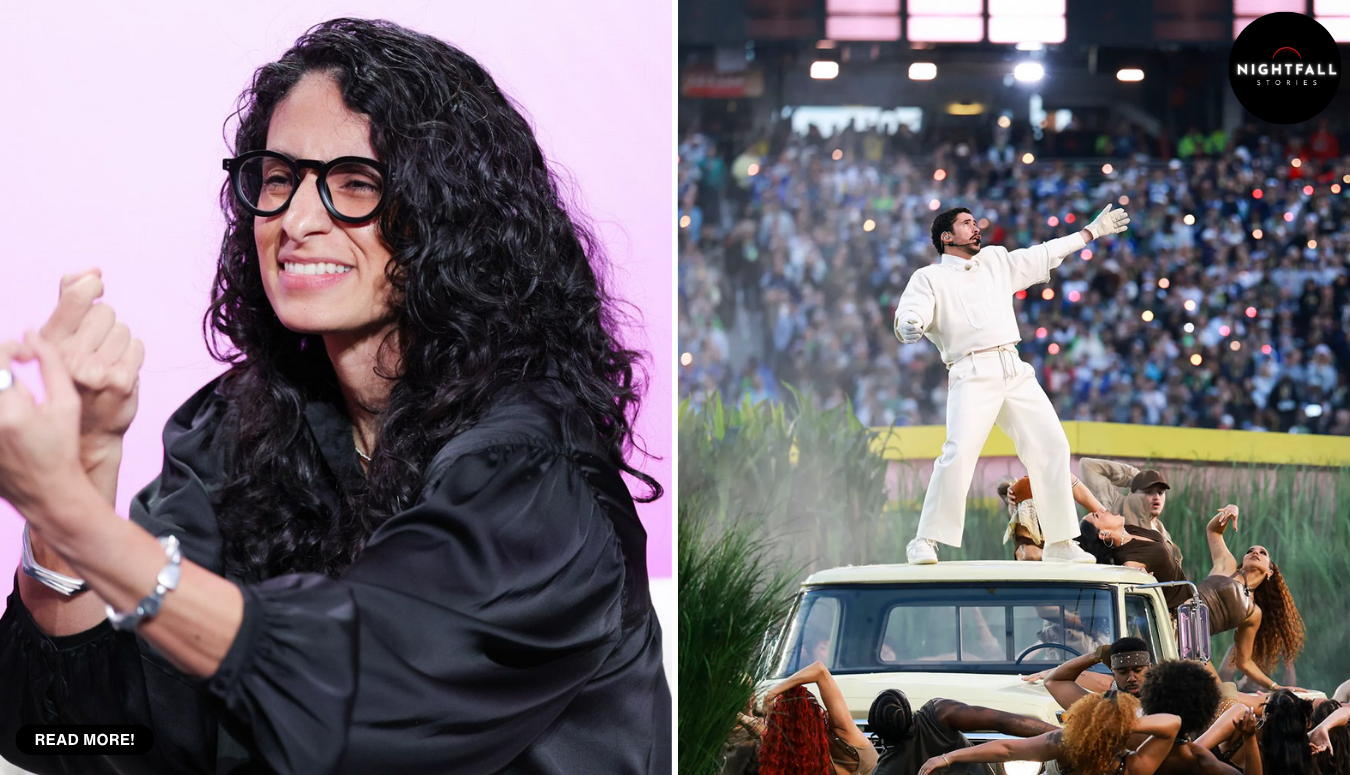
Earlier this year, in a stadium in Santa Clara, California, a woman from the mountains of Puerto Rico stood in front of a camera and performed a thirteen-minute set she could not fully hear, in a language that had never once been carried on that stage, for an audience that had spent four years asking for it. Her name is Celimar Rivera Cosme. She is Deaf. And the thing she said before she went out there was not that she was going to interpret the halftime show. She said she was going to perform it.
That distinction is the entire craft, and it is the part almost nobody explains. So let us start there, because it is more interesting than the spectacle.
Interpreting speech is hard. Interpreting music is a different job wearing the same name. When somebody gives a speech, the interpreter’s obligation is to the meaning, and the meaning is mostly in the words. When somebody performs a reggaeton track with a hook built on rhythm, a verse stacked with island slang, an ad lib thrown in sideways and a beat that is doing half the emotional work, the words are maybe a third of what is actually being communicated. An interpreter who delivers only the lyrics has technically succeeded and has actually failed, because the Deaf person watching has been handed a transcript of a party they were not invited into.
Rivera Cosme’s own framing of it, paraphrased, is that you have to add your flow, your vibe, your style and your attitude. That sounds like a personality note. It is not. It is a technical description of where the missing information goes. Tempo has to live somewhere, so it lives in the speed and the size of the signing. Register has to live somewhere, so it lives in the face and the shoulders. A rhyme that works in Spanish will not rhyme in any sign language, so the interpreter has to find a visual equivalence, a repeated handshape or a mirrored movement, that gives the ear’s pleasure back to the eye. A sung line held for four beats has to be held. A whispered line has to be made small. When the crowd noise swells, that has to be visible too, because otherwise the Deaf viewer has no idea the room just went up.
And every one of those choices is a judgement about the artist’s intent, made in advance, by one person, with no way to check it mid-performance. A halftime show gives you a fixed setlist, which is a mercy. It also gives you thirteen or so minutes of live global broadcast, no second take, and a running order rehearsed to the second. Her preparation, by her account, involved sitting with the setlist through headphones while reading the lyrics, working out where the emphasis had to fall. There is no autocue for hands.
There is a further wrinkle in how any of this reaches a Deaf viewer at home, and it is not a small one. The signed coverage went out as dedicated streams rather than as a picture-in-picture box on the main broadcast. That means a Deaf viewer had to choose. Watch the main feed and you get the director’s cut, the camera moves, the crowd, the staging, and no interpretation. Watch the signed stream and you get the language, with the performance framed however that feed frames it. Hearing viewers are never asked to make that trade. It is the single clearest illustration of why the quality of an interpreted feed matters so much: if the signing is flat, the person who chose it has given up the show to get the words, and got a bad deal.
Which is also why the profession distinguishes between interpreting and performing at all. Music interpreting has quietly become its own specialism over the last decade, largely through festival work, and the interpreters who are good at it are treated by audiences as acts in their own right. The industry standard for high-stakes work is to pair interpreters, often a Deaf interpreter working alongside a hearing colleague who feeds the audio content, precisely because the two roles need different things: one person tracks what is being said, the other delivers it in a way a native signer experiences as language rather than as captioning with hands. A Deaf signer at the front of that arrangement is not a nice piece of representation. It is the version that produces the better output, because the person shaping the delivery shares the audience’s language.
Now the language, which is where a lot of the coverage got sloppy and where it is worth being careful, because the sloppiness is itself part of the story.
She signed in Puerto Rican Sign Language, known on the island as LSPR. Several outlets described it as a dialect of American Sign Language. That framing is contested, and the reference works that catalogue the world’s languages do not support it. Puerto Rican Sign Language is listed as a language in its own right, with its own international code, described as related to American Sign Language rather than a variety of it. Glottolog, the other major linguistic catalogue, lists it separately as well. The distinction is not pedantry. Calling a language a dialect of a bigger neighbour is the oldest way there is of implying it does not need protecting.
The history explains the relationship. Signing was brought into formal education in Puerto Rico in the first decade of the twentieth century, reportedly through Catholic nuns, and American Sign Language has been in contact with the island’s signing ever since, which is why the two are related and why so much of the vocabulary overlaps. But contact is not descent. LSPR developed its own signs, its own rhythm and its own grammar, shaped by the island’s Deaf community and by Spanish rather than English, and there are signs in it that exist nowhere else. There is also a separate pidgin form, Signed Spanish, used alongside it, plus home sign systems.
It is also worth understanding why a Spanish-speaking territory ended up with a sign language related to an English-speaking one. Sign languages do not track the spoken languages around them; they track schools. Wherever a deaf school is founded, whichever signing the founders bring becomes the seed, and the community grows a language out of it. Puerto Rico’s formal deaf education arrived with signing already attached to the American tradition, which is why the relationship to ASL exists at all, while the surrounding spoken language was Spanish, which is why fingerspelling, mouth patterns and a good deal of vocabulary went a different way. That is the mechanism behind the phrase Spanish influence, which coverage tends to use as a vague gesture at flavour. It is not flavour. It is the reason two related sign languages are not interchangeable in a Puerto Rican living room.
Here is the part that gives the halftime show its real weight. LSPR is classified as threatened. Estimates of how many Deaf people use it range enormously, from around eight thousand to around forty thousand, and the direction of travel is not good: the catalogues note that American Sign Language is increasingly displacing it, to the point where ASL is on course to become the island’s only sign language. A threatened language does not usually get a global broadcast. It usually gets quietly replaced by the larger one next door, in classrooms and in workplaces and in exactly the kind of high-profile setting where somebody decides it is simpler to just use ASL.
Which somebody nearly did. The broadcaster ran dedicated sign language streams for the game, and both ASL and LSPR were offered. The LSPR provision did not appear because a production team thought of it. It was secured, and the person most often credited with securing it is Zoé Rodríguez, president and co-founder of the Puerto Rican Association of the Deaf and Deaf-Blind. Somebody had to go and make the argument that the island’s own language belonged on the biggest broadcast of the year, rather than a related one that most of the audience would not have questioned.
That pattern, the community asking rather than being offered, runs all the way back to how Rivera Cosme got into this in the first place, and it is the best fact in the story.
Four years ago, she posted a video to Instagram addressed directly to the artist. Her argument was simple and specific: roughly a hundred thousand Deaf people in Puerto Rico enjoyed his music, and when he came to the island they had no interpreted access to his concerts. She was not asking for a favour. She was pointing out a gap with a number attached to it. Within about a week, by her account, she was on the tour as an official sign language interpreter.
Read that timeline again, because it says something uncomfortable and true. The access was available the whole time. It cost the production almost nothing. It simply had not occurred to anyone, and it took a Deaf woman filming herself on a phone to make it occur to them. She went on to interpret his thirty-date residency on the island, a run so large it was measured in its economic effect on Puerto Rico rather than in ticket sales. Four years after the Instagram video, she was standing at the Super Bowl.
She is careful about what the milestone is for. Her emphasis, paraphrased, is that the important thing is that they have their own language, their own identity and their own culture. Not that she personally got to the biggest stage. That the language did.
Her own connection to the material is not incidental either. She has spoken about identifying strongly with one song in the set in particular, a track rooted in island tradition, because she grew up in the mountains, in the countryside. That is worth noting because of how easily this kind of story gets flattened into an inspiring performance by an interpreter. She was not interpreting a culture from the outside. She was interpreting her own, into her own language, for her own community, having asked for the job herself.
On her hearing, which needs stating plainly because the reporting was inconsistent and getting it wrong would be a real error about a real person. She is not a hearing interpreter serving the Deaf community from outside it. Broadcast coverage and cultural press describe her as a Deaf performer; several of the larger outlets describe her more precisely as partially deaf. Both of those are consistent with each other, and with how she works: she gave her interviews in sign, through an interpreter, including one interview where a volunteer interpreted for her into Spanish. She prepares by listening to the setlist through headphones while reading the lyrics, which tells you she uses residual hearing as one tool among several. So: Deaf, described in some reporting as partially deaf, signing as her primary language. Anyone writing about her should say that much and no more, because the finer audiological detail is hers and is nobody else’s business.
One more thing about preparation, since it is where the invisible labour sits. A halftime set is not a concert; it is a medley, stitched so that songs arrive in fragments and hand off mid-phrase. An interpreter has to learn not only the lyrics but the seams, because the moment a track cuts early is the moment the signing either lands with it or trails a beat behind and looks wrong to everyone watching, hearing or not. Getting that right is hours of rehearsal against a recording for thirteen minutes of output nobody is supposed to notice the effort in.
The reception, when the clips went round, was the part that always follows this kind of performance and is always slightly beside the point. Video of her work circulated widely and admiringly in the days afterwards, and the admiration was largely from hearing people who had never watched a music interpreter before and were startled by how much performance was in it. That is a good outcome and a small one. The bigger outcome is quieter: a threatened language appeared, unmistakably and by name, in front of one of the largest audiences television assembles anywhere, and was identified as itself rather than folded into its larger relative.
It is worth being honest that this does not fix anything structural. One broadcast does not reverse a language shift. There were still roughly a hundred thousand Deaf people on the island whose ordinary access to concerts, to theatre, to public meetings, to a doctor’s appointment, depends on whether somebody has budgeted for an interpreter that day, and a halftime show does not change that arithmetic. Music interpreting remains a specialism that very few people do well and that almost no venue pays properly for. And the pressure that has LSPR classified as threatened is still there, operating in schools and workplaces where nobody is filming.
But the sequence matters more than the moment. A Deaf woman noticed an absence, named it publicly with a number attached, and was given a job within a week. She did that job well enough that four years later an organisation from her own community could make the case that her language, not a bigger one, should be on the year’s largest broadcast. And when the case was won, the person who had started the whole thing was the one standing there to do it.
Nobody handed her that. She asked, on a phone, into a camera, in a language most of the people who could have said yes did not understand. Then she waited to see whether anyone was watching her hands.