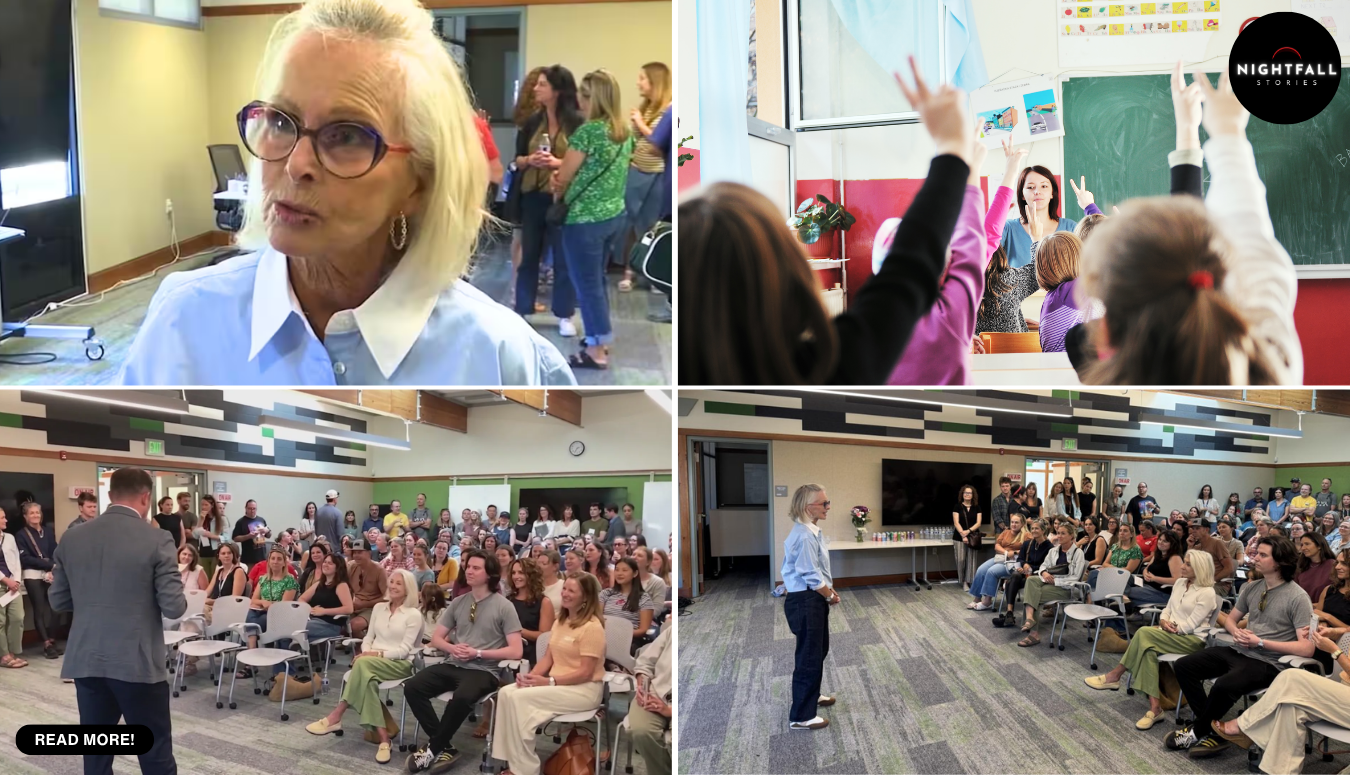
The teachers were told to be in the room, and that was about all they were told. No agenda went out. Nobody explained. In a school district, a meeting with no stated purpose right before the start of a new year usually means bad news, and most people in that room had a decent idea of what bad news in their district tends to look like. Budget shortfall. Positions cut. Class sizes going up again.
Then the principals started walking through the room handing out envelopes, and inside each envelope there was a check for $9,161.70.
There were about a hundred of them. The money came from one woman who had decided, on her own, to give away a million dollars to the teachers in the elementary and middle schools near where she lives, not as a donation to the district, not as a grant with a name on a plaque, but as personal checks written to individual human beings who would go home and decide for themselves what to do with the money. Most of the people holding those envelopes had never met her.
This happened in Marin County, California, which sits just across the water from San Francisco and is one of the wealthiest places in the United States. That is the detail that makes the whole thing turn. This is not a story about a poor community getting help. It is a story about a woman who looked at her own affluent, comfortable, extremely well appointed corner of the world and found something inside it that did not make sense to her.
Her name is Maja Kristin. She has a relative who attends a school in the Ross Valley School District, which runs four elementary schools and a middle school serving San Anselmo, Fairfax and the surrounding towns. Somewhere along the way she went looking for the actual numbers on what the district gets and what it pays, and what she found did not match the postcard.
Ross Valley sits in roughly the bottom four percent of California school districts for funding, according to the district’s own superintendent. Its teachers are the lowest paid in Marin County. A new teacher starts at about $64,000 a year. A teacher who has spent an entire career there, accumulating every step and every credential the salary schedule allows, tops out at about $119,000, which is lower than the ceiling in every other district in the county and in some cases lower than what a neighboring district pays a teacher in the middle of their career. The median household income in the county is close to $150,000.
So you have a place where the houses are worth what houses in Marin are worth, and where the people teaching the children in those houses cannot afford to live anywhere near them. That gap is not unusual in American education. What is unusual is that somebody with a million dollars looked directly at it and treated it as a problem with a solution rather than a fact of life.
Kristin has described what she saw as an injustice, and she did not use the word loosely. She spent her working life as a civil rights lawyer, much of it representing people who had been abused as children, including in cases brought against the Catholic Church. She taught negotiation and mediation at Stanford, at Berkeley and at what was then UC Hastings. She was once named by a major magazine as one of the ten best women lawyers in the country. She also grew up in public housing in San Francisco, which is not a biographical footnote here so much as the whole explanation. She knows exactly what a public school is for and exactly who depends on one.
She has a phrase for how she handles her money, which she has described as the last breath, the last dime. The idea is that she intends to give it all away while she is alive to see where it lands, rather than leaving a pile behind for other people to argue over. She has given three million dollars to the American Red Cross. She has given three million to a human rights center at Berkeley. A few years ago she handed over a 120 acre property in Nicasio to a therapeutic riding program that works with disabled riders. This million was not a sudden impulse. It was the same person doing the same thing she has been doing for years, aimed this time at a target close enough to walk to.
The structure of the gift is the part worth slowing down on, because it is the part that separates this from ordinary philanthropy. Kristin did not write a check to the school district. If she had, the money would have entered a general fund, and a general fund is a place where a million dollars becomes a line item, then a discussion, then a compromise, then a smaller number spread across a list of urgent needs, most of which are genuinely urgent. It would have gone to roofs and software licenses and the deficit. It would have done good. Nobody would have felt it.
Instead the money was divided into roughly a hundred equal pieces and put into a hundred envelopes with a hundred names on them. Every full time teacher got the same amount. Not a bonus tied to performance, not a prize for the best in the building, not a stipend attached to a project that would need reporting afterwards. Just the same number, to everybody, with no conditions on what they did with it.
That flat equal split says something the money alone does not. It says the problem is not that some teachers are underpaid. It is that all of them are, and that a system can be quietly, respectably unfair to an entire group of people for years without anyone having to be a villain about it.
The reaction in the room was what you would expect, which is to say people cried and people laughed and a few people clearly did not believe the check was real. One teacher said afterwards that it was life changing, which is a phrase that gets used carelessly and in this case was doing plain literal work. Another, a mother of three, described what the money actually meant in her house: things her kids wanted to do that she had been saying no to, and now would not have to. That is what $9,161.70 buys a public school teacher in an expensive county. Not a vacation home. The ability to say yes to a child a few more times a year.
The superintendent, Tyler Graff, said he had been astounded, and he made the point that he had worked in schools for around two decades and had seen a lot of generosity in that time, and had never seen anything like this. Which is believable. Districts are used to being given things. Parent foundations raise money. Companies donate equipment. What districts are not used to is a private citizen going around them entirely, because going around them implies a judgment about what happens to money once it goes in.
If there is a tension in this story, that is where it sits, and it is worth being honest about rather than smoothing over. Graff himself named it gently when he said he hoped further fundraising might reach the custodians and the support staff, the people who were not in that room and did not get an envelope. A school does not run on teachers alone. It runs on the person who cleans the building, the aide who sits with the child who cannot sit still, the cook, the bus driver, the office manager who knows every family by name. They were not included, because the gift was aimed at a documented salary gap for a specific job category, and because a million dollars split further is a million dollars that means less to each person who gets it. Both things are true. A gift that is huge for one group and nothing for the person mopping the hallway next door is still a complicated object, even when it is a good one.
The other thing worth saying plainly is that this does not fix anything structural. The teachers got one payment. Their salary schedule is unchanged. The district is still in the bottom few percent of the state for funding, which is the actual problem, and which exists for reasons that have nothing to do with anybody’s generosity. California funds most of its schools through a formula tied to enrollment and student need, and districts like Ross Valley, small and not classified as high need, land near the bottom of it while sitting in a community where everything costs a fortune. No individual donor can legislate that away. The district has been negotiating its way forward the ordinary way, with teachers receiving a six percent raise this year and another six percent scheduled for the next, which helps and does not close the gap.
Kristin knows this. She has been explicit that she does not think one person writing a check is the answer, and that what she wants is for other people in her community to notice that they are allowed to act. Her argument, more or less, is that citizens can write direct checks, and that waiting for the funding formula to be fixed is not the only option available to a person who has money and a conscience. She has been clear that she would like the gift to prompt other residents to give, to organize, to press politically, rather than to simply admire what she did and move on.
There is something almost confrontational about that, delivered in the form of a hundred envelopes. Marin is not short of wealthy people. It is not short of foundations, or galas, or people who care deeply about education in the abstract. What it was short of, apparently, was somebody willing to do the least glamorous version of caring, which is to find out what the teachers in your neighborhood actually earn and then transfer money to them personally.
None of this is unique to one county, which is why the story travelled the way it did. Across the United States, public school teachers earn noticeably less than other workers with comparable education, a gap that has widened over the past couple of decades rather than closed. Large numbers of them spend their own money on supplies for their classrooms every year, quietly, without reimbursement, because the alternative is a child going without. Many work second jobs in the summer. The profession has a retention problem that everybody in it can explain in about one sentence, and the sentence is always about money.
So when a hundred teachers in an expensive suburb opened envelopes, people in very different places recognised the shape of it. Not the amount, which almost nobody gets. The recognition was in the funding rank, the salary ceiling, the meeting called with no agenda and the reflex assumption that the news would be bad. Teachers elsewhere read that and knew the feeling in the room before the envelopes came out.
It is also worth noticing what the gift was not. It was not anonymous. Kristin let her name be used, which is a choice with a cost, because it invites the usual commentary about rich people and what they should be doing instead. She appears to have decided that the argument she wanted to make only works if somebody is standing behind it. An anonymous million dollars is a nice surprise. A named million dollars is a challenge to everyone else with the same postcode.
The other quiet lesson is about what money does when it reaches a person directly instead of an institution. Every one of those checks went to somebody who knows exactly what their own life is short of. One of them is dealing with a car that is failing. One has debt from a credential program. One has a child who wants to play a sport that costs more than the family has been able to spare. Nobody had to apply, justify, report or account for any of it. For people in a profession where almost every dollar arrives with a form attached, and where the culture quietly expects them to spend their own money on their classrooms and be grateful for the chance, being handed cash and trusted with it is close to unheard of.
What happened afterwards has been the ordinary afterwards of any news story that spreads. The district went back to work. School started. The people in that room went to their classrooms and taught, and most of the students had no idea anything had happened. Some of the teachers have talked publicly about it, some have not. The money has by now mostly been spent or saved or used to pay something down, which is what money is for and the entire point of giving it to people rather than to a budget.
And a hundred people who spend their working lives in a county that can be quite good at not noticing them found out that at least one person had gone to the trouble of looking up what they were paid, decided it was wrong, and done something about it that they could hold in their hands.
Most teachers never get told that their work was worth anything in a way they can take home. These ones did, in an envelope, in a meeting nobody had explained to them, on a day they had been braced for bad news.