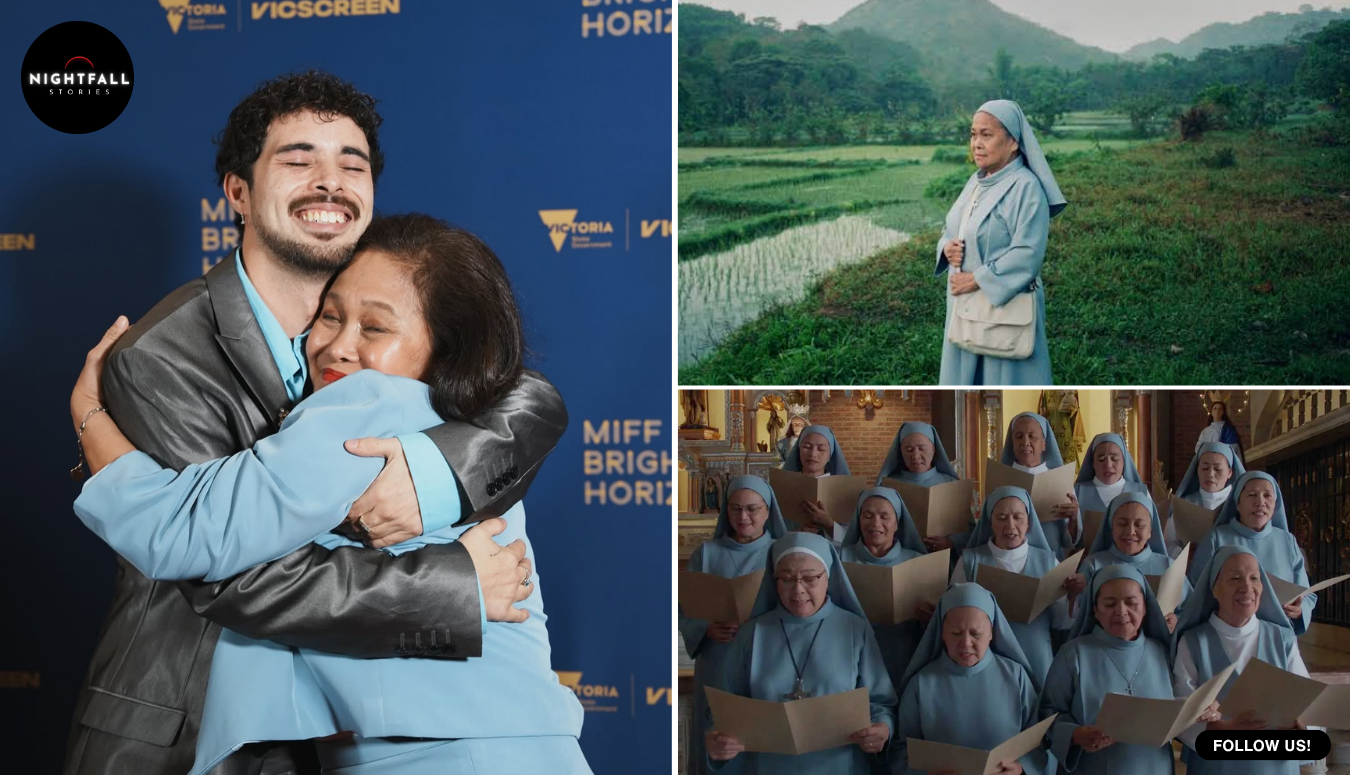
Australia has put forward a film for the Academy Award for Best International Feature, and almost nothing about it looks Australian. It was shot in the mountains of northern Luzon, in the Philippines. Its dialogue is in Tagalog. Its lead is a veteran Filipino character actress who has spent decades in supporting roles. Its cast includes some of Philippine cinema’s most recognisable names. If you stopped a hundred people on a street in Sydney and asked them to name the film representing their country at the Oscars this season, it is a safe bet that very few of them could.
The film is called First Light, and it is the debut feature of James J. Robinson. It qualifies as Australia’s entry not by accident or loophole but by the plain text of the rules, and the selection committee that chose it called it a shining example of Australian filmmaking. That phrase is doing a lot of work, and the argument it opens up is one that film industries all over the world have been circling for years without ever quite settling.
Here is what the film actually is. Ruby Ruiz plays Sister Yolanda, an ageing nun in a remote convent whose certainty about her own faith begins to give way after a suspicious death draws her into the corruption around her. It is a slow, watchful film about institutions and the people who have given their lives to them, and about what is left when the institution turns out not to deserve that. Robinson wrote it as well as directed it. Amy Dellar shot it. Geri Docherty edited it. The score is by Ana Roxanne. The supporting cast includes Maricel Soriano, one of the biggest stars Philippine cinema has produced, along with Rez Cortez and the filmmaker Kidlat Tahimik, whose own work helped define Philippine independent cinema decades ago.
Robinson is Filipino-Australian. Before this he built a career as a photographer and image-maker, with editorial work for publications including The New York Times, Vogue and GQ, and commercial campaigns alongside it. First Light is the first time he has carried a feature by himself, and the way it is shot, with a photographer’s patience for a face holding still, gives that away more than any credit does.
The money came from both sides. Screen Australia funded it. So did VicScreen and the Melbourne International Film Festival’s Premiere Fund, and so did the Film Development Council of the Philippines. It is a co-production in the formal sense, not just the sentimental one, with Australian producers and Filipino producers and an Australian director of Filipino descent telling a Filipino story with a largely Filipino cast. Split any one of those threads out and you can make the film sound like it belongs entirely to one country. Hold them all at once and the question gets harder.
The rule that makes the submission possible is short and much misunderstood. The Academy’s category is for a feature-length film produced outside the United States with a predominantly non-English dialogue track. That is it. The language has to be mostly something other than English. It does not have to be a language spoken in the submitting country. That last part changed two decades ago, when the Academy dropped the requirement that a film use an official language of the country sending it. Before that change, a country could be blocked from submitting its own best work simply because the characters in it spoke the wrong tongue.
What the rules do still require is that the submitting country had meaningful creative control. A film can be rejected if the Academy decides the country putting it forward did not exercise enough artistic control over it. That test has teeth, and it has been used. Films have been pulled out of the race before nominations for failing it, and others have fallen over on the language rule from the opposite direction. A Nigerian entry was famously disqualified some years ago for having too much English in it, which stung precisely because English is one of Nigeria’s own official languages. The category has always been a slightly awkward instrument, measuring language when everybody assumes it is measuring nationality.
Each country also gets exactly one submission, chosen not by the Academy but by a national organisation, jury or committee made up of people from that country’s film industry. So the decision that put First Light forward was made in Australia, by Australians working in Australian film, weighing it against everything else the country produced that year. They described it as a meditative work about an ageing woman whose faith gives way as her world crumbles, and said it leaves an indelible mark. They also called Robinson’s debut impressive, which, given that debuts rarely get sent to the Oscars by anyone, reads as the more consequential half of the sentence.
The objection writes itself, and it is worth stating properly rather than in caricature. A national submission is supposed to be the country showing the world what its cinema looks like right now. If the film it sends is in a language almost nobody there speaks, set in a landscape none of its audiences live in, populated by actors its audiences do not know, then what exactly is being represented? There is only one slot. Every year, a country’s committee has to tell some number of films, made by people who spent years on them, that this was not their turn. Choosing a film that a general domestic audience cannot readily identify as theirs is a real cost, and pretending otherwise would be dishonest. There is a related worry, raised in other countries about other films over the years, that funding bodies and producers can learn to game a language rule, and that the category rewards a kind of paperwork rather than a body of work.
The defence is at least as strong, and it starts with the fact that this is what Australian cinema actually looks like. The country’s film industry is built by people whose families came from somewhere else, and the stories they most want to tell are frequently not set within its own borders. Robinson is Australian. He is also Filipino. Asking him to pick one so that a submission form looks tidier is asking him to make a smaller film than the one he made. The co-production financing was Australian public money, the producers include Australians, and the post-production and creative leadership sit inside the Australian industry, which is precisely the artistic control the rules ask about. And the film did find its audience there. It ran five weeks in Australian cinemas, which for a subtitled art-house debut is a genuine result, and it was runner-up for the audience award at the Sydney Film Festival.
The uncomfortable footnote to all of that is what happened in the Philippines. There, the film lasted less than a week in cinemas. A Tagalog-language film with Maricel Soriano in it, made largely by Filipinos, in the Philippines, could not hold a screen in the country it is about, and then became the official Oscar submission of a different country entirely. One of the co-producers, Christelle Lou Dychangco, reflected afterwards that there is usually a larger lesson waiting on the other side of what looks like failure, which is a generous way to describe a week-long run turning into an awards campaign.
There is a second layer to the season that makes the whole thing stranger. The Philippines submitted its own entry, Filipiñana, a satire from Rafael Manuel. So the Academy’s international race includes two Tagalog-language films, one carrying the flag of the Philippines and one carrying the flag of Australia, competing for the same handful of shortlist places. Nothing in the rules prevents it. Nothing about it feels quite normal either, and it is probably the clearest illustration available of the gap between what the category measures and what audiences assume it measures.
If you want to know whether the committee made a defensible artistic call, the record before the submission is a reasonable guide. First Light premiered at the Melbourne International Film Festival, where Robinson won the Blackmagic Design Award for Best Australian Director and the fifty thousand dollar prize that comes with it. From there it went to the Marrakech International Film Festival, where it competed for the top prize, and on through Rotterdam, Shanghai, Glasgow and New Zealand. Reviewers have been unusually warm for a first feature. One Australian critic called it an astonishing debut. Screen International described it as assured and precisely crafted. None of that guarantees anything at the Oscars, where hundreds of films compete for a short list of ten and then five, and where campaign budgets matter more than anyone likes to admit. But it does mean the committee was not reaching.
Ruby Ruiz’s reaction to the news was the least complicated part of the whole story. She said she felt overwhelming joy and gratitude, and that she had not expected it at all. She has worked in Philippine film and television for a very long time, largely in the kind of roles that get described as memorable without getting described by name, and she is now the lead of a film in an Oscar race. Whatever you think about which flag is flying over it, that part is unambiguous.
There is one more piece of context that complicates the tidy version of the objection, which is that Australia has been here before. The country has a short and intermittent history in this category, and two of its most respected entries were not in English either. Ten Canoes, made two decades ago, was performed in Aboriginal languages of Arnhem Land. Samson and Delilah, a few years later, was a film with barely any dialogue at all, and what there was of it was largely in Warlpiri. Both were sent forward as Australian films precisely because the rule requires a predominantly non-English track, and nobody seriously argued that they were not Australian. The country’s relationship with this particular award has always run through the languages that are not the dominant one. That does not settle the argument about First Light, because those films were made on Australian land about Australian lives, and this one is not. But it does mean the committee was not inventing a new idea when it decided that Australian cinema and the English language are not the same thing.
It is worth being clear about how a decision like this gets made, too, because the process is less grand than the announcement sounds. There is no government minister signing off. A committee drawn from the industry, working to the Academy’s deadline, watches the eligible field, argues, and votes. The eligible field is smaller than people assume, because a film has to have had a qualifying theatrical run in the submitting country within a set window, which immediately removes most of what a country produces in a year. Then the language rule removes almost everything else, since the overwhelming majority of what Australia makes is in English and therefore cannot be entered in this category at all. That is the part most of the commentary misses. Australia was not choosing First Light over its year’s best English-language dramas. Those were never in the running. It was choosing among a very small pool of films that satisfied a language requirement, and in that pool, First Light was the one with the festival record, the reviews and the director’s prize behind it.
Understanding that reframes the objection without dissolving it. If you think the category should showcase a nation’s cinema, then a rule that structurally excludes most of what an English-speaking country makes is the problem, not the committee that worked within it. If you think the category should simply celebrate good films made outside the United States in languages other than English, then First Light is doing exactly what it is supposed to do, and the flag beside its name is administrative trivia. Most of the heat in this argument comes from people holding one of those definitions while assuming everyone else holds the same one.
The submission also sits inside a longer shift in how the category works. Beginning with this coming ceremony, films that win the top jury prize at six of the largest international festivals, Berlin, Busan, Cannes, Sundance, Toronto and Venice, become eligible regardless of whether a national committee chose them. That is the Academy quietly conceding that handing one slot per country to one national committee was always going to miss things. The single-entry structure has been called fundamentally flawed by people inside the industry for years, on the grounds that a country producing five extraordinary films in a year can only send one, while a country producing none still sends one. First Light is not an abuse of that structure. It is a demonstration of how strange the structure already was.
What happens next is a calendar. The shortlist of fifteen comes in mid-December. The five nominees are announced in late January. The ceremony is in March. Realistically, a debut feature with no major distribution muscle behind it in the United States faces very long odds against the season’s heavyweights, and the honest thing to say is that the submission itself is the achievement here, not a prediction of anything further. Whether readers can watch it easily outside Australia and the Philippines is not yet clear, and it would be unfair to promise that they can.
But the reason this one is worth paying attention to has less to do with awards than with the definition quietly being tested. National cinema used to mean films made in a country, about that country, in that country’s language, for that country’s audience. For a long time now it has meant something looser and more accurate: films made by the people a country is actually made of, about the places those people come from. Australia sent a film set eight thousand kilometres from its own coastline, in a language most of its citizens do not speak, and called it a shining example of Australian filmmaking. You can argue with the phrase. It is harder to argue that it is untrue.