There is a particular kind of quiet that comes over a room when everyone realises at the same moment that what they are watching is not part of the show.
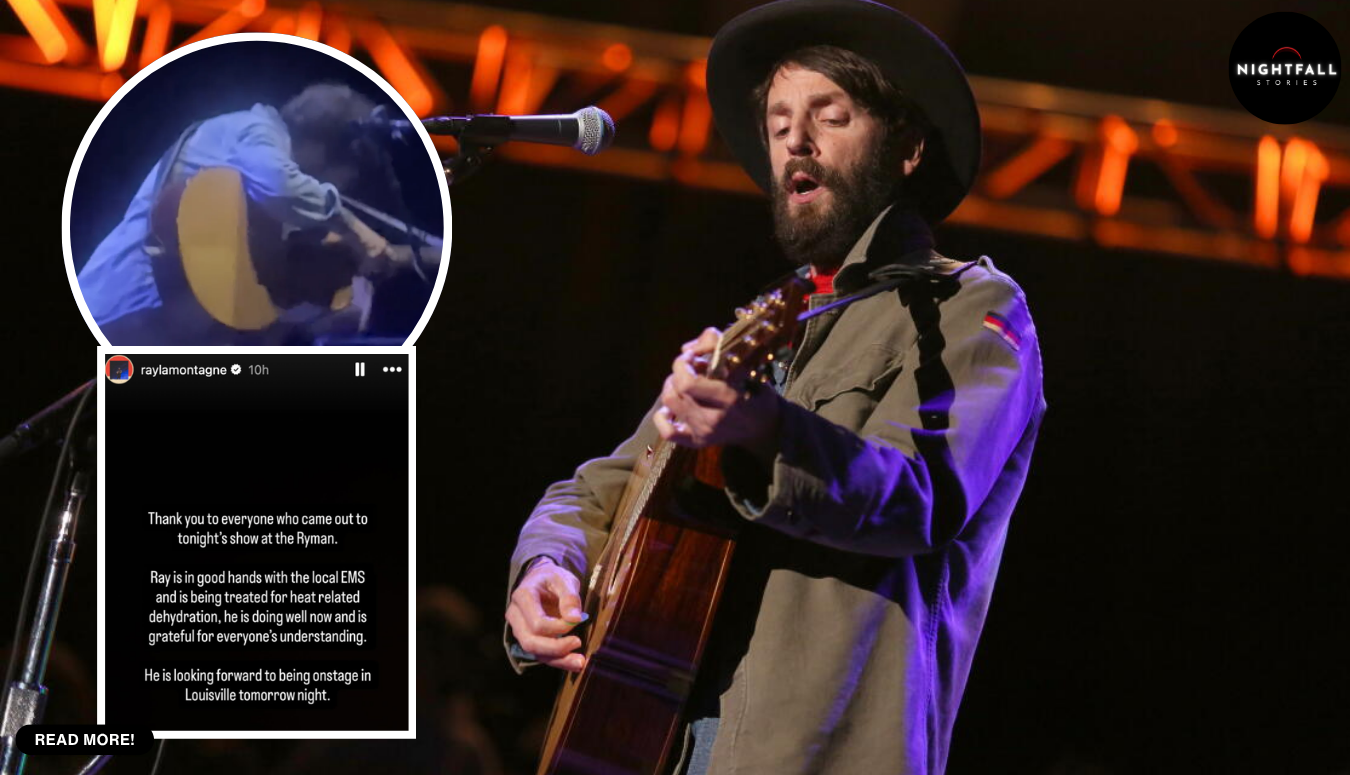
Ray LaMontagne was near the end of his set at the Ryman Auditorium in Nashville. He reached for the microphone stand, and he went down. Emergency medical crews came into the building and treated him there. The concert ended early. A couple of thousand people walked out into the warm night with no idea whether the man they had just watched was all right.
His management posted an update not long after. He was in the care of local emergency services, he was being treated for heat-related dehydration, he was doing well, and he was grateful to everyone for understanding. That statement is the whole of what has been said publicly about what happened to him, and it is worth being clear that it is a statement from his team rather than a medical record. Nobody outside that circle knows anything more, and the honest version of this story does not pretend otherwise.
What makes the night stranger is that it had been going oddly for a while before that. Earlier in the set he had stopped mid-song, apparently losing his place, and stepped off the stage briefly before coming back and carrying on. Accounts from the room and from the outlets that covered it differ slightly on which songs were involved, so it is not worth pinning down precisely. What is consistent across every version is the sequence. Something was wrong, he paused, he went off, he came back, he kept playing, and then near the end of the night he did not get up.
The following evening he was onstage at the Louisville Palace.
That is the fact people have found hardest to process, and it deserves to be handled carefully rather than turned into a slogan. He played. There is no public account of a doctor clearing him, no public account of what he did with the intervening day, and no statement from him about the decision. So the only truthful thing to say is that twenty-four hours after emergency crews treated him in a theatre, he performed again, and that this is what happened rather than what anybody should aspire to. Playing through it is not a virtue and nobody reading this should take it as one. The reason it is interesting is not that it was brave. It is that it is a window into what a touring schedule actually does to the people inside it.
Consider the machinery around a single night on a tour like this one. A venue with staff rostered. An opening act, in this case the Canadian songwriter Tamara Lindeman and her band The Weather Station, who have been supporting on the whole run. A crew that has already loaded in. A few thousand tickets sold to people who arranged childcare and time off. Every one of those things pulls in the same direction, which is forward. The only person in the whole apparatus whose body has a vote is the one standing at the front of it, and he is also the person with the least room to say no.
The support act is worth a mention too, because it says something about the kind of tour this is. Tamara Lindeman, who records as The Weather Station, is a Canadian songwriter whose recent work is closer to chamber pop than to folk and who writes with a seriousness that does not obviously sell tickets. She is on every date of this run. That is not a promoter’s choice. That is an artist picking somebody he wants to listen to from the side of the stage.
And LaMontagne is an unusually poor fit for that machine, which is what makes his presence on a long run notable in the first place.
He has been openly, consistently uncomfortable with the performing life for more than twenty years. He describes himself as a very private person. He rarely gives interviews. The parts of a music career that involve being looked at have never sat well with him, and he has said as much often enough that it is simply part of the public record rather than a piece of mythology. He is not a man who tours because he loves the room.
The story of how he got there at all is one of the better ones in modern folk music, and it is worth telling properly, because it explains the shape of everything since.
He was born in New Hampshire in the early seventies, one of six children raised by a single mother, and the family moved a great deal. He spent part of his teens in Utah, where by his own telling he was more interested in drawing than in anything the school wanted from him. He ended up in Maine, and after finishing school he took a job in a shoe factory in Lewiston.
The turn came from a clock radio. He woke up one morning to a Stephen Stills song, and something in it rearranged what he thought he was allowed to want. He left the factory. He started playing out at the end of the nineties, tutoring part time to stay afloat, recording a demo, taking opening slots wherever he could get them.
A music executive named Ron Clayton heard him at a festival in Maine and put him in front of a publisher. That led, eventually, to Trouble, his debut, produced by Ethan Johns and released by RCA in 2004. It sold something like a quarter of a million copies in the United States and around half a million worldwide, which for a record with almost no promotional machinery behind it and a singer who would not play the game is a remarkable number. Those songs, Trouble and Jolene and Hold You In My Arms, have spent two decades turning up in other people’s most important moments.
The songs on it have had a stranger afterlife than most. Trouble arrived without a face attached to it, at a moment when a singer was still expected to be a personality, and it spread almost entirely by people handing it to each other. It turned up in television scores and in films, in wedding first dances and at funerals, and a lot of the people who know every word of it could not pick him out of a room. That anonymity is unusual and he appears to have protected it deliberately. The record is famous. He is not, particularly, and that seems to be exactly the arrangement he wanted.
He kept going, and the career settled into a pattern of quiet, well-made records that did better than their profile suggested. He won a Grammy for best contemporary folk album for God Willin’ and the Creek Don’t Rise. He has nine studio albums now. The most recent, Long Way Home, came out a couple of years ago and was his first without a major label behind him, released on his own imprint with independent distribution. Its lead single went to number one on the adult alternative airplay chart, his third to do that. Twenty years in, working for himself, still topping a chart.
Which brings us to why this particular tour exists. The billing is a twentieth anniversary run for Trouble, and the draw is that he is performing the album complete, in sequence, for the first time on a tour. For an artist who has spent two decades resisting the idea that he owes anybody the old songs, that is a real concession, and a warm one. The anniversary framing is loose, since the record is from 2004 and the tour is happening now, but the branding is not the point. The point is that he decided to go back and play the thing that made him, all of it, every night.
Playing a record front to back is a different job from playing a set, and anyone who has done it will tell you so. A setlist is built to manage a performer as much as an audience. You put the hard one early while the voice is fresh, you follow the demanding song with one that lets you breathe, you read the room and move things around. An album in sequence removes all of that. The order was decided in a studio two decades ago by a much younger man who was not thinking about how it would feel to sing it several nights a week at fifty three. You take it as it comes.
Trouble is also not a gentle record to sing. It sits low and then asks him to push, and the thing people love about that voice, the rasp at the top of it, is produced by doing something to a throat that throats do not enjoy. Across a full run of theatre dates, an hour and forty minutes a night on average, that accumulates.
He was supposed to do it a year earlier. The run was postponed because he needed oral surgery and a longer recovery than anyone had planned for. Ticketing pages for several of the dates still carry the original date they were moved from, including the Louisville show, which was rescheduled from almost exactly a year before the night he ended up playing it. He rebooked the whole tour and started again in late summer, opening in Salt Lake City and working east.
So by the time he reached Nashville he was a couple of weeks into a run he had already once had to abandon, performing a full album plus a second set of catalogue material, roughly a hundred minutes of singing a night, in the back end of an American summer.
The Ryman is not an incidental venue in any of this. It is a former tabernacle, built in the late nineteenth century, with wooden pews instead of seats and a reputation as one of the best sounding rooms in the world for exactly the kind of music LaMontagne makes. It is also a building whose acoustic virtues come from being a brick box that was never designed for air conditioning, and people in the room that night reported it was unusually warm. Playing the Ryman is a milestone for a songwriter. It is not a comfortable night’s work.
It is also, for a performer, an exposed room in a way modern venues are not. The audience is close, in rows of church pews, and there is no darkness to hide in. The sound is so good precisely because nothing between the singer and the back wall is disguising anything. Everyone in that building could see clearly that something was happening, which is part of why the coverage afterwards was so immediate.
What happened afterwards was, by the standards of the internet, restrained and quite decent. Footage from the audience existed within minutes, as it always does now, and most of the coverage chose not to lean on it. The man had a medical emergency in front of two thousand strangers holding cameras, which is a thing that would have been private in any other era and any other job. The kindest thing the rest of us can do with that is not watch it, and the coverage that mattered stuck to what his team actually said.
There is no follow-up statement beyond that first one. He has not spoken publicly about it. He went to Louisville, and then he kept going, north and east through theatres and opera houses and amphitheatres, a show every second night or so. He has played through the second half of the month with no further incident reported and the tour has dates running into the autumn.
That is the ending, and it is a quiet one, which suits him. There is no lesson here about pushing through and no arc of triumph over adversity, because neither he nor anyone around him has claimed one. A man who never much wanted to be looked at went back out to play his first record all the way through for the people who have carried it around for twenty years, his body objected in the most public possible way, his team said what it said, and he went back to work the next night.
The nicest detail in the whole story is the one nobody planned. On the tour statistics for this run, the songs he has played most often, the ones that turn up in nearly every set, are the ones from that first record. Trouble. Jolene. Hold You In My Arms. How Come. Two decades of writing since, nine albums of it, and the songs a room full of people still wait for are the ones a man wrote after he quit a shoe factory because a clock radio went off at the right moment.
He is still out there singing them.