When the instrument-giving network got going in the Los Angeles burn zone, the donations that arrived were exactly what you would expect. Guitars. Keyboards. Amplifiers, cables, microphone stands, the working parts of a musician’s life. All of it useful, all of it needed, and all of it the kind of thing that can be bought again.
Then Brandon Jay, a composer who had lost his own home and studio in the Eaton fire, started noticing what people actually said when they came to collect a replacement instrument. They were grateful for the guitar. But a lot of them wanted to talk about something else, and what they wanted to talk about was their records. Forty years of crate digging. A father’s jazz albums. The twelve inch single somebody bought at fourteen with money from a first job. None of it insured, none of it itemised, none of it on any form anywhere, and none of it coming back.
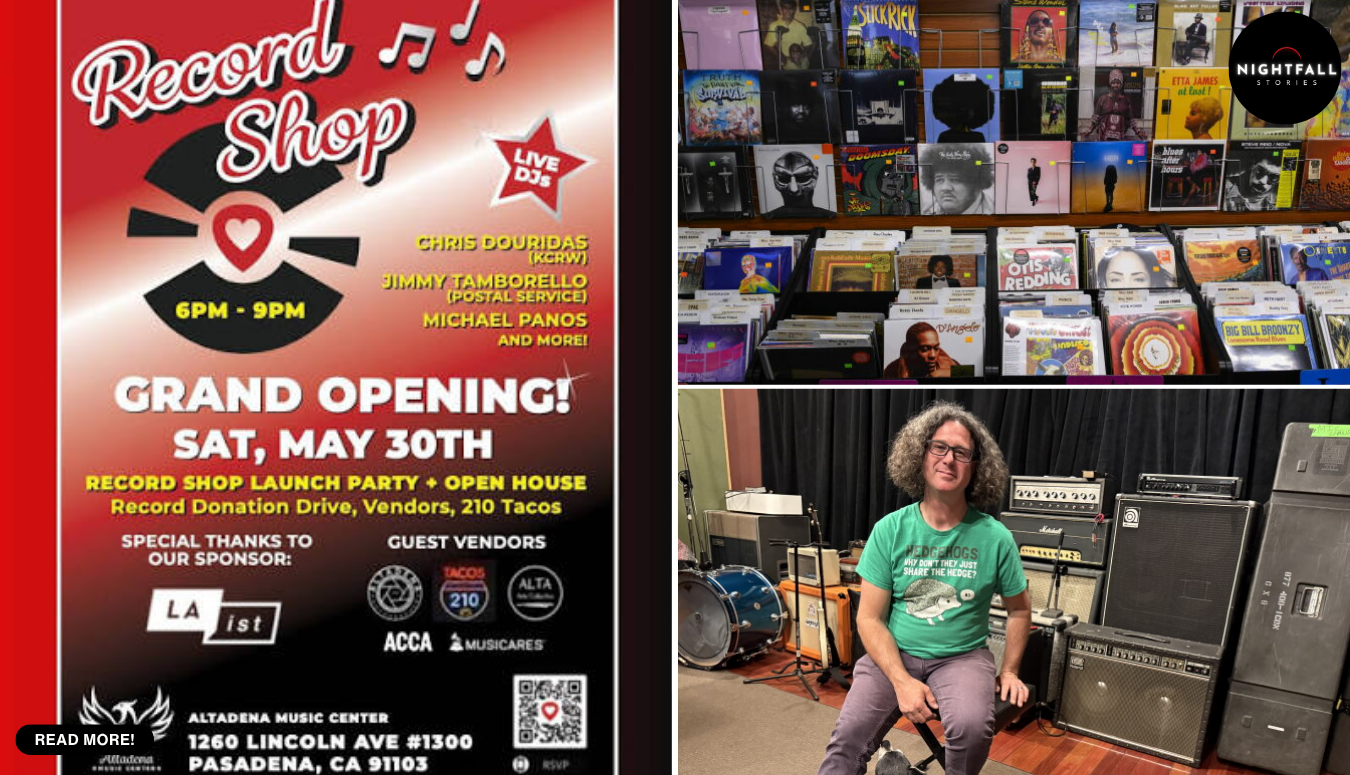
Earlier this year he opened a shop for exactly that. The Altadena Music Center sits on Lincoln Avenue in Pasadena, and for people who lost their collections in the fires it is free. Not discounted. Free. Fire survivors register for a slot, come in, and take away up to ten records a month at no cost. The shop opened with roughly three thousand donated LPs on the shelves, and it has been running since.
That is a small thing set against the scale of what happened, and Jay has never pretended otherwise. But the reason this story is worth more than a feel-good paragraph is the argument sitting underneath it, which is a genuinely sharp one about how disaster relief works and where it stops.
Relief money is built to replace tools. That is not a criticism, it is a design feature. A grant programme needs to know what was lost, what it cost and what it will cost to replace, because that is how a cheque gets written and audited. A producer can tell you the model number of the console that burned. A guitarist can tell you the serial number. There is a receipt, a market price, an insurance schedule, a comparable item sitting in a warehouse somewhere waiting to be shipped.
And the sector did write those cheques, at real scale. The Guitar Center Music Foundation, whose executive director is Myka Miller, fulfilled grants for more than seven hundred people in the first six months after the fires, and put instruments into fifteen affected schools and community organisations. MusiCares, led by executive director Theresa Wolters, has distributed more than fifteen million dollars to over three thousand two hundred music professionals since the wildfires, and ran a health and wellness clinic in Altadena at the end of that first year.
Those are the sector’s numbers, and they belong to those organisations, not to Jay’s network. It matters to keep them separate, because the temptation in a story like this is to let the big figures drift towards the sympathetic individual, and that would badly overstate what one composer and a room full of volunteers did. Jay’s operation is small. The institutional relief machinery is large. The point is not that the small thing replaced the large thing. The point is that the small thing noticed a gap the large thing structurally cannot reach.
Because a record collection has no receipts. It was not bought in one transaction. It was accumulated, usually over decades, usually in small amounts, usually without any record of what was paid or when. Ask somebody to list it and they cannot. Ask an insurer to value it and the number comes out either absurdly low or impossible to defend. And even if a cheque arrived tomorrow for the full replacement cost, there is no shop where you can walk in and buy back the specific accumulation of one person’s taste over forty years. The thing that made it valuable was that it was assembled, and assembly is the part money cannot buy.
So it falls outside every form. Not because anyone decided it should, but because the paperwork has nowhere to put it.
There is also something specific about the format. A streaming library survives a fire because it was never in the house. A hard drive of purchased downloads might survive if it was backed up somewhere else. Vinyl is the opposite of all that. It is heavy, it is physical, it sits in one place on one wall, and in a fire it is gone completely and at once. The people who kept their music as objects rather than as subscriptions lost all of it, and they lost it precisely because of the choice that made them care about it in the first place.
That is the quiet cruelty in the arithmetic, and it is worth saying plainly rather than dressing up. The more seriously somebody had taken their collection, the more completely they lost it. A casual listener with a phone lost nothing. Somebody who had spent thirty years building shelves lost thirty years.
The loss itself is not abstract. More than sixteen thousand homes and businesses were destroyed across the Los Angeles fires, and the music community in and around Altadena was hit disproportionately hard, because it was a neighbourhood where working musicians could still afford to live and still afford to build a studio in a spare room. Rich Mouser, a producer and engineer whose home studio was known as the Mouse House, lost something in the region of half a million dollars of equipment. Adron McCann, a singer-songwriter and audio producer, lost her at-home studio, her instruments and her personal belongings together, in one night.
Mouser’s figure is the measurable end of the loss. It is quantifiable precisely because it was professional equipment, which is to say it was the part of the disaster that the forms were built for. McCann’s loss sits at the other end, where the studio and the instruments and the belongings were not separate categories at all but one continuous life, and where the itemised claim stops describing the thing being claimed.
Jay and his wife Gwendolyn Sanford, also a composer, started the network after losing their own house, studio and nearly all of their instruments. That matters to how the operation runs, because it is not an outside charity arriving with a programme. It is people in the burn area organising for people in the burn area, which means the information travels by conversation rather than by application form, and which is probably the only reason anyone noticed the records problem at all. Nobody fills in a grant application about the albums they used to own. They mention it while they are picking up a guitar.
The network runs as a fiscally sponsored nonprofit under an established foundation, which is the unglamorous but important detail that makes donations tax deductible and keeps the books visible. It also runs a registry where displaced musicians can list what they lost so donors can match specific items, which is a neat inversion of how most giving works: instead of a warehouse of donated gear waiting for someone to claim it, a list of named needs waiting for someone to fill them. Before the record shop existed, the same operation had already got more than a thousand three hundred albums into survivors’ hands.
Then came the shop, which is a different proposition from a giveaway. A giveaway is a pile. A shop is browsing, and browsing is the whole point, because the experience the fire destroyed was not ownership of discs, it was the act of flipping through a crate and finding something.
It opens on the last Saturday of each month, by appointment. Survivors book a slot. Ten records a visit. The stock comes entirely from donations, which arrive in boxes from people across the city who went through their own shelves, and this is where the operation’s real fragility lives. Three thousand records sounds like a lot until you divide it by ten and remember that the shop is open twelve times a year and that the people coming through it are rebuilding collections, not buying a souvenir. Donated stock is also not the same as a giveaway count. Nobody publishes a figure for how many records have actually gone out of the door since opening day, and no honest version of this story will invent one.
There is a harder question than the arithmetic, which is what a free record shop is actually for. It does not rebuild a house. It does not pay rent while a rebuild drags through permits and insurance disputes. It does not restore a studio, replace a client list, or recover the eighteen months of income a destroyed home studio costs a working producer. Anyone who has lived through a disaster recovery knows how quickly the warm gestures start to grate against the unglamorous things that are not getting done.
Jay has answered that one himself, and the answer is more honest than the question expects. He has described the project as a lovely distraction that also keeps him going, which is the thing people rarely admit about running a relief effort while being one of the people who needs relief. It is not purely altruism. It is a structure to put a day inside when the day would otherwise be phone calls about a claim.
And the second half of the answer is that the gesture is not competing with the house. The house has agencies, insurers, contractors, a city permit office and a timeline measured in years. Nobody else was coming for the records. If the free shop did not exist, the gap would simply stay a gap, because it is not anybody’s remit and never will be.
The shop also stocks a benefit compilation put together for fire relief, with cover art by Shepard Fairey and a roster of Los Angeles artists, including a cover version recorded by Jay alongside roughly fifty other musicians who were affected. Alongside the records, the building keeps a room stocked with donated instruments, so the original mission and the newer one sit in the same space. Somebody who comes in for a guitar can leave with ten albums, which is not a coincidence of layout.
What stays with you about the whole thing is how ordinary the insight was. Nobody ran a needs assessment. There was no commissioned report on uninsured cultural assets in wildfire recovery, though someone will eventually write one and it will say what Jay worked out by standing in a room handing out amplifiers. The relief sector was doing its job competently and at scale, writing seven hundred grants and moving fifteen million dollars, and the gap it left was not a failure of generosity. It was a failure of category. Records are not equipment, so they were not covered, so nobody mentioned them, so nobody noticed, until someone who was in the same position happened to be close enough to hear it.
It is worth being careful about how this gets told, because there is a version of this story that turns a neighbourhood’s worst year into something charming, and that version does a disservice to the people in it. Sixteen thousand households lost their homes. Some people died. A free record shop does not soften that and should not be asked to. What it does is answer one specific, narrow, genuinely unaddressed thing, and it answers it well, and the reason it is worth writing about is the precision rather than the warmth.
The shelves are the honest measure of where it stands now. They are stocked, they are being restocked, and they will empty if the donations stop, because there is no funding stream for a record shop that charges nothing. The operation has not announced a second location, a long-term lease, or a target. It opened, and it is running, and that is the whole of what can be said about it.
Which may be enough. Most relief stories end with a number, and numbers are how large organisations prove they did something. This one ends with a room on Lincoln Avenue where, on one Saturday a month, somebody who lost everything sits on the floor in front of a crate and finds a record they had not thought about in thirty years, picks it up, and takes it home to a rental apartment. There is no line on any form for that. There is now a shop for it.