There is a front gate on a housing estate in Hull, in the north of England, and a woman in her seventies who has been waiting at it for twenty-eight years.
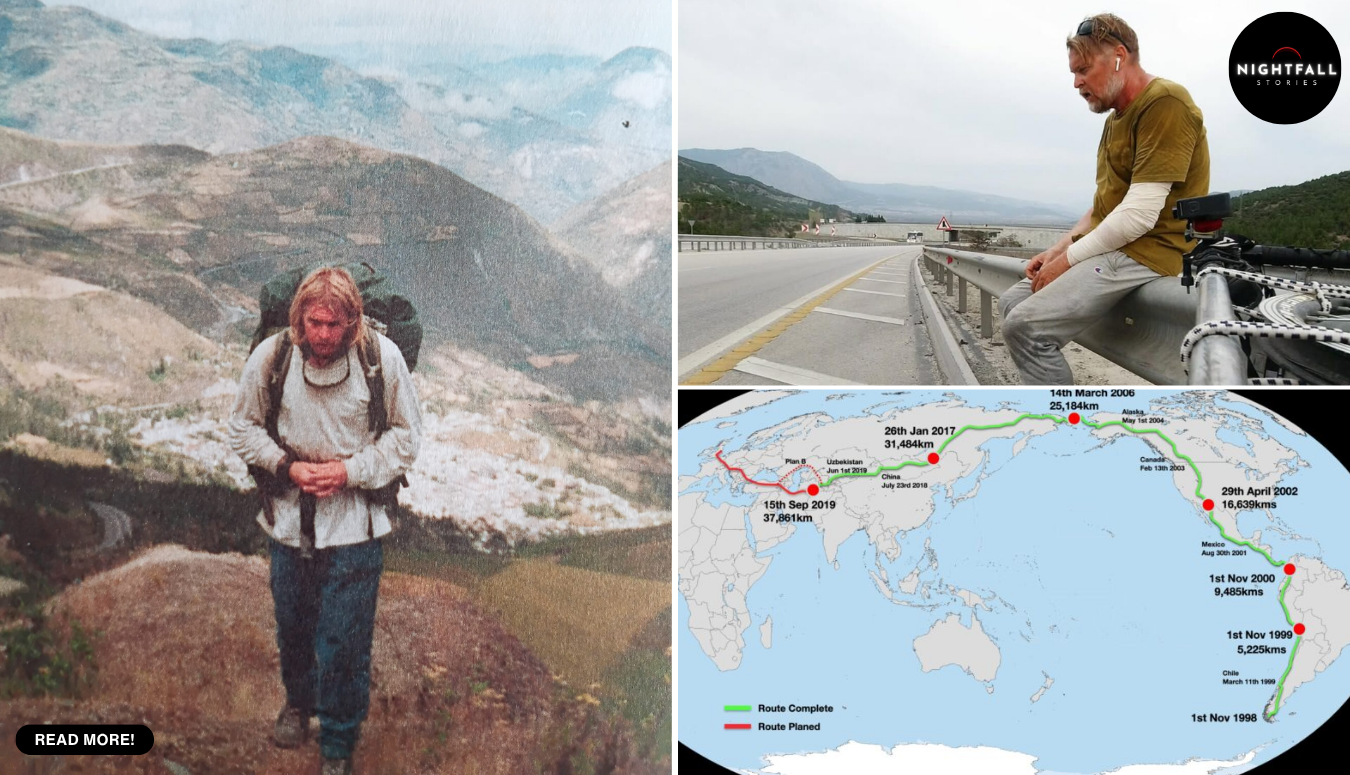
Her son left in the autumn of 1998. He flew to the far southern tip of Chile, stood on the shore at Punta Arenas with about $500 to his name, and started walking north. The rule he set himself was simple enough to explain in one breath and brutal enough to eat most of his adult life: he would not get into a vehicle. Not a bus, not a taxi, not a boat, and absolutely not a plane home for Christmas. Every mile between that beach and his mother’s front door would be covered under his own power, in an unbroken line, or the whole thing meant nothing.
He thought it would take twelve years. He is now fifty-seven, and he has covered roughly 36,000 miles, and he is still not home.
Karl Bushby was twenty-nine when he set off. He had served twelve years with the British Army’s Parachute Regiment and come out the other side of it without much idea what to do next, which is a more common story among former soldiers than most people realise. What he chose to do instead was invent a problem enormous enough to fill the rest of his life, and then live inside it. He called it the Goliath Expedition, and for most of the last three decades it has behaved exactly like the name suggests.
He walked the length of South America. He crossed the Darién Gap, the roadless stretch of jungle and swamp between Colombia and Panama that swallows people every year, and got briefly detained on the other side for his trouble. He walked up through Central America, through Mexico, through the United States, and then up through Canada and into Alaska, which is where the map stops being helpful and starts being a joke. To keep the line unbroken he had to cross the Bering Strait. So in 2006 he walked across it, over the moving sea ice, with a French adventurer named Dimitri Kieffer, hopping between floes that were not designed to hold a man and a sled. He became the first Briton to do it. Russia arrested him when he arrived.
It is worth understanding why he could not simply take the ferry from Alaska and pick the line up again, because that logic governs everything that has happened since. The moment you accept a lift, even a short one, even a legal and sensible one, you are no longer walking around the world. You are walking most of the way around the world with a gap in it. The whole value of what he was doing lived in the absence of that gap, which meant every obstacle he met had to be solved rather than bypassed. A normal traveller sees a closed border and books a flight. He saw a closed border and lost two years.
That set the pattern for the second half. The extraordinary thing about this walk is not the terrain. It is the paperwork. By his own reckoning, close to half of the twenty-eight years has gone not on walking but on sitting somewhere waiting for a stamp, an exemption, a letter, a visa, a ruling. Russia banned him for five years in 2013 over a border technicality, then reversed it. He lost years to the global financial crisis, when sponsorship simply evaporated and there was no money to move. He lost more years to the pandemic, which stranded him in Mexico. When he could not get a visa for Iran, he did not shrug and take a ferry, because a ferry would have ended the expedition. He swam instead. In 2024 he and the American walker Angela Maxwell swam roughly 179 miles across the Caspian Sea, with the Azerbaijani coastguard shadowing them, and it took thirty-one days and about 132 hours in the water.
That detail matters enormously for what is happening to him right now, so hold onto it.
The rest of the Asian leg reads like a list of places people drive through. He crossed Kazakhstan, Uzbekistan and Turkmenistan, including a traverse of the Kyzylkum desert, and came out through Azerbaijan. None of that was sponsored adventure with a film crew. For long stretches there was no money at all, because the funding for a project like this depends on public interest, and public interest depends on visible progress, and visible progress is the exact thing that visa refusals take away from you. He has spent years parked in Mexico, more than once, not because he wanted to be there but because it was the only country that would keep letting him back in while he waited for somebody else’s government to decide something.
He entered Europe in the spring of last year, crossing the Bosphorus in Istanbul on foot, with something like 3,000 kilometres left. He walked through Turkey, Bulgaria, Romania and into Hungary, stopped for the winter near Győr, resumed in the spring, and came west through Austria, Germany and Belgium. And there, with roughly 600 miles left out of 36,000, the walk ran into the thing that has stopped it dead.
Britain is an island. There is no footpath to it.
There is, however, a tunnel. The Channel Tunnel has a service tunnel running between the two rail bores, a maintenance corridor a little under five metres wide, and for years Bushby’s plan for the final crossing was to be walked through it under escort. It is not a public right of way and nobody was pretending it was. It was a request, made politely and repeatedly, for a one-off exception at the end of a twenty-eight year project.
Earlier this year the tunnel’s operator said no. The stated reason was operational rather than personal. Closing the service tunnel for something in the region of fifteen hours, or spread over two days, would disrupt essential maintenance and create a safety risk to passenger services, and the company said it could not accommodate the request. Read coldly, that is a reasonable position for a business that moves millions of people a year through a hole under the sea. Read from the Belgian roadside, it is a man being told that the last 0.06 percent of his life’s work is administratively inconvenient.
Then came the second wall. Swimming the Channel sounds like the obvious fallback, and it was always the backup plan, but there is a French rule dating from 2018 that blocks departures from French shores toward Britain. The reasons behind that order have nothing to do with adventurers and everything to do with the small boats that cross those shipping lanes, and nobody sensible argues the rule is malicious. But its effect on one particular man was absolute. He could not walk under the water and he could not legally start swimming across it. A supporters’ petition went up. Coverage picked the story up and ran it as bureaucracy versus a hero, which is satisfying and not quite fair to either side.
Here is where the story stands as of now, and it is worth being precise, because this is a live situation rather than a finished one.
The tunnel answer has not changed. It is still no. But in early September his team confirmed that after a long negotiation they had secured permission from the French authorities for him to swim out from the French coast. He said the wording carefully, as a man does when he has been disappointed before: it looks like, after a prolonged period, they have managed to secure permission to swim from the coast of France. A crossing date around the start of October has been reported, with a support boat alongside, and the expectation is that it takes two to three days rather than the single push a Channel swimmer would normally attempt.
To put the scale of that in perspective, he has walked the equivalent of one and a half times around the planet. What is left is about the distance from one side of a mid-sized city to the other, and it is the only part he has never been able to solve on his own.
Twenty-one miles. Strong tides, one of the busiest shipping lanes on earth, and water sitting somewhere around 17 to 19 degrees Celsius, which is roughly 63 to 66 Fahrenheit, which sounds survivable until you have been in it for forty hours.
And after the swim, it still is not over. He would land somewhere on the English coast and then walk, and his mother’s home is in Hull, which is a long way northeast of Kent. The estimate given this month was that he expects to reach her door within about two months of finishing the swim. So the finish line everyone has been writing about is not a date anyone can hold you to yet. It has moved from twelve years to twenty-eight, and it is still moving.
People sometimes ask whether swimming breaks his own rule, and it is a fair question. His rule was never that his feet must touch land at all times. It was that he would never be carried. A vehicle moves you whether or not you are trying. Swimming does not. The Caspian settled that argument long before the Channel raised it.
Now for the part that the headlines about tunnels and petitions tend to skip, and it is the only part that really matters.
When Karl Bushby walked out of Hull in 1998, he left behind a five-year-old son named Adam. Adam is a grown man now. In the intervening decades his father has seen him a handful of times, in the gaps, on the pauses, when visas and money forced a stop. Bushby has said plainly that two romantic relationships ended because of the expedition, because you cannot build a life with someone whose entire identity is the refusal to stay. In twenty-eight years he has been with his family three times.
His mother, Angela, is seventy-five. She worked as a packer in a snack food factory before she retired. She lives on the Sutton Park estate in Hull, in the house her son is walking toward, and her front room has been slowly colonised by him: photographs, scrapbooks, clippings, the accumulated paper record of a journey she has mostly experienced as an absence. For years there were occasional phone calls from wherever he was. Now it is mostly messages.
She has said she will be there when he comes through the gate, that she will give him a hug, and then she will ask him what time he calls this. Anyone who has a mother will recognise the tone instantly. It is the joke you make when the alternative is saying something you cannot get through.
She has also said something quieter and sadder, which is that she does not think he will ever be able to stay in one place now. Twenty-eight years is long enough for a decision to stop being a decision and become a personality.
Bushby himself does not sell the ending as triumph, and that is one of the more honest things about him. Asked about finishing, he has talked about mixed feelings, about the thing needing to be wrapped up, about it being a hard stop and effectively the end of a life rather than the completion of a trip. He does not know what he is supposed to do afterwards. He has spent his entire adult existence pointed at one gate in one city, and once he walks through it, the direction is gone.
What he will not accept is the idea that the years were spent on suffering. His account of the world, told again and again across three decades, is almost embarrassingly warm. Strangers fed him. Strangers put him up. In Colombia he was stopped at gunpoint by armed men who, once they understood what he was doing, bought him a coat. He has said the world did that, meaning the walk was not something he achieved against people but something people carried him through, which is a strange thing to say about a man whose rule was that nobody was allowed to carry him.
Both things are true at once, and that tension is the whole story. He made a choice at twenty-nine that cost him his son’s childhood, two relationships, most of his mother’s later life and any conventional version of a future, and in exchange he got a line on a map that nobody else has drawn and a quarter of a century of ordinary people being decent to him in seventy-odd countries. Nobody gets to say whether that trade was worth it except the people who paid for it, and one of them was five years old and did not get a vote.
So, clearly, because this story is still moving and will keep moving: he has not finished. He has not swum the Channel. He has not reached Hull. The tunnel operator has not changed its answer. What has changed, and changed only recently, is that the French side has reportedly cleared the way for him to get in the water and start, which after months of looking like the end of the road is the difference between a stalled expedition and a live one.
If it goes the way he hopes, sometime in the next few months a fifty-seven year old man will walk up a street on the Sutton Park estate with a battered trailer behind him, and a woman of seventy-five will be standing at a gate she has been standing at, in one sense, since before most of the people reading this were born.
He has said he already knows what he wants his first words to be. Told you I could do it. Now, what’s for tea.
That is not the line of a man who thinks he has conquered anything. It is the line of a boy coming in late for dinner, which is, when you strip out the ice and the jungle and the shipping lanes and the twenty-eight years, exactly what this has always been.