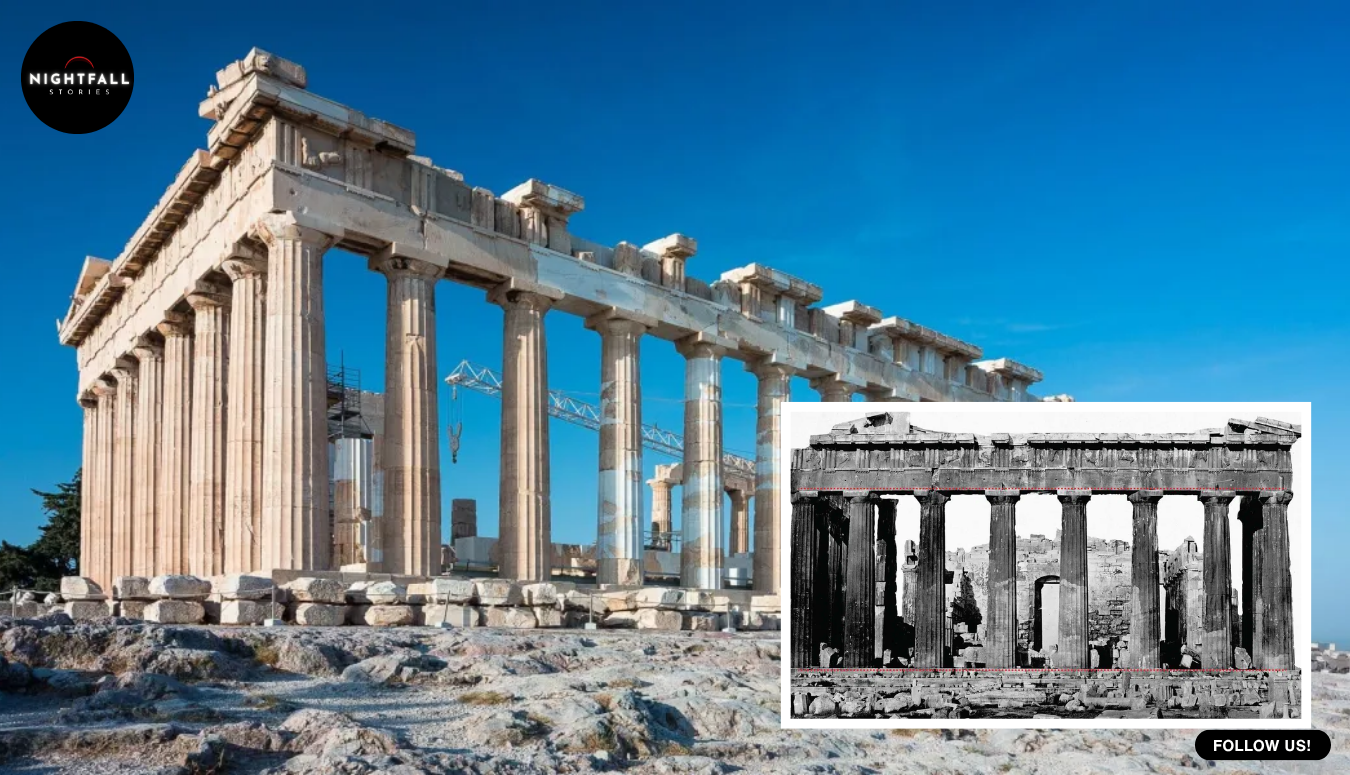
The Parthenon’s floor is not flat. Walk along the long south side of the temple and the marble platform under your feet rises gently towards the middle and falls away again at the far corner, like a very long, very shallow hill. For about two thousand years the explanation has been the same, and it is one of the most repeated facts in the history of building: the Greeks curved it on purpose, because a perfectly straight line that long would look as if it sagged, and the curve was there to cancel the sag out.
Alain Goriely went and worked out how big that curve actually is. Across the whole length of the platform, it rises roughly six centimetres. Two and a bit inches, spread over a stretch of stone longer than two buses. His argument, published in Royal Society Open Science under the title The Illusion of Illusions, is that a deviation that small cannot possibly be doing the job attributed to it, because at any distance from which a human being actually looks at the Parthenon, nobody can see six centimetres of anything. And the illusion it is supposed to be correcting, he says, does not reliably exist in the first place.
Goriely is not an archaeologist and does not pretend to be. He is the Statutory Professor of Mathematical Modelling at Oxford, a Fellow of the Royal Society, and he directs both the Oxford Centre for Industrial Applied Mathematics and the International Brain and Mechanics Trauma Lab. His day job is the mathematics of things that grow and bend: plant tendrils, elastic rods, the mechanics of brain tissue under impact. He has written books on biological growth and on applied mathematics. Curved structures and how they behave are, in a fairly literal sense, his specialism, which is why a classical temple with a measurably curved base ended up on his desk at all.
What he brought to it was the one question that two millennia of commentary had somehow skipped. Not whether the Parthenon is curved, which is beyond dispute and has been measured to fractions of a millimetre. Not whether the curves are beautiful, which is a matter of taste. The question was simply this: is the correction big enough to correct anything?
Start with where the story came from, because that turns out to matter. The Parthenon was finished around the middle of the fifth century before our era, roughly 432 BC by the usual reckoning. The earliest surviving written claim that Greek builders adjusted their buildings to defeat optical distortion comes from Vitruvius, the Roman architect and writer, working something like four centuries later. That gap is worth sitting with. Vitruvius was further in time from the men who cut the Parthenon’s blocks than we are from the first printing presses in Europe. He was not interviewing the builders. He had no access to their notes, their drawings, or their reasoning. He was an educated Roman explaining why Greek buildings looked the way they did, in a treatise meant to teach architecture to his contemporaries, and the explanation he offered was elegant, plausible and entirely unsupported by any evidence he bothered to supply.
That single late source became the received account. It was repeated, elaborated and eventually treated as something the Greeks themselves had told us. Then, in the nineteenth century, something happened that made the story feel confirmed rather than inherited. Francis Penrose went to Athens in the 1840s and 1850s and surveyed the temple with extraordinary care, and his measurements showed the curves were real. The platform did rise. The columns did swell. The corner columns were thicker. The whole building leaned very slightly inwards.
Here is where a subtle logical slip got locked in. Penrose proved the refinements existed. He did not, and could not, prove why. But the combination of Vitruvius saying the Greeks corrected illusions, and a Victorian surveyor demonstrating that the geometry really was adjusted, read to everyone as a case closed. The explanation and the measurement had shaken hands, and nobody checked whether they were actually compatible.
Goriely’s paper counts at least twelve separate optical corrections that have been claimed for the Parthenon over the centuries. Twelve. Each one a confident statement about what the builders were compensating for. He goes through them and finds that the illusions in question are either not real or far too small for the eye to register, and in several cases both.
Take the sagging horizontal, the oldest and most famous of the lot. The claim is that a long, straight horizontal line, seen against the sky, appears to droop in the middle, so the builders arched it to compensate. Goriely’s point is blunt: there is no good evidence that long horizontal lines inherently look as though they dip. It is an assertion that has been passed along rather than tested. You can test it yourself on any long bridge parapet or railway platform, and most people, looking honestly, see a straight line looking straight.
Then there is the Hering illusion, which does exist and is a genuine, well documented quirk of human vision. Put a pair of parallel lines across a radiating fan of other lines and the parallel pair appears to bow. It is a real effect, demonstrated thousands of times on paper. The trouble is getting from a printed diagram to a building made of stone. The Parthenon’s columns are vertical and rather widely spaced, the geometry is three dimensional, and the conditions that produce the Hering effect on a flat page do not obviously transfer to a colonnade seen in sunlight from forty metres away. Goriely argues the effect simply is not clearly present on a structure like this.
And then the columns themselves. Entasis is the name for the slight outward swell in a Greek column, the way it is not a plain cylinder or a simple cone but bulges almost imperceptibly around its lower middle. The standard story says a straight-sided column looks pinched or concave, and the swell restores it to apparent straightness. Goriely did the arithmetic on the Parthenon’s own columns. The maximum bulge is about eighteen millimetres. Less than the width of a thumb, on a column around ten metres tall, viewed from the distance at which human beings stand. At that scale the swell is, by his account, barely perceptible from normal viewpoints, which makes it a strange thing to install as a correction if the aim was for anyone to notice the result.
The corner columns get a similar treatment. The classic claim is that an outer column seen against bright sky looks thinner than its neighbours seen against the dark wall behind, so the corner columns were thickened to even things up. Goriely finds the set of positions from which that compensation would actually work is so narrow as to be practically useless. A building does not get viewed from one surveyed spot. It gets viewed from the slope you climb, the road below, the ridge opposite, the shade of the gateway, from near and far and off to the side. A correction that only functions at a single vantage point is not a correction.
If the optical account is wrong, the obvious next question is what the refinements were for, and this is where Goriely’s paper is admirably willing to be unglamorous. The curved platform, he suggests, may well be about water. Rain falling on a dead flat marble floor sits there and works its way into joints. A floor that rises in the middle sheds it off the edges. That is not mysticism, it is plumbing, and it is exactly the sort of thing that experienced builders do without writing a treatise about it. As for the swelling columns, the explanation may be no deeper than that they look better: a slightly convex profile reads as alive and organic where a ruler-straight one reads as dead. Greek sculptors were not shy about preferring the shape that looked right. Goriely also notes that the swell cannot have been structural in the way sometimes suggested, because marble under the load of that roof would crush long before it would buckle.
It is a deflating set of answers, and the temptation is to use it as a punchline. That would be unfair, because the deflating answers are probably the correct ones, and they are also more interesting than they first appear. They describe craftsmen solving practical problems and trusting their eyes, rather than philosophers encoding a theory of perception into limestone. The Parthenon does not become less remarkable if its builders were shedding rainwater and chasing a profile that pleased them. If anything it becomes more human.
It is also worth being fair to Vitruvius, who has spent the last few weeks being treated in headlines as a man who got it wrong. He was not conducting a fraud. He was doing what every writer about the distant past does, which is to offer the most coherent account available to him, and his account had the enormous advantage of making sense. Of course they corrected for the eye. Look how carefully everything else is done. A people who could carve the Parthenon frieze would hardly have been careless about the floor. The reasoning is reasonable. It is simply not evidence, and the problem was never Vitruvius. The problem was everybody afterwards who stopped treating it as a guess.
That is the part of this story with teeth, and it has nothing to do with Athens. A claim lasted two thousand years, made it into essentially every architectural education in the Western world, got repeated in textbooks, on plaques, by guides standing on the Acropolis every day of the summer, and was believed by people who were in every other respect rigorous. It survived not because anyone had verified it but because it was repeated by people who assumed somebody else had. All it ever needed was for one person to ask how many centimetres we were talking about, and to compare that number against what is known about the limits of human vision. That took until now. Nobody was hiding anything. Everybody just took it on trust.
Goriely’s own summary of the position is careful, and worth reporting precisely because it is narrower than the headlines around it. His conclusion is that there is insufficient historical evidence and no scientific evidence for the extraordinary claim that the Parthenon’s refinements were implemented as optical corrections. Read that again and notice what it does not say. It does not say the refinements are accidental. It does not say the builders were unsophisticated. It does not say they never thought about how the building would look. It says the specific, confident, universally repeated explanation has nothing underneath it.
And there is plenty the paper does not settle, which an honest account has to say out loud. It cannot tell us what the builders actually intended, because no Greek source survives that explains the refinements at all, and absence of a stated reason is not proof of the reason Goriely prefers. Drainage is a hypothesis, a sensible one, not a demonstration. Nor does a perception threshold argument fully close the door: vision is strange, and effects below the level at which you can consciously measure a difference can still, in some circumstances, shift how something feels. A six centimetre rise over that distance is far too small for anyone to see as a curve. Whether it contributes nothing whatsoever to the impression the building makes is a harder claim, and the paper’s strongest ground is the first part rather than the second.
Then there is the question of what the field says back, and here the honest answer is that it has not said much yet. The work has been widely covered, in Greece and beyond, but at the time of writing no named architectural historian or classical archaeologist appears to have published a substantive response. Specialists in Greek architecture have spent careers on this building and some of them will not accept a mathematician’s verdict quietly, nor should they have to. The arguments they are likely to make are predictable and legitimate. That ancient intention is a historical question as much as a geometric one. That the refinements come as a package, platform and columns and inward lean and corner thickening together, and a package suggests a programme rather than a dozen unrelated habits. That the perceptual literature on real buildings in real light is thinner than the literature on diagrams. None of that has been argued in print yet. When it is, the exchange will be the valuable part, and anyone reading about this now should hold the conclusion loosely until it happens.
What is not in doubt is the number, and the number is the whole story. Six centimetres. One mathematician, a published measurement already lying in the record since the 1850s, and a question nobody had put to it. The Parthenon still stands on its hill with its floor very slightly arched and its columns very slightly swollen, exactly as it has for twenty-four centuries, and it is still one of the most carefully made objects human beings have ever produced. The only thing that has changed is the sentence we say about it, which turns out to have been written by a Roman four hundred years too late, and believed by everyone since because it sounded like the kind of thing that ought to be true.